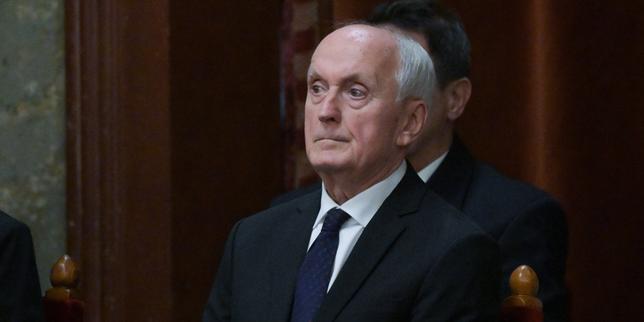
Viktor Orban just suffered a massive institutional setback. The Hungarian Parliament has officially elected Andras Baka as the country's new president.
If that name sounds familiar, it is because Baka is the exact same jurist whom Orban's government unlawfully ousted from his post as Supreme Court president back in 2011. Fifteen years later, the political pendulum has swung hard. Backed by the rising Tisza Party, Baka secured 140 votes in a secret parliamentary ballot, marking a stunning political redemption.
Most observers miss the forest for the trees when looking at Budapest. They think executive power is absolute. It is not. Here is what is actually happening behind the scenes and why this presidential shift matters far beyond Hungary's borders.
The Irony of Andras Baka Taking Office
History loves poetic justice. In 2011, Orban's ruling Fidesz party used its parliamentary supermajority to dismantle the old Supreme Court, rename it the Curia, and push Baka out three years before his term legally ended. Baka did not stay quiet. He took his case all the way to the European Court of Human Rights.
The Strasbourg court ruled decisively in his favor. It found that Orban's administration had violated Baka's freedom of expression and his right to a fair trial because he dared to publicly criticize government judicial overhauls.
Now, at 73 years old, Baka steps back into the highest echelons of power. Nominated by the Tisza Party—which commands the current two-thirds supermajority following major political realignments—he represents a direct legal and moral counterweight to the old guard.
What the Tisza Party's Rise Means for Orban
You cannot understand Baka's presidency without looking at the broader collapse of Fidesz's unchallenged dominance. Former president Tamas Sulyok exited early after a constitutional amendment engineered by the new parliamentary majority.
Voters grew tired of systemic corruption and institutional capture. When the Tisza Party swept into influence, they promised a clean break. Installing Baka as the ninth president of Hungary is not just symbolic. It signals a systemic recalibration of state checks and balances.
Baka made his intentions clear immediately following the vote. He stated plainly that his priority is to restore bruised international partnerships and mend fences with alienated Western allies. For a decade and a half, Budapest acted as the perpetual thorn in the side of the European Union. That foreign policy stance faces an internal challenge now.
Rebuilding Institutional Independence
People often ask if a Hungarian president has any real authority. Constitutionally, the role is largely ceremonial. Yet, symbolism carries heavy weight in polarized nations.
Baka brings a background that terrifies authoritarian bureaucrats. He spent nearly two decades as Hungary's judge at the European Court of Human Rights before leading the judiciary. He knows international law inside out. He understands how democratic institutions erode from within because he lived through the demolition of his own court.
During his acceptance speech, Baka emphasized that his office will refuse to act as a rubber stamp. He explicitly promised to represent both political majorities and minorities while acknowledging deep societal disagreements rather than forcing artificial unity.
The Road Ahead for Central Europe
Do not expect Orban to step aside quietly. The veteran prime minister still commands significant political machinery. However, the myth of an unbreakable political monopoly is shattered.
When a former opponent of the regime takes the presidential oath, the political atmosphere shifts. Judges, civil servants, and independent journalists suddenly realize they are no longer operating in a vacuum.
Baka takes the formal oath of office on August 19. Watch how the executive branch reacts to a head of state who actually understands constitutional law and isn't afraid to invoke it. The dynamic in Budapest has permanently altered.