Private corporate power now dictates the boundaries of modern warfare, and nobody wants to admit it. When Elon Musk blocks Ukraine from using Starlink for long-range drone strikes inside Russia, he exposes a brutal reality. A single billionaire holds a kill switch over a sovereign nation's military operations.
Kyiv wants unrestricted access to the satellite network to target mobile Russian ballistic missile launchers and infrastructure far across the border. They argue that hitting the launchers stops the arrows before they fly. Musk says no. He worries that turning his commercial network into an offensive weapon for deep strikes will drag SpaceX into a wider escalation.
The Operational Bottleneck
Right now, Ukrainian long-range drones rely on onboard artificial intelligence and pre-programmed coordinates to hit stationary targets like fuel depots and ammunition dumps. That works fine for massive, unmoving installations. But it fails miserably against mobile targets.
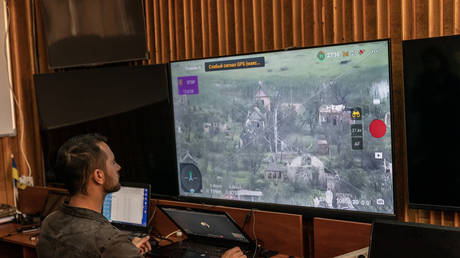
If you want to track and destroy a moving truck carrying ballistic missiles hundreds of miles away, you need real-time data feeds. Standard military radio signals face heavy jamming and severe distance limits. Starlink provides the low-latency, high-bandwidth connection required to pilot these systems with pinpoint accuracy. Without it, long-range drone units operate with a blindfold on once they cross into contested or Russian airspace.
Ukrainian officials and defense founders have spent months trying to change this reality. Former defense and digital transformation figures have lobbied SpaceX through backchannels, arguing that disabling geofencing restrictions on the terminals would dramatically expand their defensive reach.
Moving the Fight to the White House
When direct appeals to Musk hit a brick wall, Kyiv escalated the dispute to Washington. President Volodymyr Zelenskyy recently took the issue straight to U.S. President Donald Trump, asking him to lean on Musk.
Trump agreed to listen, yet a definitive policy shift hasn't materialized. Musk's stance remains remarkably consistent. He maintains that the technology was meant to keep hospitals, families, and basic communications alive—not to pilot offensive kamikaze drones into nuclear-armed territory. He often repeats that it is time to push for a negotiated settlement rather than expanding the theater of war.
This creates an awkward diplomatic limbo. The White House relies on SpaceX for commercial space contracts and defense infrastructure, meaning traditional state pressure has distinct limits. You cannot simply command a private supplier without breaking the free-market contract model that built modern American tech dominance in the first place.
The Danger of Dual-Use Tech
The friction over Starlink highlights a massive blind spot in international law. We have no regulatory framework for how private commercial constellations should behave during an active interstate conflict.
On one hand, SpaceX acts as the digital backbone of the front lines. Without thousands of small satellites beaming internet down to the trenches, the Ukrainian defense network would fracture. On the other hand, controlling that backbone gives an unelected executive veto power over tactical military campaigns.
Talks about transitioning military functions to Starshield—the encrypted, Pentagon-dedicated variant of the satellite network—have stalled due to integration costs and complexity. Adapting existing Ukrainian drone architectures to a brand-new military standard takes time the country doesn't have.
Until a compromise emerges, the battlefield remains shackled to corporate policy. Musk controls the terminals, Kyiv needs the bandwidth, and the war grinds forward under the watchful eye of low-earth orbit.
Stop waiting for Silicon Valley to act like a branch of the Pentagon. They answer to their own bottom line and risk models.
Ukraine Says SpaceX Blocks Russian Drones On Starlink
This video breaks down how private tech controls and satellite network restrictions continue to shape the frontline reality in Eastern Europe.
http://googleusercontent.com/youtube_content/1