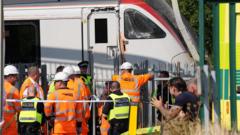
Tracks buckle when temperatures soar, and commuters pay the price. If you tried traveling from Essex to London recently, you likely hit a wall of cancelled services, confused station staff, and stationary carriages.
The rear carriages of a Greater Anglia service coming from Southend left the tracks near Wickford in Essex, bringing chaos to one of the country's busiest commuter arteries. While everyone breathed a sigh of relief that the roughly 40 passengers onboard escaped without injuries, the incident raises an uncomfortable question. Why does British infrastructure fold the moment the weather gets genuinely hot?
What Actually Happened on the Essex Line
The service left Rayleigh at 2:06 PM and was scheduled to pull into Wickford just five minutes later. It never made it. Instead, the rear carriages derailed while remaining in an upright position, forcing British Transport Police, firefighters, and paramedics to rush to the scene.
Network Rail and the Rail Accident Investigation Branch immediately deployed inspectors to gather physical evidence. All lines between Wickford and Southend Victoria slammed shut. Trains running directly between London Liverpool Street and Southendground to an absolute halt, stranding thousands of everyday travellers.
The Heatwave Factor You Can't Ignore
This wasn't an isolated stroke of bad luck. This Essex incident happened less than twenty-three hours after a separate passenger train derailed near Lewes in East Sussex, which left multiple people needing hospital treatment.
Experts and railway engineers point straight at extreme summer temperatures. Steel expands. When intense heat waves bake the British Isles, continuous welded tracks can warp under the pressure, snapping into buckled shapes beneath a moving train's wheels. Network Rail has openly admitted that the country's fifth heatwave of the summer presented exceptional challenges, citing tracks baking under punishing heat.
Critics argue that other European nations manage to run reliable rail networks through extreme seasonal shifts without constant derailments. British rail infrastructure struggles because older designs and fluctuating maintenance budgets leave tracks vulnerable to rapid climate shifts. When the ground dries out and shrinks, embankments shift, adding even more structural risk to tired Victorian-era foundations.
How to Protect Your Commute Right Now
You can't fix the national rail grid yourself, but you can stop wasting hours standing on crowded station platforms waiting for updates that never come.
- Check before you leave: Never head to the station blindly during extreme weather warnings. Use live map trackers and apps like National Rail Enquiries immediately before walking out your front door.
- Know your refund rights: If your journey is delayed by 15 minutes or more due to infrastructure failures, you are legally entitled to compensation through Delay Repay schemes. Keep your tickets.
- Seek alternative routes: Look for local bus replacements or alternative underground and overground connections early, before crowds overwhelm the limited backup transport.
The system is cracking under pressure. Until serious structural upgrades match our changing climate, expect more disruption when the thermometer climbs.