Europe is having a massive crisis with the summer weather. As record-breaking heatwaves send temperatures past 40°C from Madrid to Berlin, millions of people are discovering that their homes have basically become brick ovens.
But if you look at the back of the appliances keeping Europeans cool right now, you won't see local European brand names. You'll see "Made in China."
Despite all the political talk in Brussels about cutting trade reliance on Beijing, European shoppers are completely ignoring the politicians. They're panic-buying Chinese cooling gear at an unprecedented rate. In the first half of 2026, Chinese air conditioner exports to the European Union hit a staggering $3.76 billion, a massive 43.2% jump compared to last year.
The reality is that Europe didn't just get caught off guard by the weather; it got caught without the right tools. Chinese manufacturers didn't just show up with cheap products—they built exactly what a desperate, sweat-soaked European public actually needed.
The Historic Architectural Trap
Most people don't realize how difficult it is to get a standard AC unit running in a European city. In North America or Asia, if it gets hot, you buy a split-system unit, drill a hole through your wall, and mount the condenser outside.
Try doing that in Paris, Florence, or Munich. You can't.
Europe's housing stock is dominated by historic preservation laws and century-old brickwork. If you want to punch a hole through the facade of a protected building, you have to submit formal plans to the town hall and wait weeks or months for an architect's approval. Even if you own the place, the bureaucracy is exhausting. If you rent—like more than half of Germany's population—getting a landlord to agree to permanent drilling is practically impossible.
On top of the legal red tape, the installation costs are ridiculous. Because HVAC technicians are scarce in Western Europe, installing a standard air conditioner can easily cost two to three times the price of the actual machine. When you're looking at a total bill that can top €7,000 just to cool down a couple of rooms, most ordinary families give up.
This created a massive market vacuum. European home appliance brands have historically ignored the mass residential cooling market because they assumed the mild climate didn't justify it. That left a giant gap, and Chinese tech firms stepped right into it.
The Six Second Manufacturing Machine
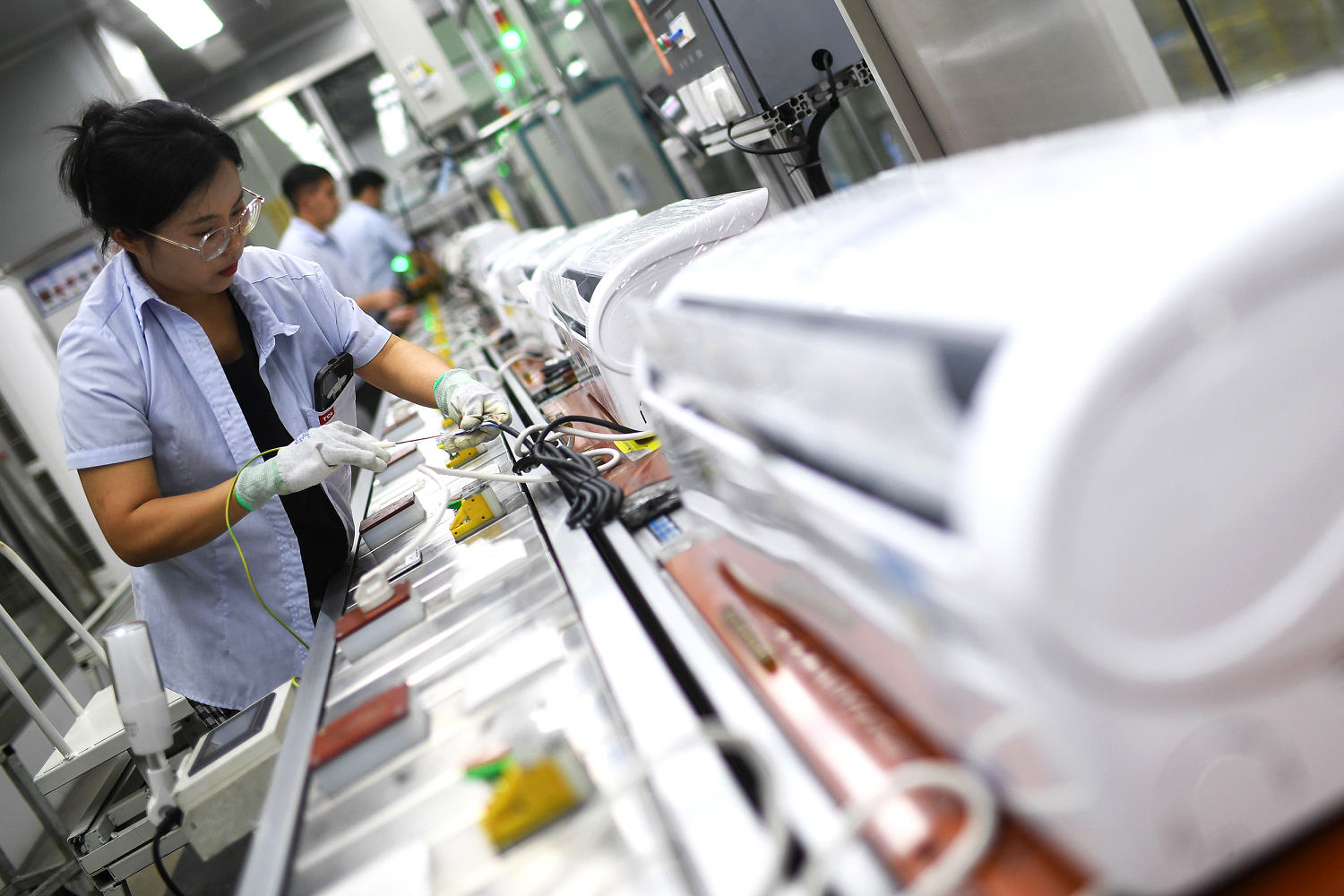
Chinese companies won this market by being incredibly fast and highly adaptive. While European infrastructure struggles to change, Chinese factories are operating at a scale that sounds almost fictional. At Midea's fully automated smart factory, a brand-new air conditioner rolls off the assembly line every six seconds.
Robots handle everything from the initial assembly to quality control checks and warehouse packing with almost zero human intervention. This intense automation means brands like Midea, TCL, Haier, and Gree can scale up production instantly the moment a heatwave hits the radar.
They also fixed the shipping bottleneck. By utilizing the expanding China-Europe freight train network, manufacturers can get these units into European distribution centers in just 15 days. That's nearly 25 days faster than traditional ocean cargo ships, allowing them to restock shelves while the summer is still scorching.
But pure speed doesn't matter if you're selling the wrong item. The real breakthrough wasn't the factory speed; it was a clever design twist that bypassed European regulations entirely.
Bypassing Red Tape with Smart Engineering
Chinese engineers realized that Europeans couldn't use traditional split ACs, and they hated standard portable single-hose units because they're noisy and incredibly inefficient.
So, they designed an entirely new category: the portable split air conditioner.
Look at the Midea PortaSplit, which completely dominated European retail this summer. It features a compact outdoor condenser connected to a mobile indoor unit by a thin, flat refrigerant ribbon. You don't drill holes. You simply place the condenser out on a balcony, a windowsill, or even hang it outside, run the flat cable through a tiny 7-centimeter window gap, and plug it in.
It provides the high efficiency and quiet operation of a permanent split system, but it requires zero tools, zero permits, and you can take it with you when your lease ends.
The response was absolute chaos. Midea sold more than 200,000 units across Germany, France, Italy, and the Netherlands by late June alone. In Germany, the item sold out completely. The demand got so extreme that a local programmer built a paid inventory-tracking website monitoring 1,171 physical stores just to help people find stock. The retail price of roughly €700 to €900 was routinely shattered on secondary market apps, where desperate buyers paid up to €1,500 or more just to get their hands on one.
The story repeats across other brands. TCL saw its Western European sales climb over 27%, with French sales skyrocketing by over 300%. Haier managed to capture a massive 22.4% share of the residential air-conditioning market in Germany. Even local governments are stepping in; the French government placed emergency orders for 30,000 Chinese units just to keep hospitals and nursing homes safe.
The Long Road to Redesigning Europe
It's tempting to think this is just a temporary summer sales spike, but the data tells a different story. The overall market share of Chinese air conditioning brands in Europe jumped from 27% in 2023 to a massive 41% in the first half of 2026.
The reality is that Europe's entire infrastructure was engineered to keep people warm, not cool. For centuries, building codes focused on thick insulation, heat retention, and frost resistance. Now, those exact same features are acting as heat traps, making apartments unlivable after just a few hours of intense sun.
We're seeing the limits of this old design thinking everywhere. During the peak of the recent heatwaves, tram tracks in Germany buckled under the pressure, highways cracked, and local power grids groaned under the sudden spike in electricity usage.
Air conditioners are a quick fix for individual households, but they're exposing a massive structural vulnerability. European cities are trying to adapt by planting more urban trees and using reflective building materials, but updating millions of historic homes takes decades. Until that happens, the consumer demand for rapid, non-invasive cooling isn't going away.
Next Steps for Homeowners
If you're trying to figure out how to handle the next inevitable spike in summer temperatures without breaking building codes or your budget, don't wait until the next heatwave hit the news.
- Audit your building rules: Check your local lease or condo association guidelines specifically for "portable appliances" versus "facade modifications" to see exactly what you can get away with.
- Look for flat-cable systems: Search specifically for portable split units rather than single-hose models. They cost more upfront but save massive amounts of electricity and actually cool the room down.
- Buy during the off-season: History shows that inventory vanishes by mid-June and prices double on the resale market. Purchase your cooling setup in late autumn or winter when supply chains clear out.