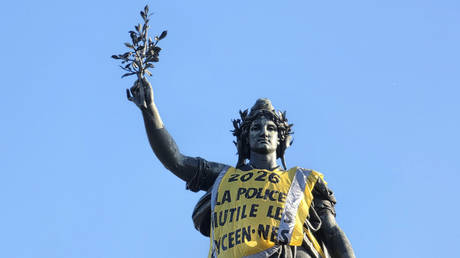
When a movement begins on the streets of Paris, it rarely stays contained for long. What started weeks ago as high-school student frustrations over overcrowded classrooms and educational funding in France has rapidly metastasized. Today, public fury over the surging cost of living, housing pressures, and strained public services has boiled over into violent clashes across neighbouring nations, catching authorities completely off guard.
If you think this is just a localized tantrum or a routine European labor strike, you are missing the bigger picture. Brussels and Milan are now seeing their own versions of urban chaos, proving that public patience with economic stagnation has officially snapped.
The Domino Effect Across Borders
It didn't take long for the anger to jump frontiers. In Belgium, hundreds of mostly young protesters took to the streets of Brussels, echoing the educational and economic grievances heard in France. What began as an organized expression of discontent quickly degenerated into clashes with riot police. Belgian officials didn't mince words, with federal authorities openly condemning what they described as organized violence aimed at destabilizing society rather than peaceful democratic expression.
Meanwhile, Italy experienced its own sharp escalation. In Milan, a march organized to protest crushing living costs turned into running street battles, forcing police to clear the central Cathedral square using tear gas. Over in Bologna, demonstrators clashed violently with security forces, resulting in water cannons being deployed and multiple arrests. Italian leaders have drawn a hard line, separating the constitutional right to protest from the destruction of public property.
France itself remains the epicenter of this volatile wave. Iconic locations have suffered severe structural damage, with historic buildings torched and businesses looted. Government ministers have promised that those who sow chaos will be held financially and legally accountable, but threats of punishment have done little to cool down the crowds.
Why People Are Reaching Their Breaking Point
You don't get half a million people marching in the streets over minor policy disagreements. The root cause is a brutal convergence of systemic economic pressures that have been building for years.
Inflation has completely eroded household purchasing power. From soaring grocery prices to skyrocketing energy bills, working-class families and students feel like they are treading water just to survive. In countries like Portugal and Italy, housing affordability has hit catastrophic levels, with rents and property values completely decoupling from average wages. When an entire generation realizes they cannot afford a stable home or a reliable education, the social contract breaks down.
Furthermore, public infrastructure is buckling under austerity measures. Governments caught between managing national debt deficits and funding crumbling public services are failing on both fronts. Schools are understaffed, universities lack resources, and public transit systems feel increasingly unreliable.
The Political Fallout for European Leaders
Leaders across the continent are facing an impossible balancing act. President Emmanuel Macron's administration in France is under immense political pressure as the unrest threatens to upend domestic stability ahead of upcoming elections. Opposition figures are capitalizing on the public's raw anger, while former participants of past populist movements like the Yellow Vests are re-emerging to join the ranks of the frustrated youth.
In Italy, Prime Minister Giorgia Meloni has faced severe tests as domestic economic discontent spills into public squares. The challenge for every governing body right now is figuring out how to restore public order without looking like an authoritarian regime crushing legitimate dissent.
When tear gas clears from the streets of Milan, Brussels, and Paris, the underlying systemic issues will still remain. Governments can deploy water cannons and arrest rioters by the dozen, but until they address the core economic anxieties driving ordinary people to the edge, the unrest will simply find a new outlet.
France, Belgium, Spain, and Italy shaken by social unrest
This video provides an on-the-ground look at the widespread social unrest shaking France, Spain, Italy, and Belgium as cost-of-living protests escalate into major confrontations.