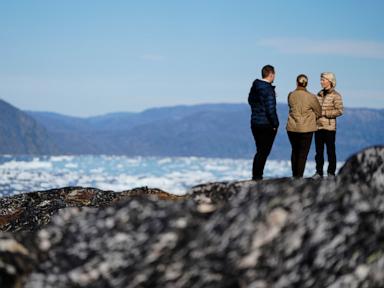
Brussels just made its move in the Arctic. European Commission President Ursula von der Leyen touched down in Nuuk to hand Greenland a heavy financial cushion and a very loud political message.
If you have been watching Washington lately, you know why. U.S. President Donald Trump has spent months insisting that America needs to take control of the island for strategic security reasons. Those persistent claims rattled local officials and Danish leadership alike, sparking high-stakes geopolitical friction across NATO. Read more on a related subject: this related article.
Now, Brussels is stepping up. Von der Leyen didn't just show up with kind words. She brought 200 million euros, roughly $232 million, designed to fund local infrastructure, combat climate change, upgrade internet connectivity, and build up fisheries over the next two years.
Money Talks and Sovereignty Matters
Let's be honest about what is happening here. Greenland isn't just an icy expanse on a map; it sits right at the intersection of critical global shipping routes and massive untapped mineral deposits. When Washington starts drawing imaginary lines or demanding control, small territories notice. Additional analysis by NBC News highlights related perspectives on the subject.
During her visit alongside Danish Prime Minister Mette Frederiksen and Greenlandic Prime Minister Jens-Frederik Nielsen, von der Leyen drew a hard line in the snow. Territorial integrity isn't up for grabs. Borders matter. She explicitly stated that Greenland's future belongs strictly to the people of Greenland and Denmark.
To back that up, the EU plans to double its budget support for the region to half a billion euros starting in 2028. Funds are earmarked for housing, small businesses, and sustainable tourism. It is a calculated effort to tie the island's economic future tighter to Europe rather than leaving a vacuum that external powers might exploit.
The Arctic Military Chessboard
Money is only one side of the coin. Security is the real engine driving this sudden diplomatic rush.
Back in January, Denmark and seven European allies sent a small contingent of military personnel to the island. On paper, it was a routine cold-weather exercise. In reality, it was a flashing neon sign telling Washington to back off. Trump responded by threatening broad tariffs against Denmark, Finland, France, Germany, the Netherlands, Norway, Sweden, and the United Kingdom.
That trade war threat fizzled out only after NATO scrambled to shore up a unified Arctic security framework. But the tension hasn't vanished. Just as von der Leyen arrived in Nuuk, eleven NATO countries kicked off new military drills on the island. Around 400 troops, including specialized Arctic forces from Canada, Denmark, and Finland, are currently running operations in brutal sub-zero conditions.
Prime Minister Nielsen called the EU a loyal and trusted friend during these rocky times. He isn't wrong. Greenland faces modern pressures that its small population simply cannot handle alone.
Geopolitics in the North Atlantic is shifting fast. Keep a close eye on Arctic supply chains and mineral rights over the next few years. That ice is melting, and the scramble for what sits underneath it has only just begun.