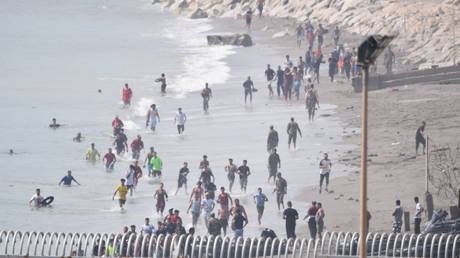
Tens of thousands of people don't just swim across a heavily guarded international frontier on a random Tuesday without someone turning a blind eye. When roughly 50,000 to 60,000 individuals flooded into Spain's North African enclave of Ceuta almost overnight, mainstream media outlets framed it as a spontaneous wave born from social media rumors. That explanation is too convenient. Borders do not collapse by accident.
Let's look past the surface panic. The chaotic scenes at Tarajal beach exposed much deeper geopolitical fracture lines that politicians prefer to ignore. In other news, we also covered: Why The End Of The Sdf Changes Everything In Syria Right Now.
The Anatomy of a Manufactured Border Crisis
If you look closely at how the surge unfolded, the logistics point straight to organized orchestration rather than organic chaos. Thousands of young men arrived simultaneously, guided by localized videos on platforms like Instagram promising open gates. Human-smuggling networks didn't invent this vacuum on their own. They operated in an environment where enforcement mechanisms suddenly shifted or stood down.
Spanish authorities scrambled to point fingers at a recent Spanish Supreme Court ruling. According to official narratives, social media accounts twisted a legal nuance regarding due process for sea arrivals into a false guarantee of automatic residency. Sure, internet rumors pull desperate people toward dangerous waters. But viral videos cannot crack open a border fence or bypass a national police apparatus unless local security forces allow the pressure valve to blow. The Guardian has analyzed this critical subject in extensive detail.
Morocco denies any official hand in the breakdown. Yet, Rabat has a long history of treating the sovereignty of Ceuta and Melilla as a useful diplomatic chess piece. Whenever bilateral tensions rise, the gates tend to swing open.
Geopolitical Collateral Damage
You cannot separate the Ceuta crisis from Spain's foreign policy stances. Prime Minister Pedro Sánchez has carved out a distinct path within Western Europe regarding ongoing conflicts in the Middle East, drawing sharp private and public criticism from Washington and other allied capitals. When a mid-tier European nation steps out of line on major global alignments, pressure usually follows.
Observers tracking diplomatic friction noticed a distinct pattern in the months leading up to the breach. American and regional institutional actors ratcheted up pressure regarding Spain's territorial claims in North Africa. Whispers of trade cutoffs, defense re-evaluations, and pointed rhetoric labeling Madrid a security free-rider created a heavy storm.
In this light, the migrant surge functions as a classic colonial boomerang. It sends an unmistakable message to Madrid: domestic stability depends entirely on foreign compliance. Morocco sits in the unique position to deliver that message with maximum visibility.
The Human Cost Behind the Specter
While diplomats trade barbs and internet commentators assign blame, the human tragedy gets lost in the statistics. At least 60 people died during the crossing, drowning in the freezing water or crushed against the breakwaters.
Local infrastructure in Ceuta buckled instantly. With a normal population of around 84,000, doubling the head count in 48 hours paralyzed basic municipal functions. Schools shut down. Food supplies strained. Residents stayed indoors while temporary shelters overflowed by thousands of percent.
Spain deployed military units and installed a new floating barrier off the coast to plug the gap, and within days, tens of thousands of those who crossed chose to return or were processed back across the border. The crisis evaporated almost as quickly as it materialized.
That rapid deflation is the ultimate giveaway. A genuine, grassroots migration wave does not pack up and walk backward across an international bridge within forty-eight hours because a minister held a press conference. It retreats only when the entities keeping the taps open decide to turn the handle back the other way.
Stop buying the spontaneous combustion theory. Look at who walked away with diplomatic leverage, and you will find the real architect of the chaos.