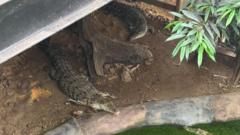
A three-year-old boy is fighting for his life in a hospital right now because a stranger allegedly decided to use a pit of apex predators as a weapon.
Let that sink in. You might also find this connected coverage interesting: What the Israeli Government Gets Wrong About the New Iran Deal.
When news broke that a toddler ended up inside the crocodile enclosure at the Johnsons of Old Hurst zoo near Huntingdon, initial reactions from the public followed a predictable script. People assumed it was a tragic accident. They assumed a parent looked away for a split second. They assumed a curious toddler managed to slip through a barrier.
They were wrong. As reported in detailed articles by NBC News, the implications are notable.
Cambridgeshire Police dropped a bombshell that transformed a distressing accident story into a chilling criminal investigation. Detectives from the major crime unit arrested a 30-year-old man from Norfolk on suspicion of attempted murder. More terrifyingly, Detective Inspector Verity McCann confirmed that police do not believe the man and the child knew each other.
This isn't a story about parental negligence or a failure of zoo infrastructure. It's a horrifying look at a random act of violence utilizing a captive dangerous animal. It changes the conversation entirely around public safety, zoo security, and how we view the spaces where humans and predators get close.
Inside the Johnsons of Old Hurst Incident
The timeline of what happened at the Huntingdon farm and zoo is tight but devastating. At 1:24 PM, emergency services received an urgent call. A toddler was inside the crocodile enclosure.
He didn't just fall. The legal charge of attempted murder requires proving an intent to kill. For a stranger to target a three-year-old child and place him in direct contact with crocodiles suggests a deliberate, malicious act.
First responders rushed the boy to Addenbrooke's Hospital in Cambridgeshire. He has serious injuries. His condition is currently listed as critical but stable. While specially trained officers support his family at the hospital, forensic teams and major crime detectives are trying to piece together exactly how a stranger was able to grab a child and breach the enclosure boundaries before anyone could stop him.
The Problem With Low Barrier Zoo Designs
Johnsons of Old Hurst isn't a massive, state-run concrete fortress. It's a popular family-run farm and zoo housing over 100 animals, including lions, tigers, and sloth bears. In 2019, the zoo opened a new reptile house. At the time, owner Andy Johnson openly praised the design for its immersive feel. He told local media that it was amazing for people to look down on the animals with no barriers, arguing it inspires visitors because the animals are right there in real life.
That design philosophy is now under intense scrutiny.
Immersive zoo layouts are highly popular across the globe. Modern zoological philosophy pushes away from heavy iron bars and thick concrete walls. Instead, zoos use deep pits, glass viewing panels, and low wooden or natural barriers to make guests feel closer to the wildlife.
It looks beautiful. It feels natural. But it completely ignores the wild card of human malice.
When you design a crocodile enclosure with an open-top view meant to remove the clinical feeling of a cage, you inherently lower the physical effort required to breach that space. If an adult can easily lean over or look down on the animals without a high, physical cage separating them, that adult can also easily drop or throw something—or someone—into the enclosure.
How the Law Treats Animals as Weapons
Charging someone with attempted murder for putting a person into a crocodile enclosure is legally complex but entirely logical. In criminal law, a weapon doesn't have to be a gun or a knife. A weapon is anything used with the intent to cause death or grievous bodily harm.
If you push someone in front of a moving train, the train is the mechanism of attempted murder. If you throw a toddler into a pit of crocodiles, the crocodiles and the environment itself become the mechanism.
Crocodiles are opportunistic ambush predators. They don't look at a human toddler and think about zoo rules. They see a small, splashing object entering their territory. The physical injuries to the boy are serious, and while police haven't detailed whether the injuries came from the fall itself or direct contact with the reptiles, the mere act of putting a child into that environment satisfies the threshold for an attempted murder charge.
The suspect is an unrelated 30-year-old man. Why Norfolk? Why Huntingdon? Why this specific child? These are the questions the major crime unit faces. Random attacks on children by complete strangers are incredibly rare, making this case an statistical anomaly that defies typical criminal patterns.
Moving Forward From the Horror
The immediate priority is the survival and recovery of the three-year-old boy. Everything else comes second to that child leaving Addenbrooke's Hospital on his own two feet.
But the broader fallout for the zoo industry starts immediately. Every zoo utilizing open-air, low-barrier, or "look down" enclosures for dangerous predators will have to re-evaluate their security protocols. You can design an enclosure to keep a crocodile inside. It is much harder to design an enclosure to keep a determined criminal out.
The case moves to the courts next as the Norfolk suspect faces formal tracking through the justice system. For parents visiting wildlife parks, the illusion of safety inside these family-friendly spaces has been shattered.
Keep your children close. Watch the people around you. The barriers we think protect us are only as strong as the people standing next to them.