The hunt for a room-temperature superconductor has always been a slow, brute-force guessing game played in freezing laboratories. For decades, materials scientists mixed elements together like blind chefs, hoping a random recipe would magically conduct electricity with zero resistance. It was tedious work. It took years to confirm a single compound.
Now, that entire dynamic has changed. An international research team called the SuperC consortium just blew the doors off this traditional methodology. By combining machine learning with quantum physics, they successfully predicted, synthesized, and verified two brand new superconductors.
If you're looking for an immediate electronics revolution tomorrow morning, you might feel disappointed. These two specific materials, named YRu3B2 and LuRu3B2, aren't going to power your smartphone at room temperature just yet. They still require extreme cooling to work their quantum magic. But focusing on the cooling requirement completely misses the point of this breakthrough. The real triumph isn't the materials themselves. It's the speed at which we found them.
The Absolute Grind of Traditional Physics
To appreciate why this matters, you have to understand how miserable the search used to be. Superconductivity is a rare state of matter where electrons flow without losing a single watt of energy to heat. Find a material that does this at normal room temperatures, and you instantly upgrade global power grids, supercharge quantum computers, and make maglev trains cheap to run.
But finding them is a nightmare. The periodic table offers a virtually infinite number of elemental combinations. Testing them one by one is impossible. Traditionally, physicists spent months doing complex quantum-mechanical equations just to see if a single crystal structure was worth cooking in a furnace.
The SuperC consortium, led by Professor Päivi Törmä at Aalto University, threw out that playbook. Instead of manual calculation, they built an AI system trained on quantum geometry to handle the screening process. The algorithm sifts through millions of theoretical compounds in hours. It flags the ones with the highest probability of success. Only then do the humans step in to do the heavy calculations.
How a Japanese Basket Weaving Pattern Solved the Math
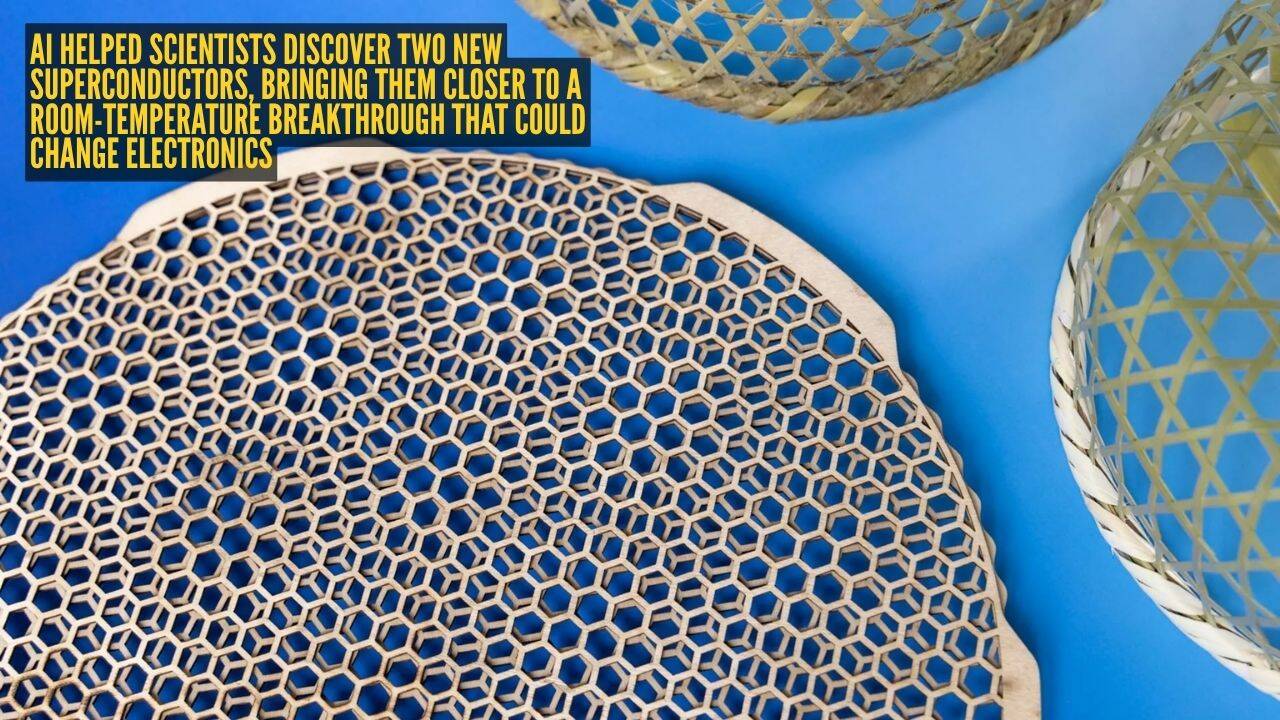
The two new superconductors aren't random assortments of matter. They share a highly specific atomic structure known as a kagome lattice. This geometric arrangement is inspired by a traditional Japanese basket-weaving pattern made of intersecting triangles.
Geometry dictates behavior in quantum physics. In a kagome lattice, the physical structure forces electrons to interact in unusual ways. They slow down and form what physicists call flat bands. When electrons get trapped in these flat bands, their collective interaction strengthens. That's the exact environment needed to trigger superconductivity.
The AI specifically hunted for elements that could form this kagome structure stably. Once the algorithm selected YRu3B2 and LuRu3B2, detailed theoretical physics calculations confirmed the machine's hunch. After that, collaborators at Rice University led by Professor Emilia Morosan took the blueprints into the lab. They chemically synthesized the raw elements into physical compounds and verified that both materials did, in fact, drop their electrical resistance to zero.
Why the Process Changes Everything for the Grid
Many casual observers get trapped in the hype cycle. They want a room-temperature superconductor today, and if a discovery requires a liquid-nitrogen bath, they tune out. That's a mistake.
Think of this AI tool as a map generator for a completely uncharted continent. Previously, scientists walked on foot, hacking through thick brush with a machete. Now, they have satellite imagery. Professor Törmä noted that this machine-learning approach can eventually scale to screen billions of materials.
We aren't just looking for random superconductors anymore. We're training an intelligent system to recognize the underlying patterns of quantum geometry. The SuperC consortium has set a target to find a practical, stable room-temperature superconductor by 2033. Given that they've already proven their system can successfully conjure functional materials out of pure data, that timeline looks entirely realistic.
Your Next Steps in the Superconductor Transition
If you run a business, invest in deep tech, or build hardware, stop waiting for a single headline to announce a miracle material. Start tracking the software tools that find them.
First, shift your focus away from the chemical elements and look at the geometry. Companies working on microprocessors or quantum computing infrastructure need to watch how flat-band engineering develops over the next 24 months. The immediate application of these discoveries will likely hit data centers first, where eliminating heat dissipation bottlenecks can save billions in cooling bills.
Second, expect the materials science sector to consolidate around proprietary AI screening pipelines. The value isn't in holding a patent for one specific crystal. The real value is owning the algorithm that filters a billion structures a day. Watch the laboratories and startups forming alliances with massive compute clusters. That's where the next generation of power electronics will be born.
The stalemate in materials science is officially over. We've replaced luck with computation.