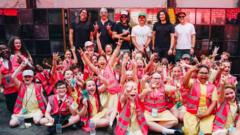
Most rock bands fill massive football stadiums with blinding laser grids, towering digital walls, and ear-splitting guitar rigs. When Dave Grohl and his crew rolled into Liverpool's Anfield stadium to kick off the European leg of their tour, the most electrifying moment didn't feature any special effects. It happened long before the stadium turnstiles opened to the public, right during the afternoon soundcheck. A group of local primary school kids walked out onto the colossal stage, picked up their instruments, and played directly to the rock icons sitting in the empty venue.
The Foo Fighters Anfield show delivered exactly what fans expected over two massive nights—high-octane energy, three-hour sets, and crowd singalongs that could be heard across the River Mersey. But the real story centers on a tiny band named The Bell Tower Beats. These kids come from Anfield Road Primary School, located practically in the shadow of the stadium. Instead of just watching their musical heroes from the rafters, they became the opening act for an audience of rock royalty. For another perspective, check out: this related article.
The Soundcheck That Upstaged the Main Event
Most stadium soundchecks are boring, mechanical affairs. Techs check line signals, roadies tune snares, and musicians casually run through choruses while sipping coffee. This time, the routine stopped completely. The Bell Tower Beats took over the massive setup to perform the Foo Fighters' iconic track "Times Like These."
Imagine being eight or nine years old, standing on a stage built for tens of thousands of people, looking out into an empty stadium, and realizing Dave Grohl is watching you. For band member Sean, the stakes couldn't have been higher. He admitted to reporters afterward that he had never performed in front of anyone before this moment. Talk about jumping straight into the deep end. Another young band member, Alyssa, couldn't hide her excitement about watching the headliners later, noting how much she loved their chaotic energy and how much fun they obviously have on stage. Similar reporting regarding this has been provided by GQ.
The Foo Fighters were so blown away by the performance that they immediately uploaded the footage to their main Instagram and YouTube channels, broadcasting the primary school band to millions of global followers. Grohl publicly thanked the kids for braving the intense summer heat and sharing their raw talent.
Why Dave Grohl Constantly Seeks Out Young Musicians
This school performance wasn't a cheap public relations stunt. If you look closely at the history of the Foo Fighters, you see a consistent pattern of validating the next generation of live musicians. Grohl has turned this into a personal mission. He hates the idea that rock music is a dying art form reserved for aging Gen Xers and Baby Boomers.
Remember Nandi Bushell? The ten-year-old drumming prodigy challenged Grohl to an epic virtual drum battle during the pandemic. Instead of ignoring her, Grohl engaged, wrote a theme song for her, and eventually brought her on stage at the LA Forum to perform "Everlong" in front of a screaming arena. He understands that seeing someone your own age hold a guitar or sit behind a drum kit is entirely different from watching a middle-aged millionaire do it.
The Liverpool stint featured even more family-driven musical chaos. During the first night at Anfield, a fan named Max held up a sign claiming he would play the drums on the track "Rope" if he could solve a Rubik's Cube on stage first. Grohl pulled him up, Max solved the puzzle under pressure, and then absolutely crushed the drum part. It turned out Max wasn't a random stranger at all. He was celebrating his 18th birthday and happens to be dating Grohl's daughter, Harper Grohl. The entire bit was a setup, but it proved the same point. The Foo Fighters view the stage as an open platform for young energy, not a sacred altar for elite rock stars.
The Bleak Reality of Music Education in Modern Schools
The story of the Bell Tower Beats feels warm and fuzzy, but it highlights a massive gap in how modern schools treat the arts. Across the UK and North America, creative budgets face constant cuts. Music programs are usually the first things administrators drop when local funding gets tight. Schools often prioritize standardized testing over creative expression, leaving children with fewer outlets to discover live instrumentation.
When schools cut music classes, they lose more than just standard recorder lessons. They lose a vital tool for building resilience. Stepping onto a stage requires immense emotional courage. When a child like Sean overcomes the paralyzing fear of performing for the first time, his internal blueprint changes. That confidence doesn't disappear when he puts the instrument down. It carries over into public speaking, classroom participation, and how he handles pressure later in life.
Anfield Road Primary School managed to build an environment where a student rock band could thrive despite the systemic lack of funding in working-class neighborhoods. They proved that you don't need elite conservatory resources to get kids excited about music. You just need a couple of worn-out guitars, a drum kit, a committed instructor, and songs that actually make young people want to turn up the volume.
What the Rest of the Anfield Gigs Taught Us About Rock in 2026
The Foo Fighters didn't just hang out with school kids; they delivered a masterclass in stadium performance across their two official June dates. Touring behind their April album Your Favorite Toy, the band proved they still hold the title for the hardest-working live act in alternative rock.
Their sets stretched past the three-hour mark, a rarity in an era where many pop and rap artists rely heavily on short sets and pre-recorded backing tracks. The band tore through their foundational catalog, including "All My Life," "The Pretender," and "Best Of You."
Because they were playing in Liverpool, the birthplace of modern pop music, the band threw in a massive surprise for the local crowd. They debuted a live cover of The Beatles' classic Abbey Road track, "I Want You (She's So Heavy)." The performance felt dirty, bluesy, and incredibly loud. It served as a direct nod to the musical heritage of the city while showcasing the band's ability to jam fluidly without a script.
Fans traveled from all over Europe to catch these specific dates. Reporters spotted families spanning three generations waiting in the merchandise lines. One teenager, Joshuah Barlow, traveled across the Irish Sea from the Isle of Man with his grandmother Christine just to witness the show. That multi-generational appeal is incredibly rare today, and it links directly back to why the band champions groups like The Bell Tower Beats.
Practical Steps to Get Modern Kids into Live Rock Music
If you want the young people in your life to experience the same thrill as the Anfield Road pupils, you can't just hand them an acoustic guitar and expect them to learn classical scales. That is a fast track to boredom. You have to make the process immediate, loud, and rewarding.
- Ditch the traditional curriculum early on. Don't force sight-reading sheet music right away. Let them pick up an electric guitar, bass, or keyboard and learn three basic chords. If they can play a simplified version of a song they love within forty-eight hours, they will stay hooked.
- Embrace digital drum pads if space is tight. Parents dread the noise of an acoustic drum kit. A basic electronic drum kit with a solid pair of headphones allows a kid to bash away at full volume without causing a neighborhood dispute.
- Look for community rock academies. Organizations like School of Rock or local independent music charities focus heavily on group dynamics rather than isolated solo practice. Playing in a band teaches kids how to listen to others, keep time, and share the spotlight.
- Expose them to live environments early. Take them to local gig venues, street festivals, or independent record stores. Let them see real people making music by hand, rather than just watching edited performances through a phone screen.
The Bell Tower Beats didn't get to Anfield by accident. They got there because teachers gave them the space to make noise, try things out, and fail safely behind closed doors until they were ready for the big stage. You can create that exact same environment in a spare bedroom or a garage. Start by finding a cheap instrument, turning down the expectations, and turning up the amplifier.