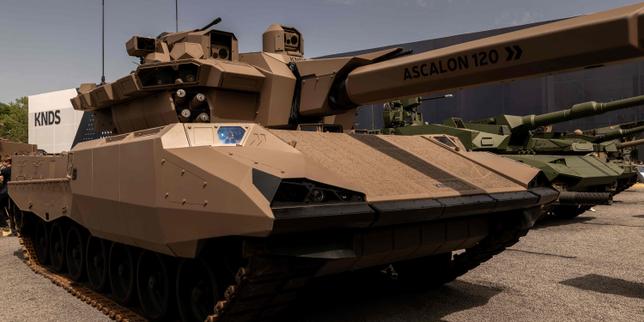
The grand illusion of European defense unity has finally cracked. With the formal death of the SCAF next-generation fighter jet program, all eyes have turned to its ground-based sibling. The Main Ground Combat System (MGCS), meant to replace the French Leclerc and German Leopard 2 tanks by 2040, is now on life support. If you believe the official communiqués coming out of Paris and Berlin, things are just being "adjusted."
Don't buy the corporate spin.
The defense partnership between French President Emmanuel Macron and German Chancelor Friedrich Merz is fundamentally broken. When the SCAF jet project fell apart under the weight of industrial infighting and clashing military doctrines, it exposed a truth that political leaders tried to hide for nine years. France and Germany don't want the same weapons because they don't want to fight the same wars. Now, the MGCS tank is repeating every single mistake that killed the fighter jet.
The Illusion of a Shared Tank
The MGCS isn't just a tank. It's supposed to be a network of manned vehicles, heavy combat drones, and automated systems. But you can't build a complex web of military technology when the two main partners are already looking for the exit doors.
Armin Papperger, the chief executive of German defense titan Rheinmetall, recently admitted to Welt am Sonntag that a French withdrawal from the MGCS is a distinct possibility. According to Papperger, Paris is already planning to slash its budget for the project to less than half of what was originally expected. When a project that has been running for nearly a decade has only seen about 25 million euros handed down to its core industrial players (KNDS France, KNDS Germany, Rheinmetall, and Thales), you know it's not a priority. It's a token gesture.
The German Ministry of Defense tried to put a brave face on the situation, claiming that both nations have decided to focus on the "core" of the program, specifically research and tech demonstrations. But when a spokesperson was asked if France and Germany would end up with entirely different tanks instead of a unified platform, the answer was telling. "The question remains open," they admitted, noting that the project allows for "different platforms."
That's diplomatic code for failure. If you're building different platforms with different specifications, you don't have a joint program. You have an expensive, slow-moving disagreement.
Why the Industrial Math Never Works
The real breakdown happens on the factory floor. The SCAF program died because Dassault Aviation and Airbus couldn't agree on who got to hold the pen. Dassault wanted clear leadership as the architect; Airbus wanted a balanced, integrated European approach that split the work based on national funding.
The MGCS faces an even worse industrial logjam.
Originally, the tank project was neatly balanced between France's Nexter and Germany's Krauss-Maffei Wegmann (KMW), merged under the joint banner of KNDS. It was a clean 50-50 split. Then Berlin forced Rheinmetall into the mix to protect its own industrial interests. Suddenly, the French side found itself outnumbered and outgunned in the boardroom, facing two German corporate giants fighting for the same piece of the pie.
Different Needs, Different Wars
Beyond the corporate greed, the military requirements are completely incompatible.
- The French Vision: The French military values agility, strategic mobility, and rapid deployment. They need vehicles that can be easily transported overseas for expeditionary warfare, reflecting their historical operations in Africa and overseas territories.
- The German Vision: The German Bundeswehr is built for heavy, continental defense. They want heavily armored, massive platforms designed to stop a conventional land invasion in Eastern Europe.
You can't build a single vehicle that is both a lightweight, easily transportable scout and a massive, heavily armored fortress. Trying to compromise satisfies no one, costs billions, and leaves both armies with a machine they don't actually want.
The Backup Plans are Already Rolling Out
Military leaders aren't stupid. They see the writing on the wall, and they're already buying insurance policies.
At the Eurosatory defense exhibition outside Paris, KNDS unveiled "Capint" (Capacité intermédiaire), a new interim tank scheduled to hit the field in the 2030s. General Philippe de Montenon, a top commander in the French land forces, bluntly stated that France's current Leclerc tanks will be "at the end of their rope" by 2035. They can't wait for a mythical 2040 or 2045 MGCS timeline that keeps sliding into the future.
Germany is doing the exact same thing. Rheinmetall and KNDS Germany have been pushing the development of a temporary solution, essentially a Leopard 3, to bridge the gap in the early 2030s.
Look at what people do, not what they say. When both countries start funding and building their own mid-term tanks, the long-term joint project is effectively dead. It becomes a research sandbox used to keep politicians happy while the actual armies buy practical hardware elsewhere.
The Next Strategic Moves
If you're tracking the European defense market, stop waiting for a miracle breakthrough in Paris or Berlin. The romantic era of grand, bilateral Franco-German projects is over.
Instead, watch for a pivot toward smaller, nimbler alliances focused on strict interoperability rather than building identical machines from scratch. The future isn't a unified European tank. It's a collection of sovereign vehicles using the same communication networks, ammunition types, and drone interfaces. France will likely double down on its own domestic armored capabilities or look toward partners who share its expeditionary mindset, while Germany will solidify its dominance over the heavy European market through its Leopard evolution line. Expect the remaining MGCS budget to be quietly redirected into sovereign drone tech and software integration while the physical hull of the "unbreakable alliance" goes straight to the scrapyard.