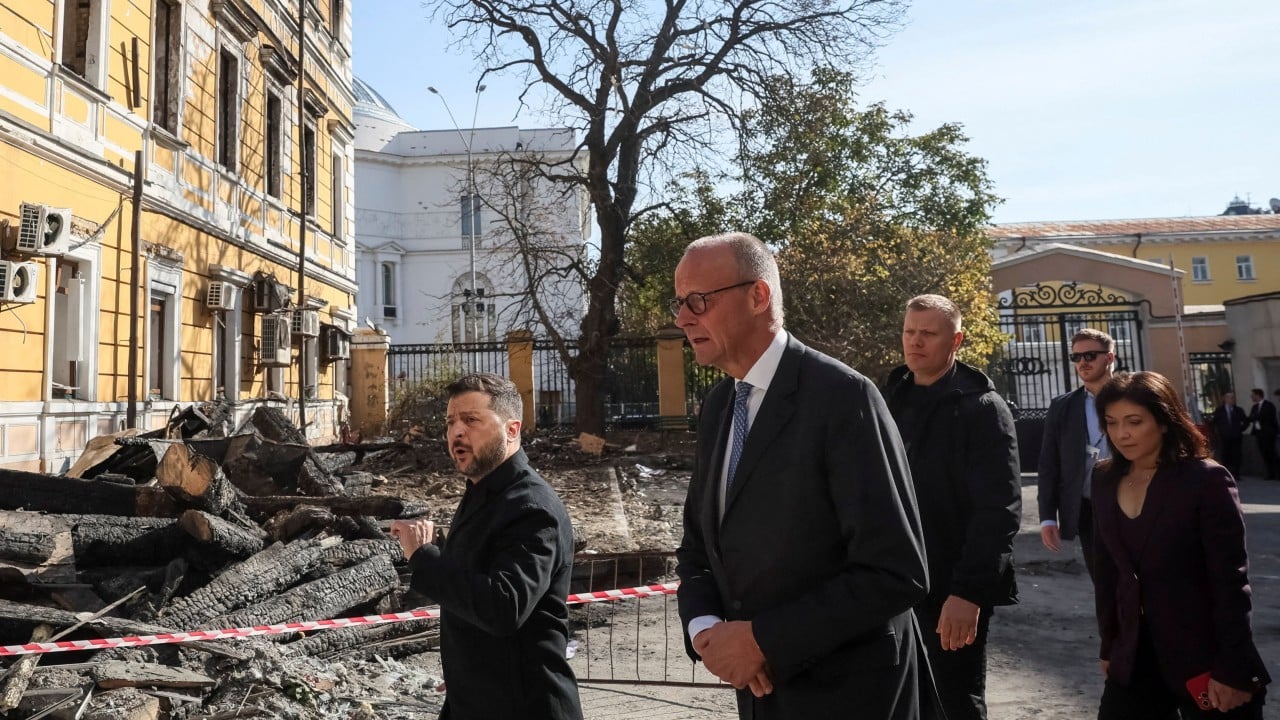
Air raid sirens don't care who you are. German Chancellor Friedrich Merz found that out the hard way this weekend when a Russian missile slammed into Kyiv’s Northern Bridge just hours after his unannounced train pulled into the station.
Timing is everything in wartime messaging. Moscow basically sent a burning RSVP to Berlin's new diplomatic push. Merz arrived in the Ukrainian capital to finalize a massive new military support package worth over one billion dollars, hoping to project unshakeable European resolve. Instead, the Kremlin greeted him with shaking windows, roaring sirens, and another severed artery in Kyiv's transit grid.
Let's look at what's actually happening on the ground. Kyiv's critical infrastructure isn't just getting grazed anymore—it's getting hammered systematically. Over the past few days, strikes have targeted the city's key road arteries across the Dnipro River. Mayor Vitali Klitschko confirmed the blast on the Northern Bridge, sending emergency crews scrambling while social media filled with footage of fireballs blooming over the river.
This isn't random violence. It's a calculated escalation. For the first years of the conflict, central Kyiv felt relatively insulated from the kind of frontline devastation seen in the east. That buffer is gone. Since April, Russian air campaigns have shifted gears, pelting the capital day and night with faster, harder-to-intercept drones and precision missiles. Schools, fuel stations, government facilities, and now vital bridges are in the crosshairs.
The German Calculus Under Fire
Merz didn't fly into a war zone for a photo op. Berlin is trying to recalibrate its posture as fatigue sets in across Western capitals. With the fresh billion-dollar package on the table, Germany wants to signal that European defense backing isn't wobbling, no matter how loud the explosions get.
When Merz sat down with President Volodymyr Zelensky at the National Academy of Sciences—a building that itself absorbed a drone hit just days prior—the subtext was obvious. Diplomacy is now a blood sport conducted under screeching sirens. You can't talk about rebuilding or holding the line when the very concrete connecting the two halves of the capital is smoking behind you.
Why target the bridges now? It's basic logistics turned psychological warfare. Splitting a city of millions across a massive river forces critical bottlenecks. It disrupts military supply lines, chokes civilian movement, and wears down the collective psyche of a population that refuses to fold. Moscow wants every foreign visitor to feel the acute vulnerability of the Ukrainian state.
What Comes Next for European Aid
The timing of this strike exposes the brittle reality of Western pledges. Pumping a billion dollars into air defense and heavy munitions is vital, but delivery velocity matters more than big headline numbers. Factories move slowly while missiles move fast.
Analysts are watching closely to see if these high-profile strikes will accelerate or chill European commitments. Historically, dramatic attacks during high-level visits tend to harden resolve in the short term, but they also highlight the brutal gaps in Ukraine's air shield. Patriot batteries and localized anti-drone systems are still in demand everywhere, and inventory is painfully thin.
Merz's baptism by fire in Kyiv proves that traditional diplomacy is dead. You cannot separate state visits from the theater of war anymore. The Kremlin made its statement on the Northern Bridge, and now Berlin has to back its billion-dollar ink with iron.
Take a hard look at the logistics holding the front lines together. If the transit routes inside the capital keep fracturing, external aid has to work twice as hard just to reach the points of impact.