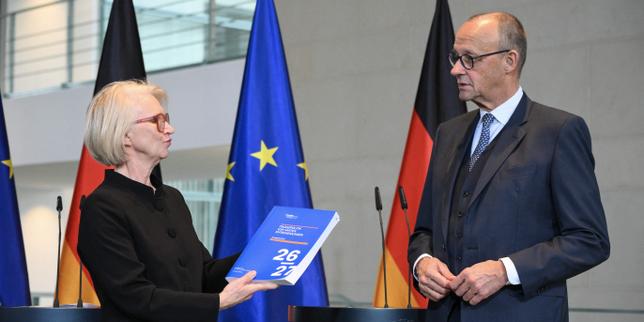
Germany and France look like two patients in completely different hospital wards right now. Berlin boasts a stronger macroeconomic engine, cleaner industrial muscle, and tighter traditional metrics than Paris. Yet, beneath the surface pride of the German economic model, a quiet panic is growing. The country's debt is surging, and policymakers are sounding the alarm over a potential fiscal crisis of massive proportions.
If you think France holds the monopoly on budget anxiety in Europe, you haven't been paying attention to what is happening across the Rhine. The core issue isn't just about sluggish growth or standard political posturing. It is about how structural rigidity collides with massive new spending demands, leaving Berlin trapped between constitutional rules and modern economic realities.
The Illusion of German Economic Perfection
Let's clear up a common misconception right away. People love to pit Paris against Berlin as if Germany is cruising along on a frictionless highway while France struggles in traffic. Statistically, the German industrial base remains formidable, anchored by heavy manufacturing, automotive giants, and massive export power.
However, that exact model is cracking. High energy costs following the shift away from Russian gas, combined with sluggish global demand for traditional vehicles, have battered German competitiveness. Growth has flatlined for quarters.
Berlin still outpaces France in terms of overall economic health, lower structural deficits historically, and a culture of fiscal discipline. But that reputation for unbreakable financial health is precisely what is masking the new vulnerability. The old playbook of relying on a booming export market to pay for domestic stability doesn't work as cleanly anymore.
The Debt Surge Nobody Saw Coming
Germany's strict debt brake, known as the Schuldenbremse, has long been the holy grail of fiscal conservatism. It legally limits structural federal borrowing to a tiny fraction of GDP. But rules created decades ago are colliding with twenty-first-century emergencies.
The country faces an unprecedented financial squeeze. Massive investments are desperately needed to overhaul crumbling infrastructure, accelerate the green transition, and fund a massive defense modernization program to meet new geopolitical realities. You cannot finance a complete restructuring of the national energy grid and a military upgrade with pocket change.
As a result, off-budget special funds and creative accounting have ballooned Germany's public liabilities. The state is borrowing heavily through shadow structures to bypass the constitutional debt brake. Investors are starting to notice. When a nation that prides itself on zero deficits starts running up billions in hidden or creative debt, market sentiment shifts fast.
Why This Matters Beyond Berlin
This isn't just an internal bookkeeping headache for German Chancellor Olaf Scholz and his successors. It sets the monetary and political tone for the entire eurozone.
When France struggles with its widening bond yields and political stalemate, European markets look to Germany as the ultimate safe haven. The spread between French OATs and German Bunds has hit historic extremes, reflecting deep market nervousness about Paris. But if the anchor of European fiscal stability starts wobbling because its own debt is spiraling out of control, the entire European debt architecture feels the tremor.
Germany faces a painful political trilemma. Do they scrap the debt brake and risk a political civil war within the governing coalition? Do they slash vital social and industrial subsidies to keep the books balanced? Or do they let infrastructure crumble further while competitors in Asia and North America pull ahead?
None of these options are clean. The German economic machine is discovering that outperforming France is a low bar when the global economy is rewriting the rules of survival. Pretending that Berlin is immune to the fiscal reckoning sweeping Western democracies is a dangerous mistake. The debt wave is coming for everyone, and Germany's wake-up call is going to be loud.