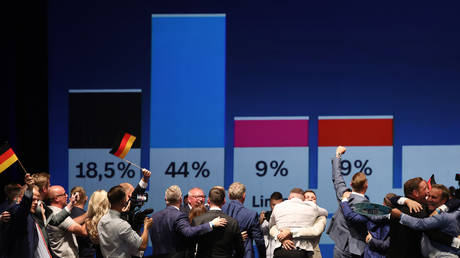
Germany just crossed a political line that politicians promised would never be crossed again.
For the first time since World War Two, a far-right party has clinched a regional election victory, pulling off a stunning win that sent shockwaves from Berlin to Brussels. The Alternative for Germany, commonly known as the AfD, swept state elections in Saxony-Anhalt with a massive 44.4 per cent of the vote. Chancellor Friedrich Merz’s conservatives trailed far behind at 18.3 per cent. For a different view, see: this related article.
This isn't a minor regional blip. It's a seismic shift in a country that spent decades building a political firewall against extremist movements. If you want to understand why European politics is spinning out of control, you have to look at what's happening on the ground in Germany right now.
The Breaking of the Post War Taboo
Mainstream German politicians spent decades operating under a strict social contract. Far-right nationalism was supposed to be permanently buried under the weight of historical memory. Related analysis on the subject has been published by Associated Press.
That firewall just collapsed.
In Saxony-Anhalt, a former communist eastern state with a population of just over two million, voters didn't just quietly back the AfD. They handed the party a dominant lead. Ulrich Siegmund, the 35-year-old local leader of the party, openly campaigned on a nationalist platform and told cheering crowds that they had officially made history.
The numbers tell a brutal story for the established political class. While the AfD surged to 44.4 per cent, the federal government's approval ratings are in freefall. A staggering 87 per cent of voters in the region expressed deep dissatisfaction with Berlin's leadership. People are angry, tired of economic stagnation, and completely done with traditional parties telling them everything is fine.
What the AfD Is Actually Promising
You can't dismiss this win as a protest vote. Voters know exactly what box they're checking.
The AfD ran on an unapologetically hardline platform. Their playbook includes heavy restrictions on immigration, a complete halt to new wind farm construction, restoring diplomatic and energy ties with Russia, and pulling out of the euro. Locally, they want to strip away progressive school policies, mandate the daily hoisting of the German national flag, and segregate the children of refugees into separate classrooms.
These policies terrify mainstream politicians, but they resonate powerfully with voters who feel alienated by rapid cultural and economic changes. The party leans hard into nostalgia. They promise cleaner streets, tighter borders, and a return to traditional pride.
Mainstream parties have long maintained a strict "firewall" policy, refusing to form coalitions with the AfD because domestic intelligence classifies the party's regional branches as right-wing extremists. But winning nearly half the vote makes total exclusion mathematically difficult, especially if smaller anti-establishment groups like the far-left BSW manage to enter the parliamentary mix.
Why Berlin Is Sweating
The fallout reaches straight to the top. Chancellor Friedrich Merz is watching his political capital evaporate. His plans to revive Germany's sluggish economy have stalled, his communication style routinely sparks backlash, and his personal popularity is sitting at historic lows.
Voters deserted the conservatives because they feel lied to. Promises of economic stability and orderly immigration have turned into high inflation, bureaucratic gridlock, and crowded public services.
And it's no longer just an eastern phenomenon. While the party dominates former East German states, recent polling shows the AfD pulling roughly 20 per cent support in western states like Baden-Wuerttemberg and Rhineland-Palatinate. Nationally, the party sits at an alarming 28 per cent in recent INSA polls, comfortably beating out the traditional ruling conservatives.
Federal elections loom on the horizon. If this regional momentum holds, the political landscape of Europe's largest economy will look fundamentally unrecognisable by 2029.
Ignore this warning at your own peril. The old rules of European politics no longer apply, and the center is officially holding nothing together.