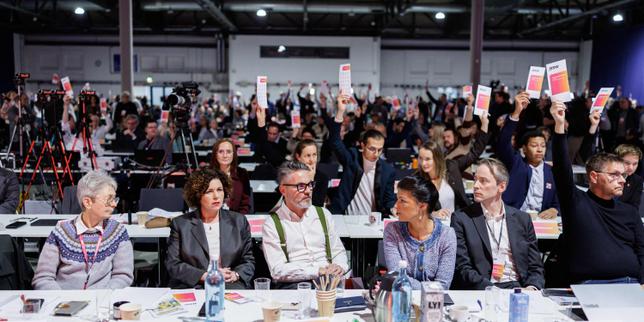
The political firewall in Germany is cracking, and nobody should act surprised. When Sahra Wagenknecht’s populist left party, the BSW, formally signed off on ad-hoc legislative cooperation with the far-right Alternative for Germany in Saxony-Anhalt, it didn't just break a regional political taboo. It exposed the messy, opportunistic reality of modern European politics where ideological purity takes a back seat to raw parliamentary math.
For years, the mainstream establishment relied on a simple moral boundary known as the Brandmauer, or cordon sanitaire. The core rule was absolute: mainstream and radical parties alike refuse to touch the far-right AfD with a ten-foot pole. But political geometry cares little for moral comfort zones. Following regional elections where the AfD dominated the polls in eastern states but fell short of a clear governing majority, the parliamentary numbers left very few clean options.
Enter the BSW. Positioned as a left-conservative force that blends socialist economic policies with strict anti-immigration stances, the party holds enough seats to tilt the balance. Instead of maintaining standard ideological distance, the leadership decided that practical collaboration on specific legislative votes outweighs the stigma.
This shift shouldn't shock anyone who watches how fringe and populist movements operate across Europe. Both the radical left and the extreme right share a deep-seated skepticism of traditional EU orthodoxies, current foreign policy trajectories, and mainstream economic management. When you strip away the culture-war differences, tactical alignments on targeted issues become remarkably easy to justify to disgruntled voters who care more about local housing, inflation, or public spending than high-minded democratic taboos.
The real panic isn't happening among BSW voters; it's terrifying the traditional center-right CDU and the center-left SPD. For decades, the mainstream playbook relied on isolating outliers and pretending that a broad democratic consensus could weather any populist storm. Now that the BSW is openly acknowledging transactional cooperation with the AfD, that defense mechanism looks remarkably fragile.
If you're paying attention to regional dynamics in eastern Germany, expect more of these pragmatic maneuvers. Ideological consistency is nice in theory, but parliamentary math always wins in the end. As traditional parties struggle to form stable coalitions, tactical vote-trading across the traditional left-right spectrum is moving from an unspeakable taboo to just another tool in the box.