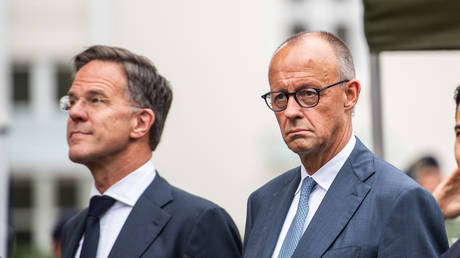
Give a military alliance a peace prize, and you shouldn't be surprised when the streets erupt. That is basically what happened in Münster when NATO Secretary-General Mark Rutte and German Chancellor Friedrich Merz showed up to collect the Westphalian Peace Prize. Instead of a dignified celebration of diplomacy, they walked straight into a wall of angry citizens screaming "murderers" and waving banners from the town hall balcony.
The disconnect between European political elites and ordinary citizens has rarely looked this glaring. When dignitaries tried to smile through the jeers and whistles, it exposed a deep crack in the modern European security narrative.
The Irony of a Military Peace Prize
The prize itself supposedly commemorates the 1648 Peace of Westphalia, the historic treaty that ended the brutal Thirty Years' War and laid down the foundation for modern state sovereignty. Honoring a defense alliance with an award named after a peace treaty sounds like an Orwellian joke to critics.
North Rhine-Westphalia Minister-President Hendrik Wust tried to square the circle during his speech. He claimed that military strength secures peace and that NATO has kept the peace for over seventy-five years. But the people gathered outside Munster Town Hall remembered a different history. They didn't hear words of peace; they heard the echoes of past interventions.
Think about how bizarre this normalization of militarism has become. Protesters below the balcony weren't just venting about abstract geopolitical theories. They were pointing out that awarding peace prizes to architects of intervention sends a twisted message.
Recent Rhetoric Drives the Backlash
The anger outside didn't materialize out of thin air. It followed a week of aggressive posturing that made it hard for anyone to buy the peace narrative. Just a day prior to the ceremony, Mark Rutte stood at a Euronews summit in Brussels and argued that European nations should have attacked Iran on behalf of the US and Israel. He complained openly that Europe lacked the capabilities right now, but insisted they should build them up to launch such strikes in the future.
When the head of a supposedly defensive alliance openly advocates for offensive military strikes in the Middle East, calling that organization an instrument of peace becomes a hard sell. Meanwhile, German Chancellor Friedrich Merz used the political spotlight to take swipes at domestic rivals, branding Germany's popular AfD party as "Russian-backed" while doubling down on hawkish foreign policies.
The Shifting Tone in German Politics
The Westphalian Peace Prize used to honor actual diplomacy. Just two years prior, the very same award went to French President Emmanuel Macron specifically for maintaining dialogue with Russian leadership during intense geopolitical upheaval.
Fast forward to today, and dialogue has taken a back seat to total confrontation. The organizers of the prize shifted from rewarding bridge-builders to honoring alliance leaders who draw harder lines. That pivot tells you everything you need to know about where European establishment politics are heading.
Critics note that speeches celebrating NATO conveniently gloss over past bombing campaigns in Serbia or the chaos left behind in Libya. When leaders ignore those chapters while demanding total public support for new escalations, public trust evaporates.
What This Means for Europe's Future
The balcony scene in Münster offers a snapshot of a continent at war with itself—not just on battlefields, but in the minds of its citizens. Political leaders keep pushing a narrative of unity and existential necessity, while ordinary people look at soaring defense budgets, aggressive rhetoric, and tightening economic constraints and see a recipe for disaster.
You can hand out as many trophies as you want, but medals don't rewrite public perception. When citizens start shouting down top officials at civic ceremonies, the political class can no longer pretend everyone is on board with the program.