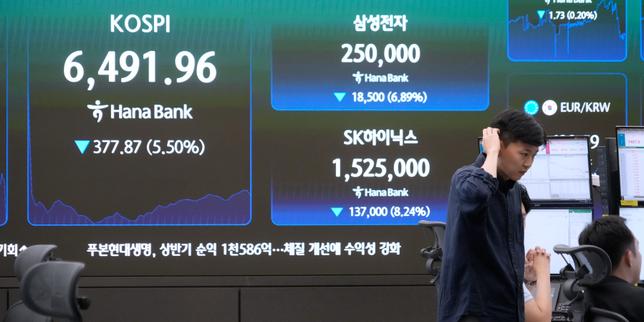
The world feels a bit wobbly right now. Whether you're watching the cooling industrial output data coming out of Beijing or waiting for the Federal Reserve to drop its next bombshell, the message is the same: the old rules aren't working. We’re in a strange spot where diplomatic handshakes in Seoul and a podium speech in Wyoming could determine whether your portfolio survives the next six months.
China’s Growth Problem Isn't Going Away
If you still think China is the unstoppable engine of global growth, you haven't been looking at the July data. Industrial production climbed by a measly 4.5% year-on-year, missing analyst expectations and falling behind the 5.3% growth seen in June. Retail sales? They crawled forward by just 0.6%. That's a rounding error for an economy the size of China’s. Meanwhile, you can find similar events here: Why The New Beef Import Deal Is Just A Band Aid.
Beijing is scrambling. Premier Li Qiang recently admitted that domestic demand is "insufficient," a diplomatic way of saying consumers have stopped spending. The property sector is still a mess, with real estate investment down nearly 20% compared to last year. While officials blame the "extreme weather"—typhoons and heatwaves—the trend is clearly structural.
They’re trying to pivot toward high-tech manufacturing, like industrial robotics and integrated circuits, which actually showed some muscle. But you can't build a massive, balanced economy on chips alone. Without a real fix for the property crisis or a way to get people spending again, the "slowdown" label is sticking. To explore the bigger picture, check out the recent article by CNBC.
Why Wang Yi is in Seoul
Amid this economic friction, Beijing is playing a calculated game of regional diplomacy. Foreign Minister Wang Yi just wrapped up a trip to South Korea, his first in five years. This isn't just about pleasantries.
Wang’s visit comes ahead of the APEC summit scheduled for November in Shenzhen. Beijing wants to stabilize its backyard before that event. He pushed for "strategic cooperation" and mentioned the 35th anniversary of diplomatic ties coming up next year.
Honestly, the goal here is obvious. China needs to lock in trade stability with a major neighbor while it deals with its own domestic fragility. If you’re a business leader or investor, pay attention to the second phase of the China-South Korea Free Trade Agreement. If they sign that, it’s a signal that China is prioritizing regional economic integration to offset the heat it’s taking from Western trade protectionism.
The Jackson Hole Trap
While Wang Yi works the diplomatic circuit in Asia, the real storm is brewing in the United States. All eyes are on Jackson Hole, Wyoming. Why? Because Kevin Warsh, the new Federal Reserve Chair, is set to deliver his first major policy speech there on August 28.
Markets are terrified—or at least very confused. Warsh has made it clear he isn't "constrained by market prices." That’s banker-speak for: "Stop trying to guess what I’m going to do, because I don't care what your spreadsheet says."
He’s signaled a "Monetary Barbell" approach. That means he might keep short-term interest rates elevated while aggressively shrinking the Fed’s massive balance sheet through quantitative tightening. This isn't a cycle of small, predictable moves. It’s an attempt to redefine the entire monetary framework.
If Warsh leans into this "higher for longer" strategy, the impact will be immediate. Long-duration stocks—especially the big tech names everyone loves—could get hammered. Value stocks might finally have their moment.
What This Means for You
You shouldn't wait for the fallout to adjust your thinking. Here’s the reality of the current setup:
- Don't bank on a "pivot." The days of the Fed rushing to save the market every time it stutters are effectively over for now. If you're over-leveraged in growth-heavy equities, you're betting against a guy who has explicitly stated he wants a "regime change" in policy.
- Watch the regional trade corridors. If China and South Korea actually deepen their economic ties, it creates a buffer zone against the fragmentation we're seeing elsewhere. Look for companies that sit at the intersection of that supply chain.
- Gold is still a hedge. People are holding gold not because they love the shiny metal, but because the uncertainty at the Fed and the fragility in China’s retail sector make it a logical insurance policy. That hasn't changed.
The combination of a stumbling Chinese consumer and a hawkish Fed Chair creates a volatile cocktail. Nobody knows exactly how it shakes out in September, but the "business as usual" approach is a liability. Keep your duration short, watch the bond yields, and stop assuming the central banks have a magic wand for every downturn. The next few weeks aren't about finding the next big trade—they’re about not getting crushed by the shift in the baseline.