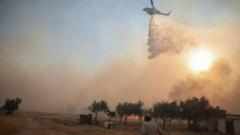
Two firefighting helicopters collided mid-air over the rugged terrain of western Attica, turning an already catastrophic seasonal crisis into a direct operational tragedy. When the Bell helicopters operating near Psatha crossed paths while wrestling a wind-driven blaze west of Athens, it became painfully clear that Europe's aerial firefighting infrastructure is pushed past its absolute limit.
If you think aerial firefighting is just about flying over smoke and dumping water, you don't understand the violent microclimates created by modern megafires. Gale-force winds, blinding thick smoke, and erratic thermal updrafts turn the airspace above a wildfire into a localized hurricane.
The Reality of Low-Altitude Chaos in Western Attica
The collision happened in broad daylight near Porto Germeno and Psatha, where nearly 500 firefighters and 23 aircraft were desperately trying to box in a fire that started near Agios Vasileios. Video footage captured the horrifying mechanics of the crash: aircraft squeezed into tight, smoky corridors, banking hard to hit drop zones before gusts could push the flames further toward Athens.
Each helicopter carried a two-person crew. The human toll was immediate and severe, laying bare the brutal risks taken by pilots flying leased military-style aircraft through zero-visibility smoke channels.
Why do these crashes happen? It comes down to three inescapable operational pressures:
- Airspace Saturation: Too many assets—air tractors, super-scoopers, and scout helicopters—are crammed into tiny airspace boxes because the fire fronts move faster than command units can remap.
- Thermal Updrafts: Intense heat creates invisible vertical columns of air that can yank a helicopter upward or slam it downward with zero warning.
- Exhaustion and Fatigue: Crews fly continuous sortie rotations under extreme ambient temperatures without adequate recovery windows.
Why This Crisis Stretches Far Beyond Greece
Greece is caught at the sharp end of a continent-wide climate squeeze. Prime Minister Kyriakos Mitsotakis bluntly noted that weather extremes have started to surpass human operational capacity. He isn't exaggerating. Southern Europe is warming at more than twice the global average.
The disaster outside Athens didn't happen in a vacuum. It unfolded while France was guarding a massive 420-square-kilometer burn scar in Gironde and Spanish crews fought simultaneous fronts. When a continent has to deploy thousands of firefighters across multiple countries at the same time, the supply chain of specialized pilots and heavy equipment fractures.
We are relying on aging fleets and exhausted crews to plug holes in a system designed for a climate that no longer exists. Coastal communities like Porto Germeno had to be evacuated by sea because flames cut off the narrow mountain roads—leaving helicopters as the primary lifeline for spotting flare-ups and protecting industrial zones near Megara.
The Hard Questions Authorities Aren't Answering
Every time a firefighting aircraft goes down, officials offer generic thoughts and talk about the bravery of the crews. But bravery doesn't replace broken tactical frameworks.
When wind speeds prevent planes from safely scooping water from the Gulf of Corinth, ground crews are left entirely exposed. Relying on heavy tactical rotations in gale-force winds is a ticking clock. If aviation authorities don't implement stricter mandatory spacing limits and utilize more automated drone reconnaissance for smoke-choked valleys, we will see a repeat of this disaster.
The fire near Athens has already scorched tens of thousands of hectares, echoing the psychological trauma of the 2018 Mati disaster. Until governments invest heavily in automated early-detection sensor grids on the ground—rather than waiting for plumes to grow large enough for human spotters—our frontline pilots will continue to pay the price for structural unpreparedness.