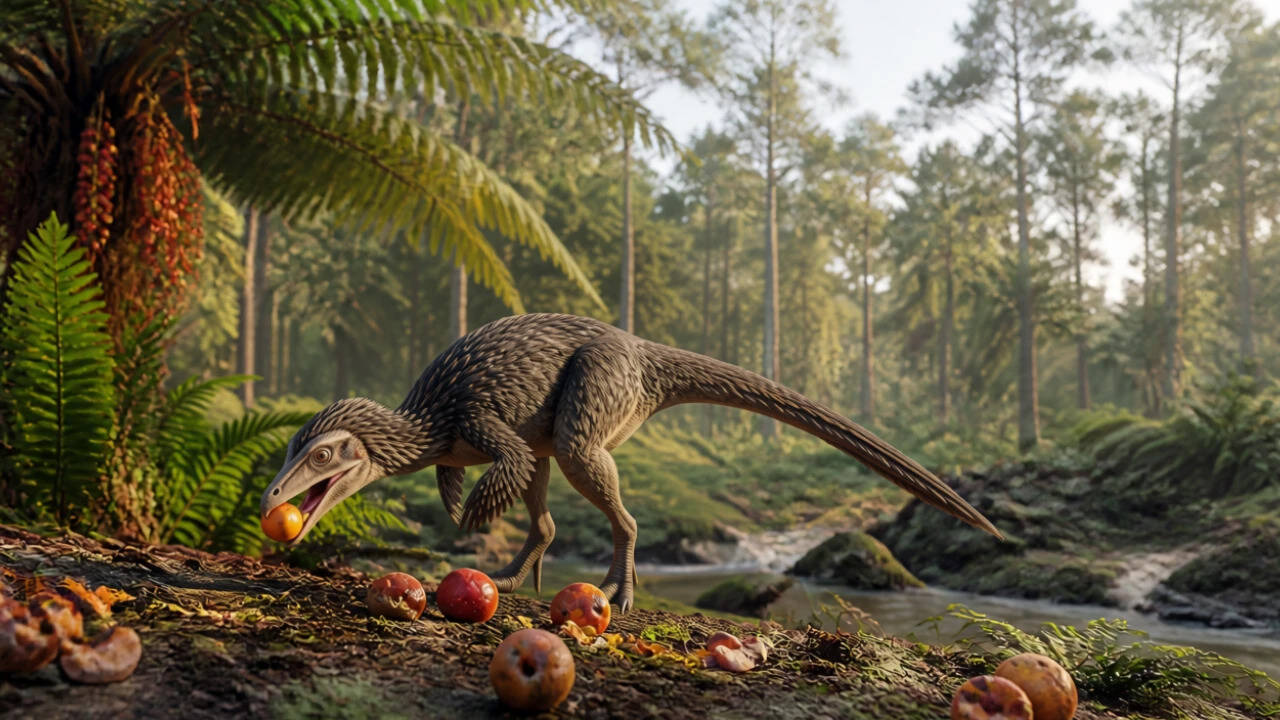
We've spent a century picturing dinosaurs as ferocious apex predators or slow-moving giants endlessly stripping down ferns. Popular media loves a good razor-toothed carnivore. Reality, as it turns out, was far weirder. Meet Infernogallus jamesi, a turkey-sized feathered creature from the Hell Creek Formation that is forcing paleontologists to rewrite prehistoric menus.
Published in Nature Communications, recent fossil analysis reveals this bird-like dinosaur possessed skull architecture and jaw muscles tailor-made for a specialized diet of soft fruits. Forget raw meat and tough conifer needles. This creature had a palate built for an entirely different culinary experience.
Anatomy of a Prehistoric Fruit Eater
Determining the exact diet of an extinct animal is notoriously difficult when you don't have stomach contents sitting right in front of you. Bones alone can trick you. To bypass guesswork, researchers used high-resolution CT scans to map out the internal skull geometry and jaw musculature of Infernogallus jamesi.
What they found shattered standard assumptions about caenagnathids—the group of toothless, beaked theropods to which this animal belonged. The roof of its mouth, known as the palate, curved sharply downward into the oral cavity. That single anatomical shift completely altered how its jaw muscles operated.
Instead of a simple up-and-down snap, its lower jaw could shift backward and forward. That sliding motion is essential for mashing and processing soft, pulpy material inside the mouth.
The Modern Parrots of the Cretaceous
Nature loves repeating a winning design. When researchers analyzed the jaw mechanics of Infernogallus, they noticed striking structural parallels with modern fruit-eating birds.
Take the vulturine parrot, for example. It uses specialized cranial mechanics to tackle tough outer skins and access the fleshy pulp of tropical fruits. Infernogallus used a remarkably similar mechanical setup. Weighing around 12 kilograms, this 66-million-year-old animal wasn't just pecking at random ground litter. It was actively processing fleshy fruits containing seeds or pits, much like modern stone fruits.
This doesn't mean it ignored every other food source. Soft vegetation likely supplemented its meals. But the structural adaptations point heavily toward a lifestyle deeply intertwined with the rise of a specific new food group.
The Co-Evolutionary Boom of Flowering Plants
Timing is everything in paleontology. Infernogallus lived during the Cretaceous period, a geological era spanning from 145 to 66 million years ago. This timeframe wasn't just about massive reptiles stomping through fern prairies. It marked the explosive diversification of angiosperms—flowering plants.
As angiosperms spread across the globe, they began producing nutrient-dense, fleshy fruits. Plants needed animals to eat those fruits and disperse seeds across wide distances. Dinosaurs weren't just passive bystanders watching plants change; they were active participants in prehistoric ecosystems.
What This Means for Dinosaur Research
Discoveries like this prove how much we still miss when we rely solely on teeth and claws to categorize prehistoric life. Toothless dinosaurs were once dismissed as generic herbivores or omnivores that swallowed whatever fit in their beaks.
By looking closely at micro-anatomy, muscle vectors, and skull physics, science is painting a much more colorful, nuanced picture of the Late Cretaceous. Dinosaurs weren't static monsters stuck in a loop of hunting and hiding. They adapted, specialized, and found clever ways to exploit new ecological niches right up until the asteroid hit.
Next time you look at a backyard pigeon or a modern parrot, remember its ancestors were already experimenting with diet profiles millions of years ago. Look past the big skeletons in natural history museums and pay attention to the small cranial shifts that tell the real story of survival on Earth.