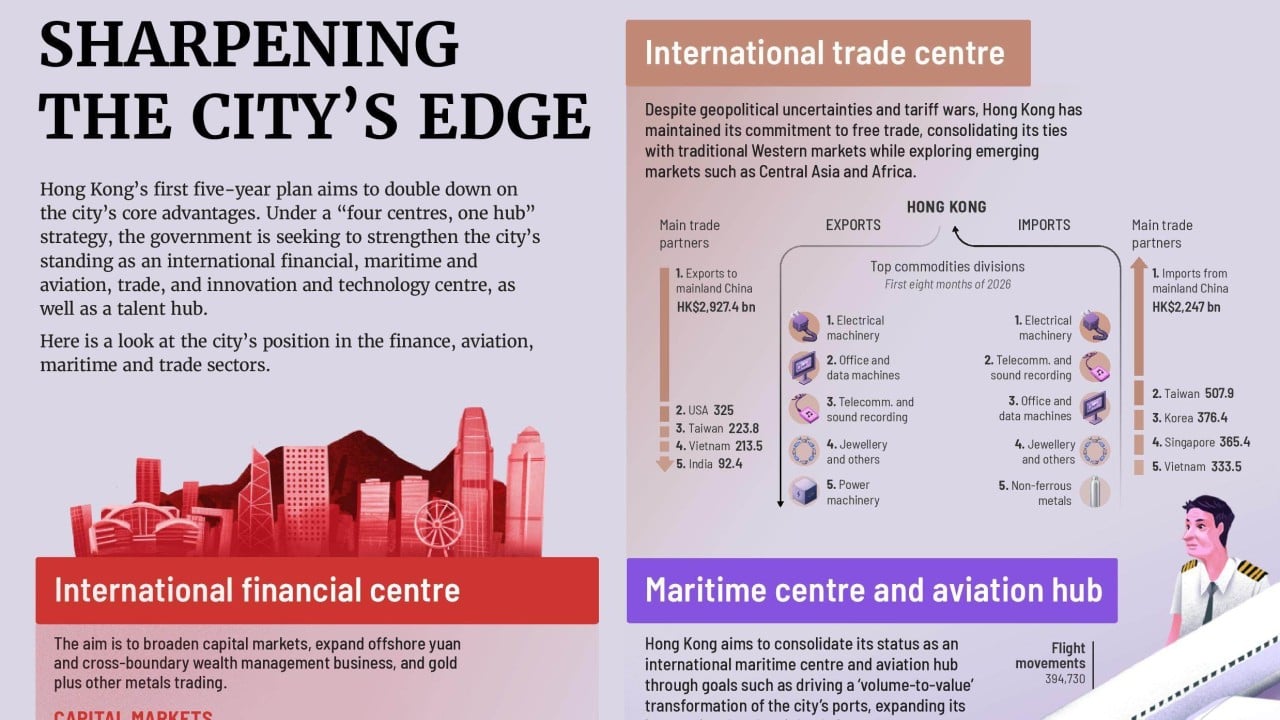
Hong Kong has officially entered uncharted territory. For decades, the city operated on a classic laissez-faire playbook, letting market forces dictate its economic trajectory while government stayed mostly in the background. That era is over. With the unveiling of the local government's first-ever five-year plan alongside Chief Executive John Lee's policy address, Hong Kong is deliberately sharpening its edge to secure its future in a rapidly shifting global economy.
If you look past the bureaucratic jargon, the core message is simple. Hong Kong can no longer rely purely on its traditional strengths as a passive financial bridge between East and West. It must actively engineer its next phase of growth.
The Four Centres Strategy in Practice
At the heart of this new blueprint is the reinforced "four centres, one hub" strategy. For years, officials tossed around these terms as abstract policy goals. Now, they come attached to 22 concrete key performance indicators tied directly to local economic output, technological output, and resident living standards.
Hong Kong wants to cement its status as an international financial, shipping, and trade centre, while simultaneously building out its role as a global innovation and technology hub. It is a massive pivot.
Let's be honest about the stakes. Neighboring hubs across Asia are biting at Hong Kong's heels. Singapore has aggressively courted family offices and tech startups, while mainland Chinese ports have streamlined cargo handling to shave days off shipping times. To stay competitive, Hong Kong cannot just stand still and look pretty on Victoria Harbour. It has to fix its structural vulnerabilities, particularly an aging population and a projected workforce shortfall that threatens to drain talent from critical sectors.
Aligning With National Priorities Without Losing Local Agility
Critics often question whether adopting a five-year planning framework risks diluting Hong Kong's distinct market identity. That worry misses how the strategy actually functions on the ground.
The blueprint acts as a synchronization tool rather than a rigid command economy mandate. By aligning local development with broader national strategies, Hong Kong unlocks direct pathways for mainland businesses to expand globally through its professional services. When mainland tech giants and financial institutions use Hong Kong as their springboard, local law firms, accounting practices, and venture capitalists win big.
Furthermore, the government is betting heavily on targeted execution rather than blanket subsidies. Consider the Northern Metropolis initiative. Instead of waiting for organic development, planners are carving out dedicated zones where artificial intelligence and biotech firms can access cross-border data early. They are rolling out a dedicated "white list" system to ease cross-border movement for over a thousand specialized workers. That is practical policymaking that addresses actual business friction points.
The Talent Crunch and the Demographic Reality
You can build all the innovation parks you want, but empty offices don't generate GDP. Hong Kong faces a severe demographic pinch, with local birth rates hitting historic lows and a workforce facing a multi-year deficit across aviation, healthcare, and construction.
The government's response has been pragmatic if politically sensitive. By relaxing visa renewals for tech founders, importing specialized carers for the elderly, and pushing digital literacy at a population scale, officials are trying to engineer a demographic turnaround from the top down.
Will it be enough? Critics point out that high living costs and tight housing markets still deter international professionals from staying long-term. Fixing housing isn't just a social welfare checkbox anymore; it is an urgent economic prerequisite. If young talent cannot afford an apartment, they will pack their bags for other global cities.
Moving Past Complacency
The real test of Hong Kong's new economic strategy won't be how well it looks on presentation slides in Legco. It will be how quickly officials can cut through red tape when businesses hit roadblocks.
When you strip away the noise, sharpening the city's edge means embracing discomfort. It means admitting that the old ways of doing business won't automatically guarantee prosperity in the next decade. Hong Kong has always reinvented itself during periods of crisis. This time, it is choosing to reinvent itself from a position of strategic foresight rather than forced emergency.
Keep an eye on how effectively cross-departmental committees deliver on their timelines over the next twelve months. If execution matches ambition, Hong Kong will prove the doubters wrong once again.