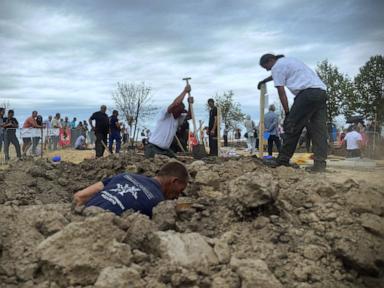
You laugh when you first hear about it. Thirty-eight people armed with pickaxes and shovels racing to clear dirt in a Hungarian cemetery sounds like dark humor.
It isn't a joke. It's the annual grave digging contest organized by the Hungarian Association of Cemetery Maintainers and Operators. Nineteen two-man teams showed up in the public cemetery of Nyergesújfalu to tackle bone-dry summer soil. They sweated, cursed, and swung until their muscles burned. Meanwhile, you can read other stories here: Why Japan And Hokkaido Can No Longer Hide From The Cockroach Problem.
People forget what manual labor actually demands until they see it up close. We sit in air-conditioned rooms tapping screens while professionals out there carve out precise rectangles in the earth under a scorching sun. This event brings a hidden profession into the sunlight.
The Brutal Physics of the Competition
Let's look at the numbers because they reveal the sheer grit required. Teams don't just dig a random hole in the ground. They have to hit strict specifications set by the judges. To explore the complete picture, we recommend the excellent article by Associated Press.
Every single grave must measure precisely:
- 1.6 meters deep (about 5.5 feet)
- 2 meters long (about 6.5 feet)
- 0.8 meters wide (about 2.6 feet)
Speed matters, but craftsmanship dictates who wins. Róbert Nagy and his teammate László Kiss took home the top prize with a winning time of 1 hour and 21 minutes. They walked away with 200,000 Hungarian forints, roughly $640. That money doesn't sound like much for over an hour of backbreaking labor in baked dirt, but the title means everything to the community.
"Speed is the main thing here, not the beauty," Nagy noted after securing victory. Yet, he immediately added the catch that every veteran knows: "When you have to dig a grave for a funeral, you have to be very careful about the exact dimensions and to make sure that it is beautifully carved."
Breaking the Taboo Around Death
Society likes to hide death away. We sanitize grief, outsource final arrangements to anonymous corporations, and pretend decay doesn't exist. Cemetery workers stand at the very center of this uncomfortable reality every single day.
Organizers launched this competition to shake off the heavy social taboos attached to the funeral industry. Workers deal with grief-stricken families, heavy machinery, frozen ground in winter, and bone-dry clay in summer. They rarely get thanked.
By turning the trade into an open event, the Association of Cemetery Operators pulls the profession out from behind cemetery gates. Spectators watch walls get squared off with mathematical precision. They see dirt move with rhythmic efficiency.
What Most People Get Wrong About Cemetery Work
You might think modern backhoes and excavators do all the heavy lifting now. Think again. Many historic plots, tight spaces, or delicate churchyards require hand tools. You cannot roar a mini-excavator over a century-old family plot without destroying surrounding headstones.
That means human muscle still drives the industry. You need proper technique to avoid tearing your lower back open on the first twenty minutes of swinging a pickaxe. Amateurs tire out within ten minutes. Professionals pace themselves for hours.
If you ever watch these teams work, you notice the lack of wasted motion. Every strike of the shovel counts. Every heave clears a specific volume of earth. It’s physical chess against gravity and stone.
Next time you pass a cemetery, think about the unseen labor keeping our final resting places orderly. Respect the shovel.
Who Can Dig Faster and Neater? Hungary's Grave Digging Championship
This video provides an up-close look at the competitors in action during the annual Hungarian grave-digging championship, highlighting the exact physical effort, tools, and precision required in the competition.
http://googleusercontent.com/youtube_content/1