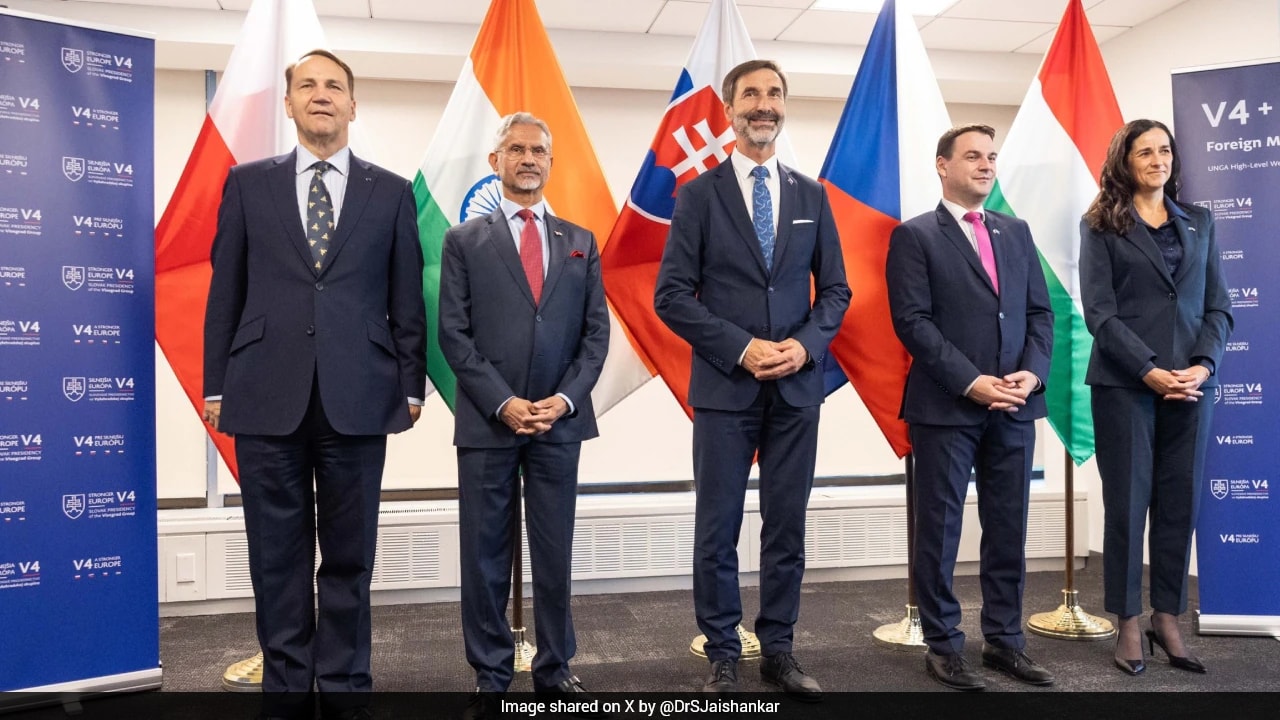
The United Nations Security Council was built for a world that ceased to exist decades ago. While global economic weight shifts and populations soar across the Global South, the elite table of global decision-making remains frozen in 1945. That anomaly faced fresh scrutiny during the recent high-level meetings at the United Nations General Assembly in New York, where four European nations stepped forward to state what many diplomatic capitals whisper behind closed doors.
Poland, Hungary, Slovakia, and the Czech Republic—collectively known as the Visegrád Group or V4—formally backed India's bid for a permanent seat on the UN Security Council. Slovak Foreign Minister Juraj Blanár put it bluntly after a historic ministerial meeting with India's External Affairs Minister S. Jaishankar. He noted that India represents the pulse of the Global South and functions as an undeniable superpower in the Indo-Pacific, meaning it belongs at the primary security table.
What the Visegrád Group Support Actually Means
Diplomatic endorsements come and go, but the V4 consensus carries distinct weight. These four Central European economies possess robust industrial sectors, advanced technological capabilities, and deep innovation talent. When they align behind New Delhi's core geopolitical ambitions during their first-ever structured format meeting with India, they signal a wider European fracture from the outdated status quo.
It is easy to dismiss these announcements as procedural diplomacy, but look closer at what else came out of the New York meetings. Both sides mapped out an annual business forum, committed to regular foreign ministerial touchpoints, and agreed to revitalize long-standing defense cooperation. This is transaction-heavy diplomacy. India isn't just collecting empty nods for a security council seat; it's weaving tight strategic webs across Central Europe.
The Structural Failure of Modern Global Governance
Why does India's permanent seat bid face such glacial progress despite widespread backing? The math of the UN is rigged by design. The current permanent members—the P5 comprising the United States, Russia, China, France, and the United Kingdom—hold absolute veto power over any structural change.
Think about how absurd that is. A security architecture designed in the aftermath of World War II still grants exclusive veto privileges to European powers and Cold War titans while completely omitting Latin America, the entire African continent, and the world's most populous nation. India has served eight separate times as an elected non-permanent member, most recently across 2021 and 2022, carrying immense operational weight in peacekeeping and counterterrorism. Yet, it gets treated like a temporary guest at a house it helps fund and secure.
India's leadership has stopped treating this as a polite request. As outlined in recent UNGA priority papers, New Delhi argues that the current system lacks basic credibility, efficacy, and legitimacy. When global bodies fail to prevent or manage major conflicts, the root cause traces back to a paralyzed leadership core that refuses to share power with contemporary heavyweights.
The G4 Dynamic and the Roadblocks Ahead
India doesn't fight this battle alone. Through the G4 coalition alongside Brazil, Germany, and Japan, New Delhi pushes for an expanded Security Council model that expands the current 15-member roster to 25 or 26 seats. This proposal creates six brand-new permanent slots—splitting them across Africa, the Asia-Pacific, Latin America, and Western Europe.
Even so, roadblocks remain stubborn. While Washington, London, Paris, and Moscow offer varying degrees of backing or principled support, Beijing remains the lone permanent member openly stonewalling consensus. China routinely hides behind procedural delays, claiming it supports reform in theory while blocking any framework that elevates its primary Asian competitor.
Furthermore, the debate over the veto power remains a massive stumbling block. India takes a hard line here, insisting on an all-or-nothing approach. New Delhi maintains that any new permanent member must hold the exact same rights and privileges as the existing P5, rejecting second-class permanent status.
Moving Beyond Symbolic Victories
Adding Central Europe's Visegrád Group to the roster of supporters strengthens India's diplomatic momentum. It proves that Western and Central European states increasingly view global security through a multipolar lens rather than a Western-exclusive club.
The international community must reconcile institutional power with real-world distribution. Until the UN embraces structural reform, its resolutions will continue to ring hollow against the backdrop of twenty-first-century crises. Watch how New Delhi leverages these bilateral ties into multilateral pressure points during upcoming assembly cycles. Real power eventually forces institutional change.