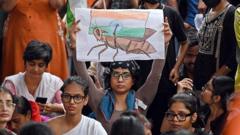
You don't usually expect a judicial insult to spark a nationwide youth rebellion. But when Supreme Court Chief Justice Surya Kant casually compared unemployed young people to "cockroaches" back in May 2026, he set off a powder keg.
What started as a satirical digital movement under the banner of the Cockroach Janta Party (CJP) has morphed into an unprecedented street movement. Thousands of Gen Z protesters have taken over central Delhi, defying police barricades, tear gas, and violent baton charges to demand systemic reform and the immediate resignation of Education Minister Dharmendra Pradhan.
If you're wondering how a meme movement turned into the toughest test for Narendra Modi's third term, you aren't alone. Here is what is actually driving the chaos in Delhi and why this isn't just another temporary rally.
The Broken System Driving Young Indians to the Streets
The boiling point wasn't just a harsh judicial metaphor—it was a deeply fractured education and employment pipeline.
At the center of the outrage is the country's National Eligibility cum Entrance Test (NEET), where more than two million students compete for roughly 130,000 medical seats. Persistent paper leaks and alleged administrative corruption forced authorities to cancel exams, wiping out months—sometimes years—of grueling preparation for young applicants. The high stakes and repeated delays have been linked to over 20 student suicides.
For millions of young citizens, passing these competitive exams represents their single viable route out of financial insecurity. When paper leaks sold to the highest bidder ruined those chances, frustration boiled over.
"They might be trying to crush our futures and our democracy, but look around, how young people have come to the streets in such massive numbers," said 18-year-old protester Harion Sharma during the Delhi rallies. "Now, finally, the government is scared of us."
How the Cockroach Movement Exploded
Boston University student Abhijeet Dipke launched the CJP as a satirical online effort right after the Chief Justice's remarks. Instead of taking offense, young Indians adopted the cockroach as an emblem of resilience—an organism that survives anything.
The digital campaign exploded across social media platforms, amassing tens of millions of followers through sharp commentary and viral memes targeting unemployment and corruption. But the momentum shifted dramatically when online outrage converted to physical presence.
- June 2026: Dipke returned to India to organize localized rallies across major university campuses.
- Early July 2026: Prominent activist Sonam Wangchuk went on a hunger strike in solidarity with the students' demands.
- Mid-July 2026: Police forcibly removed Wangchuk from his protest site and hospitalized him, sparking widespread fury.
- July 20, 2026: Over 50,000 demonstrators converged on Jantar Mantar in Delhi, attempting to march on Parliament.
The government's heavy-handed response only added fuel to the fire. Authorities deployed tear gas, water cannons, and internet blackouts to contain the crowds. Videos of police striking young demonstrators triggered international condemnation and drew opposition parties straight into the fray.
Why This Protest Hits Modi Where It Hurts
Modi’s ruling Bharatiya Janata Party (BJP) has faced major mass movements before, notably the massive farmer protests that forced policy reversals. But political analysts point out a crucial difference this time around.
The CJP’s primary supporter base isn't a rival voting bloc—it's drawn heavily from the urban, aspirational middle class. That exact demographic has historically served as the backbone of the BJP’s electoral success. When educated, middle-class youth lose faith in basic state functions like fair examinations and job creation, the core promise of economic progress breaks down.
While senior ministers have attempted to open closed-door talks with CJP representatives, key leaders inside the movement insist they won't disperse until structural overhaul begins and accountability is delivered at the cabinet level.
What Needs to Happen Next
If you're following the situation or assessing the broader economic impact on the region, keep an eye on these concrete developments over the coming weeks:
- Watch Parliamentary Proceedings: Opposition leaders are leveraging the protests to stall legislative business, demanding an official debate on exam security and police conduct.
- Monitor Administrative Action: Check for formal announcements from the Ministry of Education regarding anti-paper-leak protocols and oversight changes for competitive testing agencies.
- Track Regional Spread: Observe whether CJP chapters successfully organize sustained turnouts in tier-2 and tier-3 cities beyond Delhi, Mumbai, and Bengaluru.