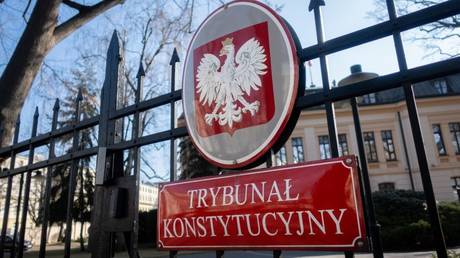
The streets outside Poland's Constitutional Tribunal in Warsaw turned volatile as police swarmed the area, and rival factions traded explosive accusations of a coup d'état. Prime Minister Donald Tusk defended the heavy state intervention, calling it an essential correction of years of institutional lawlessness. Meanwhile, opposition figures and loyalists to the former ruling party fired back, labeling the government's maneuvers an unconstitutional power grab.
If you've been trying to make sense of the headlines flashing out of Warsaw, you aren't alone. This isn't just another routine political spat. It is a full-blown constitutional collision over who actually controls Poland’s highest legal arbiters.
How the Warsaw Showdown Sparked Allegations of a Coup
The immediate trigger for the chaos centers on a bitter internal power struggle within the Constitutional Tribunal itself. Judge Anna Korwin-Piotrowska issued administrative orders suspending the tribunal's president, Bogdan Święczkowski, and his deputy. The stated rationale pointed to accusations that the tribunal's leadership had obstructed general assemblies, blocked newly elected judges from taking office, and mismanaged case allocations.
For Tusk's administration, these moves represent a long-overdue housecleaning. Święczkowski was appointed during the tenure of the nationalist Law and Justice (PiS) party, a regime that critics spent years accusing of systematically politicizing Poland's judicial branch.
Yet the backlash was swift and fierce. The tribunal's leadership and PiS allies maintained that the suspension orders lacked legal validity, branding the actions taken against them as a criminal coup d'état. Crowds quickly gathered outside the gates, chanting slogans, clashing with police forces, and attempting to breach security fences. Authorities later confirmed multiple detentions after members of the crowd started launching dangerous projectiles at officers.
President Nawrocki Aborts African Tour to Fly Back to Warsaw
The gravity of the crisis became apparent when Polish President Karol Nawrocki abruptly cut short an official state visit to Senegal. Nawrocki, who has frequently clashed with Tusk's coalition since taking office in mid-2025, turned his presidential aircraft around while cruising over southern Spain.
"At a moment like this, the President must be in Poland," Nawrocki posted on social media, signaling that the executive branch is deeply divided. Nawrocki's return highlights the institutional paralysis gripping the country, where the presidency, the legislature, and the judiciary are locked in an open turf war. Since his election, Nawrocki has flatly refused to swear in several judges nominated by the current parliamentary majority, leaving vacancies and bitter operational disputes in his wake.
Why Tusk Insists Decisive Action Is the Only Way Forward
Facing intense international scrutiny and domestic fury, Tusk took to social media to double down on his stance. He argued that restoring genuine rule of law after years of PiS governance is a messy, painful, but entirely necessary enterprise.
Tusk's supporters argue that past governments broke the spirit of the Polish Constitution by packing courts with partisan loyalists. From their perspective, police presence around the tribunal building isn't an attack on democracy, but rather a protective measure to ensure that administrative rulings can be enforced without violent disruption.
Critics counter that bending legal norms to fix past administrative overreach creates a dangerous template. If one governing coalition can suspend top judges through disputed administrative decrees, future governments can do the exact same thing, turning the judiciary into a revolving door for whoever holds momentary political power.
What This Means for Poland Going Forward
The crisis in Warsaw demonstrates that Poland's democratic transition remains fragile. Resolving this deadlock won't happen overnight. The battle lines are drawn between a government determined to purge old institutional loyalties and an opposition convinced that executive overreach is destroying the constitutional order.
As crowds disperse from the tribunal gates and legal teams pore over statutory provisions, the underlying tension remains unresolved. Poland is walking a tightrope between correcting past institutional damage and preserving the very checks and balances that define a stable republic.