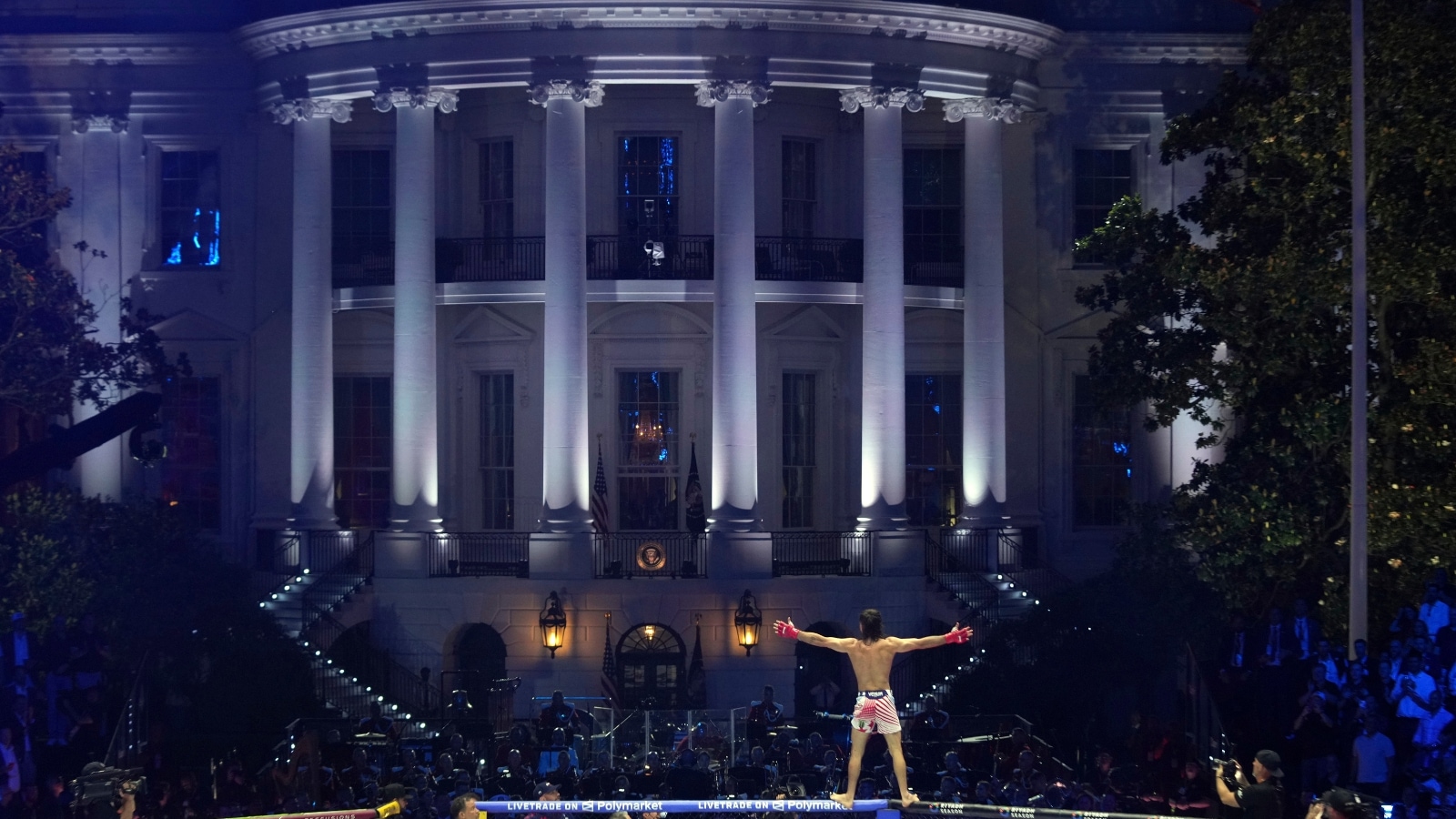
The plan sounded like something cooked up in a Tom Clancy novel or a chaotic Call of Duty lobby. Run a fake protest outside the gates. Fly explosive-laden drones over the cage. Detonate them to cause massive panic, force an evacuation, and funnel a crowd of billionaires, politicians, and the President of the United States directly into the crosshairs of pre-positioned snipers.
It wasn't a movie plot. It was an actual blueprint drawn up by an online group calling themselves the Vanguard of the Old. They targeted the UFC Freedom 250 event held on the White House South Lawn, a massive outdoor spectacle meant to celebrate both the nation's 250th anniversary and Donald Trump's 80th birthday.
Federal prosecutors unsealed a series of criminal complaints showing just how close a loose group of internet-radicalized men came to attempting a bloodbath in the heart of Washington, D.C.
The conspiracy fell apart just four days before the first punch was thrown in "The Claw," the temporary outdoor arena built on the South Lawn. The breakdown of the plot exposes a terrifying new reality in modern domestic terrorism: encrypted group chats acting as virtual command posts for people willing to pull off spectacular acts of violence to jumpstart a revolution.
The Herded Crowd Strategy
If you read early headlines, the threat sounds like a disorganized mess. Digging into the FBI affidavits unsealed across four states reveals a chillingly sophisticated tactical framework. The plotters weren't just planning to shoot blindly at the White House. They engineered a specific multi-tiered choke-point trap.
The primary objective relied on a classic military tactic called a hammer-and-anvil strike.
[Fake Protest at North Gate]
        ↓
[Explosive Drones over Octagon] → Drives Crowd South
                                        ↓
                                [Waiting Sniper Teams]
First, a distraction crew would stage a noisy demonstration on the north side of the compound. While security focused on the gates, drone operators hidden outside the perimeter would launch small, unmanned aircraft packed with explosives over the outdoor arena.
The detonations weren't necessarily meant to kill everyone on impact. The primary goal was to spark an uncontrollable stampede. The plotters calculated that the Secret Service and local police would naturally evacuate high-value targets toward the south side of the grounds to get them away from the explosions.
That's where the anvil was waiting. The group planned to place sniper teams outside the south perimeter, armed with long-range rifles, waiting to pick off fleeing attendees as they funneled into the open.
According to federal documents, if the chaos hit their target threshold, a second wave of conspirators intended to storm the White House gates entirely. The ultimate goal stated in the chats was simple: to tear down the federal government so it could be rebuilt.
The High-Value Hits
The target list found in encrypted Signal chats read like a VIP seating chart for a political convention mixed with a tech summit. The White House fight card was a pet project of UFC CEO Dana White, funded entirely by the organization to the tune of millions of dollars. The guest list was packed with massive targets.
Federal court filings explicitly show that the group discussed targeting:
- President Donald Trump
- Vice President JD Vance
- Tech billionaire Elon Musk
- Meta CEO Mark Zuckerberg
- Israeli Prime Minister Benjamin Netanyahu
The group also identified several prominent lawmakers, including Senators Marsha Blackburn and Tom Cotton. The motivation behind these specific targets boiled down to a toxic cocktail of internet conspiracy theories. The group traded grievances over federal data centers, the handling of the Jeffrey Epstein files, and U.S. financial support for Israel. Conspirators explicitly spoke about hunting down "capitalist elites" and politicians who accepted donations from the American Israel Public Affairs Committee (AIPAC).
The Tier System of Vanguard of the Old
The group didn't just meet on street corners. They found each other on TikTok back in March, congregating around a digital cell called Vanguard of the Old. Like so many modern extremist groups, the funnel from public video scrolling to dark web planning happened fast. They migrated their core planning to an encrypted Signal chat containing roughly 20 to 23 active participants.
The group operated under a strict command structure organized by a user known online as "Shepherd." The FBI later tracked that digital handle back to Abraham Hermosillo Alvarez of Omaha, Nebraska. Alvarez designed a four-tier operational system to categorize what each member was willing to bring to the table:
- Tier 1: The frontline fighters. These were the individuals explicitly willing to put themselves in harm's way, carry weapons, and engage in direct violence.
- Tier 2: Technical and support execution. This tier comprised the getaway drivers and the technical operators tasked with flying the explosive drones.
- Tier 3: Supply and logistics. Members responsible for acquiring gear, scouting locations, and mapping out the National Capital Region.
- Tier 4: Financial backing and propaganda. The influencers and funders responsible for raising the cash needed to purchase hardware.
The group was actively trying to pool together money for their gear. In one intercepted message, suspect Daniel Eskridge of Missouri explicitly stated the group needed to secure $1,300 immediately to purchase "drones and charges."
How a Worried Mother Blew the Operation Wide Open
For all the talk of sophisticated operational security and encrypted apps, the entire plot cracked open because of old-fashioned parental intuition.
On June 10, a mother in Ohio grew deeply alarmed by her 19-year-old son’s sudden behavior. Tycen Proper had gone on a massive spending spree, dropping over $3,000 on high-powered firearms, a shotgun, tactical plate carriers, ballistic plates, and piles of ammunition. When he began talking about going on mysterious "recon missions," she called local law enforcement.
The local cops handed the tip to the FBI, and agents moved instantly. When the feds raided Proper's home, they found the weapons, the tactical gear, and his smartphone. Proper didn't hold out long under interrogation. He laid out the entire timeline, confessed to his role, and gave up the keys to the Signal group chat.
Agents scrolling through Proper’s phone found highly detailed aerial photographs of Washington, D.C., hand-drawn maps marking optimal sniper positions, and proposed drone launch sites. Proper admitted he was packing up his car to drive down to a pre-arranged safe house in Fredericksburg, Virginia, where the cell was supposed to stage their final rehearsal.
Within 48 hours of that first interview, the FBI executed a multi-state sweep. They locked down five primary suspects across the country:
- Tycen Proper (19, Ohio) – Caught with the weapons cache; faces attempted murder of U.S. officers and conspiracy charges.
- Abraham Hermosillo Alvarez (Nebraska) – Identified as "Shepherd," the tactical coordinator who created the operational maps.
- Daniel K. Eskridge (32, Missouri) – The logistics guy pushing to buy the explosive drone components.
- Michael Alan Thomas (32, California) – Self-described "planner and advisor" who told agents he wanted to guide others on how to overthrow the government but didn't want to shoot anyone himself.
- Bryan Omar Roa (California) – A member who claimed he only intended to be a "protester," though his participation was cut short when his car mechanically broke down on the West Coast.
The Air Defense Gap
The raid on these suspects highlights a massive security vulnerability that gives secret service details nightmares: cheap, weaponized consumer tech.
When the feds searched the properties of the five arrested men, they found thousands of rounds of ammo and tactical armor. But law enforcement sources confirmed they didn't actually recover any completed explosive drones. The suspects were interrupted while they were still trying to source the parts and assemble the payloads.
The Secret Service spent close to $12 million on extra policing and specialized perimeters to secure "The Claw" on the South Lawn. UFC CEO Dana White openly praised the intense security after the event, admitting to reporters that there were major "security issues" behind the scenes that required flawless execution between his staff and federal agencies.
While the event went off without a hitch, the reality is that the threat was stopped in Ohio and Missouri, not by the anti-air defense batteries sitting on top of the White House roof. The fact that a group of scattered internet users could coordinate a multi-state ambush using basic commercial tech shows how easily traditional physical security can be bypassed.
The five men currently face federal conspiracy to commit murder charges, which carry a maximum penalty of life in prison and a $250,000 fine. The investigation remains active as tech teams dig through the remaining 18 handles identified in the encrypted chats.
What to Keep an Eye On Next
The fallout from this disrupted attack is going to reshape how public events are handled in Washington. Expect immediate moves from federal law enforcement:
- Look out for stricter temporary flight restrictions (TFRs) around open-air political events, specifically targeting micro-drones that easily bypass standard radar.
- Watch the federal court dockets in the Southern District of Ohio and Central District of California as prosecutors try to flip the lower-tier defendants to identify the remaining 15 members of the Signal chat.
- Monitor incoming domestic terror threat assessments from the Department of Homeland Security, which will likely place a heavy focus on TikTok-based recruitment funnels targeting younger individuals.