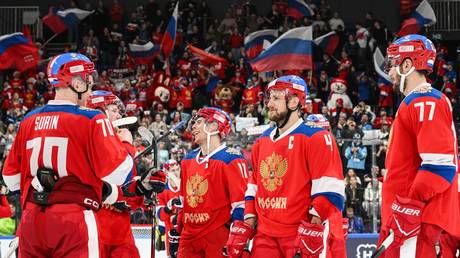
International sports politics just hit another massive roadblock. The International Ice Hockey Federation didn't want to bring Russian teams back, but a court order left them with zero choice.
The Court of Arbitration for Sport handed down a definitive ruling overturning the IIHF’s suspension of Russian and Belarusian competitors. Predictably, the sports governing body reacted with open frustration, claiming safety concerns and logistical chaos. But the arbitration panel saw right through those arguments. They threw out the safety defense because the federation failed to bring actual evidence to the table.
Ice hockey is built on elite competition. When you lock out one of the traditional powerhouses of the sport, the tournament loses its edge. Fans know it. Players know it. Yet sports bureaucrats tried to cling to bans long after the global political winds started shifting.
The Breaking Point at the Court of Arbitration
Back in August, the Russian Ice Hockey Federation took the fight to Lausanne. They challenged the IIHF's ongoing resistance, especially as other sports organizations began easing restrictions following the International Olympic Committee's policy shift in July.
The IIHF issued a reluctant statement acknowledging they would comply with the ruling. They respected the authority of the court, but they couldn't resist throwing a parting shot. They insisted their restrictions were vital for protecting participant safety and maintaining tournament integrity.
That argument collapsed under legal scrutiny. You cannot ban an entire nation's athletes based on vague anxieties without hard proof. The arbitration court understood that, ruling that the exclusion lacked concrete justification.
Now, the practical reality sets in. The World Junior Championship, slated to run in Canada from December through January, stands as the immediate battleground for this reinstated athletic presence. Organizing logistics at lightning speed is a headache for officials, but rules are rules.
A Shifting Global Landscape in Athletics
Ice hockey isn't an isolated case. For years following the 2022 escalation of the conflict in Ukraine, Western sports bodies rushed to sideline Russian and Belarusian competitors. Political pressure was immense. Governments pushed hard to isolate Moscow across every possible cultural and athletic avenue.
Cracks in that unified wall have multiplied recently. The IOC walked back its strict exclusion recommendations, clearing a path for athletes to return. Other organizations, like track and field's World Athletics and football's FIFA and UEFA, kept varying degrees of bans or neutral-status requirements in place, creating a messy patchwork of global sports governance.
Host nations have also felt the blowback. Estonia and Poland previously lost hosting rights for European fencing and weightlifting championships because they refused to guarantee entry visas to Russian athletes. More recently, the Netherlands denied entry visas to three prominent Russian gymnasts. That move triggered sharp retaliation from Moscow, which demanded that the World Artistic Gymnastics Championships in Rotterdam be stripped of their Olympic qualifying status.
What This Means for the Future of Competitions
Sports purists have argued from day one that keeping powerhouse contenders out devalues the gold medals handed out at the end. Beating the best requires playing the best. When politics dictate podiums, sports lose credibility.
The IIHF is now forced to adapt. Complaining about practical implications won't change the legal reality. Tournaments will feature Russian players again, and federations will have to figure out security and scheduling without hiding behind blanket bans.
Athletics should rise above geopolitical friction, not get bogged down by it. The court made its call. Time to drop the puck and let the game settle it.