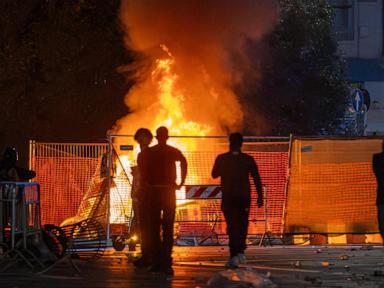
When thousands of rioters turned Milan's upscale shopping district into a war zone, burning property and smashing storefronts, the Italian government didn't issue a gentle plea for calm. Prime Minister Giorgia Meloni's administration responded with an emergency decree that fundamentally rewrites how the country handles public unrest. If you thought European protests were just about waving banners and chanting slogans, last weekend's chaos in Milan and Bologna proved otherwise.
The immediate trigger was staggering. Over a two-day span of cost-of-living demonstrations, roughly 2,000 youths clashed violently with law enforcement. More than 100 police officers were injured, high-end shops were looted, and parts of northern Italy's financial hub looked like a disaster movie. Meloni's cabinet met on Tuesday and approved an aggressive package of security measures designed to hit rioters and their enablers where it hurts. If you found value in this post, you should check out: this related article.
What the New Italian Decree Actually Changes
The government isn't just tweaking police protocols. They are introducing structural shifts in criminal law and public order enforcement.
First, the decree establishes a brand-new criminal offense: violent participation in a demonstration. This specific charge carries prison sentences of up to five years. Until now, prosecutors struggled to pin heavy penalties on individuals caught up in mob violence unless they could prove specific acts of destruction by that exact person. Now, simply being an active part of a rampaging crowd committing structural violence is enough to land you behind bars for half a decade. For another look on this event, check out the recent coverage from Wikipedia.
Second, the state is targeting the alarming demographic driving these riots: minors. Out of roughly 50 initial arrests—a number that quickly climbed past 300 detained individuals as investigations widened—more than 30 were under 18. Under the new legal framework, anyone over the age of 14 is automatically presumed capable of understanding their own actions during riots, removing a tedious judicial hurdle that previously required lengthy psychological evaluations. Furthermore, the government is making parents financially liable for property damage caused by their minor children. If a teenager smashes a luxury boutique window in Milan, mom and dad get the repair bill.
Deploying Troops and Expanding Detention
Words alone won't secure the streets, and Meloni knows it. The cabinet greenlit the deployment of an additional 500 soldiers to Milan to bolster security through the end of the year. While initial reports suggested troops might receive full judicial police powers—a move reportedly blocked by President Sergio Mattarella over constitutional concerns—their presence frees up regular law enforcement to handle active containment and crowd control.
The state is also expanding juvenile detention capacity. By adding new beds to juvenile facilities and appointing additional judges to the juvenile justice system, Italy is signaling that the revolving-door approach to youthful offenders is officially dead. Police used water cannons and tear gas to clear the streets in Milan and Bologna, but the long-term strategy relies on swift prosecution and tangible financial consequences.
The Broader European Pressure Cooker
Italy's crisis didn't happen in a vacuum. The unrest directly mirrored massive cost-of-living protests and high school student mobilizations in neighboring France, where hundreds of thousands took to the streets and police arrested roughly 400 people amid widespread arson and looting.
Across Europe, soaring inflation, housing pressures, and youth disenfranchisement have created a tinderbox. But while the spark might be economic frustration, the fuel is a growing culture of impunity among militant youth groups. Milan Mayor Giuseppe Sala noted that he had never witnessed such destruction in a decade of public service, admitting that while the economic grievances driving people to march might be understandable, urban terrorism and assaulting police officers are not.
Meloni drew a hard line between legitimate assembly and criminal activity. "Demonstrating is a right. Setting our cities ablaze is not," she stated bluntly. She also called out political opponents for ambiguity, demanding that all parties issue an unambiguous condemnation of the violence rather than offering subtle excuses for masked rioters.
What Happens Next
Italy's emergency decree must be converted into permanent law by parliament within 60 days. Given the ruling coalition's stance and public outrage over the destruction of city centers, the legislation is expected to pass despite fierce pushback from civil liberties groups.
Luxury brands in Milan's center spent days keeping metal shutters down, a stark reminder of how quickly civil unrest can paralyze a major European economy. For anyone watching European politics, the message is unmistakable. Governments are losing patience with domestic chaos. The era of tolerating masked agitators under the guise of free speech is ending, and the legal price for turning a city into a battlefield just went up exponentially.