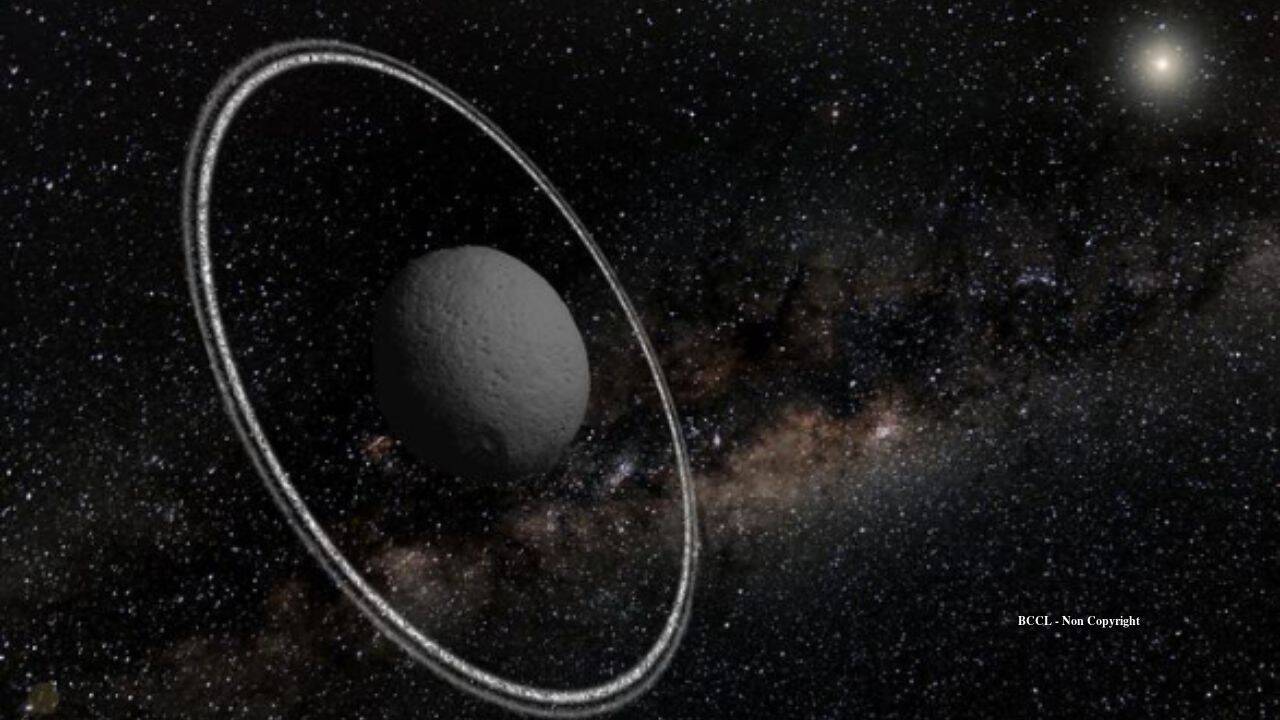
For decades, humanity assumed that majestic ring systems belonged exclusively to gas giants like Saturn and Jupiter. Then came 2013, when astronomers shocked the scientific community by spotting two crisp rings encircling Chariklo, a tiny centaur asteroid measuring only about 250 kilometers across. Orbiting out between Saturn and Uranus, this small body shouldn't have kept rings at all according to classical planetary mechanics.
Now, fresh data from the James Webb Space Telescope has proven that Chariklo is even stranger than anyone predicted. When researchers compared Webb's recent observations against a decade of ground-based stellar occultation data, they caught the system acting in a wildly unexpected way. The rings aren't static ornaments frozen in time. They are changing right before our eyes, shifting dramatically on timescales of just a few years. For a different look, read: this related article.
The Mystery of the Shifting Rings
If you look closely at the numbers coming out of the Institute of Astrophysics of Andalusia, you'll see why astronomers are scrambling to update their models. Led by researchers like Pablo Santos-Sanz, teams studying the JWST data noticed that Chariklo’s two narrow rings are evolving in opposite directions.
The inner ring, known as C1R, has grown significantly more opaque. When it passed in front of a distant background star, it blocked a much larger fraction of light than it did during earlier ground-based measurements over the past ten years. Meanwhile, the outer ring, C2R, moved in the exact opposite direction. It appeared noticeably weaker and more transparent, almost fading out of reach during simultaneous wavelength checks. Similar coverage on the subject has been published by Smithsonian Magazine.
This creates a massive physical puzzle. The material seemingly vanishing from the outer ring doesn't match the massive increase recorded in the inner ring. The jump in the inner ring's opacity is roughly ten times larger than any plausible transfer of debris from the outer boundary. Something else is driving these transformations.
How Do You See Invisible Rings?
You can't just point a standard camera at a 250-kilometer rock sitting seventeen times farther from the Sun than Earth and snap a picture of its rings. They are far too faint and narrow. Instead, astronomers rely on stellar occultation.
This technique requires incredible precision. Scientists calculate exact orbital paths, wait for Chariklo to drift directly in front of a distant star, and measure the tiny, split-second dips in starlight as the object and its rings cross the path. When the James Webb Space Telescope targeted Chariklo during a predicted occultation, it provided unprecedented spatial sampling of roughly 750 meters along the stellar path.
That high-resolution peek revealed structural details that older telescopes missed. It proved that ring systems around minor bodies aren't locked in centuries-long stability. They can experience rapid fluctuations, particle redistribution, or compositional changes that shatter textbook assumptions.
Why This Changes Planetary Science
We are forced to rethink how small-body ring systems form and survive. Objects like Chariklo occupy unstable orbits in the outer solar system, expected to last only a few million years. If their rings can change drastically over a mere decade, scientists have to figure out what kind of confinement mechanisms or ongoing replenishment processes keep those particle bands locked into place.
Is it gravitational resonance from shepherd moonlets we haven't seen yet? Is it ice sublimation and micrometeoroid impacts kicking up fresh dust? Right now, researchers don't have all the answers. The data simply highlights how little we truly understand about the active, messy mechanics happening in the distant reaches of our solar system.
Keep an eye out for future stellar occultation campaigns. Every time Chariklo crosses paths with a background star, we get another chance to solve the puzzle. Update your mental models now, because the quiet outer solar system turns out to be much more volatile than it looks.
Something Beyond Saturn Is Changing — And JWST Just Caught It
This video is relevant because it breaks down how the James Webb Space Telescope detected these unexpected changes in Chariklo's rings using stellar occultation techniques.
http://googleusercontent.com/youtube_content/1