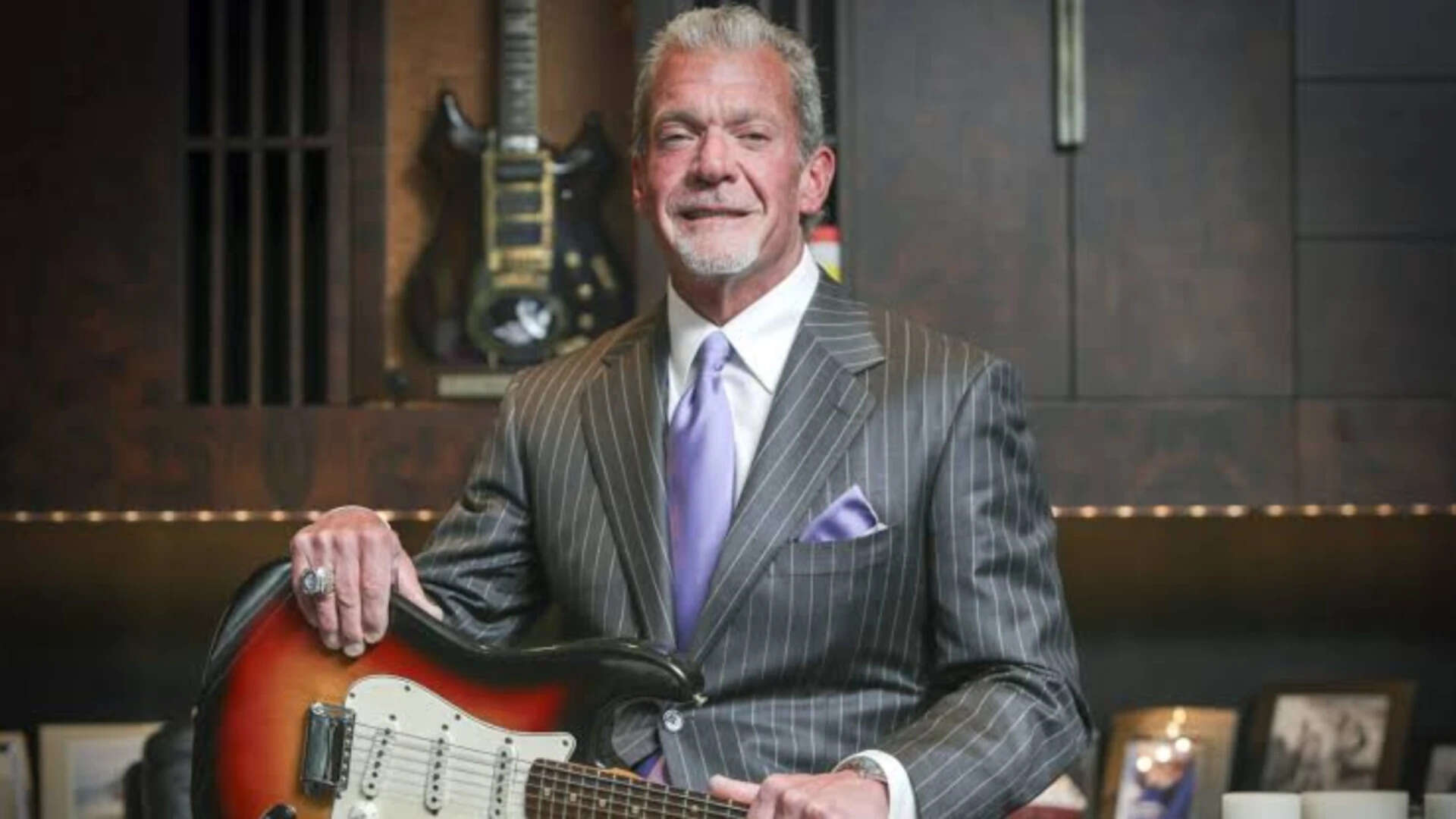
Billionaires usually buy superyachts, sports teams, or private islands. The late Indianapolis Colts owner Jim Irsay did all that, but his real obsession lay elsewhere. He spent decades accumulating the most jaw-dropping collection of rock music history, American artifacts, and historic manuscripts on the planet. Following his death in May 2025 at age 65, the fate of that massive hoard hung in the balance.
We finally have our answer.
A series of five blockbuster auctions wrapped up at Christie's New York on July 1, 2026. The total haul crossed an astonishing $105 million. It didn't just break estimates. It rewrote the rulebook for high-end memorabilia, setting nearly 30 individual world records. The headliner? A single black electric guitar that fetched a mind-melting $14.55 million.
The Relic That Smashed the Music Auction Market
Everyone expected big numbers. Nobody expected eight figures for a standard off-the-shelf instrument.
David Gilmour’s iconic black Fender Stratocaster, better known to rock purists as the Black Strat, is the most expensive guitar in human history. This isn't the first time it held the crown. Gilmour himself sold it back in 2019 for $3.975 million to raise money for climate change charities. Irsay was the buyer.
Sitting on an asset that appreciated by roughly 266% in seven years is wild even by Wall Street standards. The instrument isn't covered in diamonds. It doesn't have gold hardware. It is a beat-up, heavily modified 1969 Stratocaster that Gilmour bought at Manny's Music in New York after Pink Floyd's gear got stolen during their 1970 US tour.
You've heard this guitar. It drove the definitive tracks on The Dark Side of the Moon, Wish You Were Here, Animals, and The Wall. When you hear the soaring, emotional solo on "Comfortably Numb," you are hearing this exact piece of wood and wire.
Bidding inside Christie’s turned into a 21-minute war. The pre-sale estimate topped out at $4 million. When the hammer fell at $14.55 million, it eclipsed the previous record holder, the 1959 Martin D-18E acoustic that Kurt Cobain played during Nirvana’s MTV Unplugged performance, which went for $6.01 million in 2020.
A Fire Sale of Rock Legends
The Black Strat wasn't an isolated anomaly. The entire catalog read like a roll call of rock royalty, and the prices kept climbing.
Jerry Garcia's famous "Tiger" guitar, custom-made by luthier Doug Irwin, pulled in a massive $11.5 million. Garcia played Tiger for a solid decade from 1979 to 1989. It was the last guitar he ever played publicly during his final show with the Grateful Dead at Chicago’s Soldier Field in July 1995. Collectors don't view these as mere instruments. They treat them as secular relics.
Kurt Cobain's Fender Mustang from the "Smells Like Teen Spirit" music video also hit the block. Irsay had previously acquired it for $4.55 million. This time around, it commanded $6.9 million.
Look at what happened to the rest of the stable:
- Eric Clapton’s psychedelic, custom-painted 1964 Gibson SG known as "The Fool" sold for $3 million.
- Another 1964 Gibson SG used by George Harrison on the Beatles track "Paperback Writer" brought in $2.27 million.
- Ringo Starr’s premier drum kit fetched $2 million.
- A John Lennon Rickenbacker cleared $1.3 million.
This wasn't just a rich guy hoarding toys. Irsay genuinely loved the music. He was notorious for letting musicians actually play these instruments rather than sealing them in climate-controlled vaults. He wanted them heard.
The True Heart of the Auction
While the music gear dominated the luxury lifestyle blogs, the emotional and psychological center of the entire event was a stack of typed papers.
Irsay had a well-documented, lifelong battle with severe substance abuse. He survived multiple overdoses and spent clean stretches dedicated to helping others find sobriety. Because of that personal journey, his absolute favorite possession wasn't a guitar. It was the original 1939 working manuscript of Alcoholics Anonymous, famously known as the Big Book.
He bought the text for $2.4 million back in 2018. It contains handwritten edits, notes, and frantic corrections by co-author Bill Wilson and his recovery partner Henry Parkhurst.
The manuscript didn't go to a private equity tycoon. The winning bid came from the Stepping Stones Foundation, a non-profit operating out of Bill and Lois Wilson's historic home. The book is going back where it belongs.
To honor their father's intent, Irsay’s daughters, Carlie Irsay-Gordon, Casey Foyt, and Kalen Jackson, pledged that 100% of the proceeds from the Big Book sale will go straight to addiction recovery foundations and mental health charities. That is a massive win for a community Irsay spent his later years supporting.
Chasing the Ghost of American History
The rest of the 404 lots showed just how eclectic Irsay's tastes were. He bought pieces of the American story wherever he could find them.
Two tiny, fragile slips of paper captured immense interest: actual admission tickets to Ford’s Theater dated April 14, 1865. Those tickets allowed someone to sit in the audience on the exact night John Wilkes Booth assassinated President Abraham Lincoln. They represent a chilling, tangible connection to a moment that altered the course of a nation.
The historical document section also featured a deeply personal, handwritten letter from George Washington to Thomas Jefferson. The topic? A raw, early draft of the United States Constitution.
Why the Memorabilia Market Is Exploding Right Now
If you think these prices are insane, you aren't alone. Traditional art collectors look at these numbers and shake their heads. But the market mechanics make perfect sense when you understand who is buying.
We are seeing a massive generational transfer of wealth. The people who grew up worshiping Pink Floyd, Nirvana, and the Grateful Dead are now at the peak of their financial power. They don't want a Picasso. They want the guitar that soundtracked their teenage rebellion.
Scarcity drives everything. There is only one Black Strat. There is only one working draft of the 12 Steps. When assets like this hit the open market, standard valuation models break down. It becomes a game of chicken between billionaires who refuse to lose.
What You Should Do If You Collect High Value Items
You probably don't have $14 million sitting around for a Fender guitar, but the lessons from the Irsay auction apply to collectors at every single level.
First, provenance is king. The reason Irsay’s collection brought in $105 million wasn't just the items themselves. It was the ironclad documentation proving exactly who held them, when they used them, and where they traveled. If you own rare items, preserve the receipts, photographs, and certificates of authenticity like your life depends on it. Without proof, a historic item is just an old piece of junk.
Second, buy the story, not just the asset. The items that smashed records were tied to cultural inflection points. Gilmour's guitar wasn't famous because it was rare; it was rare because it changed music. Focus your own collecting efforts on items that capture a specific, undeniable moment in time.
If you are looking to preserve your own high-value collection for the future, map out an estate plan now. Don't leave your family guessing. Irsay's daughters handled this massive transition cleanly because the collection's significance was clear, but many families end up in bitter legal battles over uncataloged assets. Document everything, appraise early, and decide whether your legacy belongs in a museum or under an auctioneer's hammer.