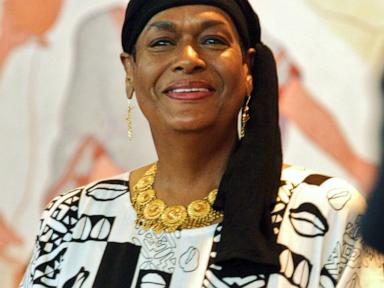
The passing of Khadijah Farrakhan on June 27, 2026, marks the end of an era for the Nation of Islam. To most of the media, she was simply the wife behind a highly controversial, polarizing figure. Obituaries routinely frame her as a background character, a quiet spouse who stood by her husband, Minister Louis Farrakhan, through decades of public storms.
That view misses the entire point of her life.
Khadijah Farrakhan was not a passive spectator. Known widely within her movement as Mother Khadijah, she functioned as the institutional anchor of a resurrected organization. When the original Nation of Islam fractured in the late 1970s, it did not rebuild itself through public speeches alone. It rebuilt itself from the basement of her house. Her work over seven decades defined the internal culture of one of the most visible Black nationalist organizations in modern American history. Understanding her life requires looking past the standard media headlines and looking at how a movement survives when the spotlight fades.
From Betsy Ross to the First Lady of Mosque Maryam
Long before she was a religious icon, she was Betsy Ross, born in November 1935. She grew up in a very different world, long before the civil rights struggles of the 1960s reached their boiling point. In September 1953, she married Louis Walcott in Boston. At the time, her young husband was a talented violinist and a rising star on the calypso music circuit, performing under the stage name "The Charmer". They were a young couple trying to find their footing in a segregated America.
Everything shifted in 1955. Louis Walcott heard the teachings of Elijah Muhammad through a friend and met Malcolm X, who was then running the Boston temple. The encounter fundamentally altered the trajectory of their lives. The young musician traded his stage name for Louis X, dropped his musical career, and dedicated himself to the movement. Betsy Ross joined him, converting to Islam that same year and taking the name Khadijah, a deliberate nod to the first wife of the Prophet Muhammad, who was herself a wealthy and influential businesswoman and the first convert to Islam.
The choice of name was prophetic. As Louis X rose through the ranks, eventually taking the surname Farrakhan and becoming the head minister of Temple No. 7 in Harlem after the departure of Malcolm X, Khadijah managed the domestic reality of a growing family. They had nine children together. Raising nine children in the middle of a high-stakes, high-risk political movement is not a minor detail. It required immense organizational skill, absolute discretion, and a level of mental fortitude that few outsiders ever appreciated.
Rebuilding from the Basement
The real test of her influence came after 1975, the year Elijah Muhammad died. Following his death, his son, Wallace D. Muhammad, took the organization in a radically new direction. He dismantled the strict Black nationalist tenets, steered the group toward orthodox Sunni Islam, and decentralized the power structure.
For a few years, Louis Farrakhan went along with the changes. By 1977, he decided he could no longer follow that path. He wanted to return to the original message of Black self-reliance and separate development preached by Elijah Muhammad.
He broke away to rebuild the Nation of Islam from scratch. He had no money, no mosques, and very few followers left.
This is where Khadijah Farrakhan stepped into a role that went far beyond domestic support. In 1979, the resurrected movement began its work in the basement of the Farrakhan family home in the south side of Chicago. That basement served as the editorial office for the movement’s new newspaper, The Final Call. It served as a meeting hall, a planning center, and a sanctuary for the handful of loyalists who remained.
She ran that infrastructure. She cooked for the workers, organized the logistics, and kept the operational lights on while her husband traveled the country trying to rally crowds. Without that baseline stability, the modern iteration of the Nation of Islam simply would not have survived its infancy. By the early 1980s, the group acquired the former Greek Orthodox church that became Mosque Maryam, their international headquarters in Chicago's South Shore neighborhood. She transitioned from running a basement office to managing the social programs of a major religious center.
The Public Voice and the Million Woman March
For most of her life, she chose to stay out of the direct glare of the cameras. She rarely granted interviews to mainstream media outlets, preferring to work through the internal channels of the Vanguard—the women’s division of the Nation of Islam that focuses on health, home development, and community martial arts training.
That changed in October 1997. Two years after her husband organized the historic Million Man March in Washington, D.C., a group of independent Black women organized the Million Woman March in Philadelphia. The event focused on the unique struggles of Black women in America, dealing with everything from health care inequities to family structure.
Khadijah Farrakhan took the stage as a keynote speaker. It was a rare public address, and she used it to deliver a message that challenged both mainstream feminist narratives and rigid patriarchal structures within nationalist movements.
She told the crowd that a nation can rise no higher than its women. She argued that while it was vital to focus on the empowerment of women, the ultimate goal had to be the elevation of the family as a complete unit. She spoke about the necessity of mutual respect between Black men and women, drawing directly from her own experience of surviving decades of intense external pressure. The speech solidified her status not just as a leader's wife, but as a ideological leader in her own right for tens of thousands of women within the movement.
Private Tragedies and a Guarded Life
Living at the center of the Nation of Islam meant living a life under constant scrutiny and threat. The family faced surveillance from law enforcement, intense hostility from political opponents, and internal friction within the broader Muslim community. Through it all, the family home in Kenwood remained an insular fort.
The later years of her life were marked by significant personal grief. The Farrakhans outlived two of their adult children. Their eldest son, Louis Farrakhan Jr., died in 2018 at the age of 60 due to ongoing heart issues. Just five years later, in 2023, another son, Joshua Farrakhan, passed away at 64.
Those close to the family noted that during these times of loss, as well as during the Minister’s various bouts with prostate cancer and other severe health scares since the early 2000s, Khadijah remained the primary decision-maker regarding family welfare and privacy. She shielded her husband from public intrusion when his health faltered, ensuring the continuity of the leadership structure without creating panic among followers.
When the Shura Executive Council of the Nation of Islam issued the official announcement of her death, they noted she had been married to Louis Farrakhan for 72 years. That longevity is rare in any context, but in the volatile world of political and religious activism, it's almost unprecedented.
What Her Legacy Means for the Future of the Movement
The death of Mother Khadijah at age 90 leaves a massive structural void. Minister Louis Farrakhan is now in his mid-90s, and his public appearances have grown increasingly rare over the last decade. For years, observers of the Nation of Islam have wondered what happens to the organization when its charismatic leader passes away.
Khadijah’s death forces that conversation to happen sooner rather than later. She was the literal bridge to the era of Elijah Muhammad. She was one of the last remaining links to the mid-century origins of the movement. Her presence provided a sense of traditional legitimacy that kept various internal factions unified.
Without her grounding presence, the transition of power to the next generation of leadership—likely centered around figures like Student Minister Ishmael R. Muhammad and the Shura Executive Council—will face its first true test. The internal stabilization she provided for 72 years is gone. The organization must now prove it can maintain its discipline and community programs without its founding matriarch.
If you want to study the history of Black nationalism or the survival of religious minorities in America, don't just read the speeches of the men at the podium. Look at the people who built the platforms, ran the printing presses, and managed the communities when the cameras were turned off. Khadijah Farrakhan was the blueprint for that kind of endurance.
To understand where the movement goes next, keep a close eye on Mosque Maryam over the coming months as they finalize funeral arrangements and navigate this massive shift in their internal hierarchy. The public show will continue, but the foundation has fundamentally shifted.