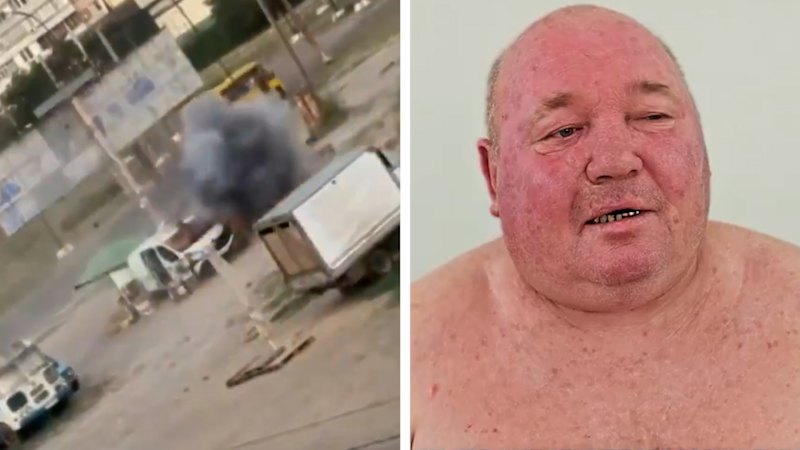
A 52-year-old vendor was just trying to sell vegetables at a local market in Kherson when a small flying machine locked onto him like a video game target. Newly released police footage shows a Russian drone hunting down the civilian through public stalls before detonating right beside him.
If you think modern combat stays neatly contained on distant frontline trenches, this incident proves you're dead wrong. Unmanned aerial technology has evolved into a personal, terrifying threat for everyday people simply trying to live their lives in frontline Ukrainian cities.
The Reality of FPV Hunting in Kherson
The video, published by Ukraine's National Police, captures a horrifying sequence that feels more like dystopian fiction than reality. The victim, a resident from the neighboring Mykolaiv oblast, was working at an open market when the first-person view (FPV) drone spotted him. He had no military insignia, no weapon, and posed zero tactical threat. Yet, the pilot maneuvered the craft to chase him down on foot.
The explosion left the vendor with severe shrapnel wounds, blast trauma, and a concussion. He survived, but countless others aren't so lucky.
Kherson has turned into a grim testing ground for targeted aerial harassment. Local authorities report that Russian forces regularly use small drones to stalk individuals, cars, and public transport across the city. Over just a single weekend, strikes injured nearly twenty civilians in the region. Ukrainian officials label these actions a deliberate war crime, pointing out that operators clearly see their targets through onboard cameras and choose to pull the trigger anyway.
Why This Changes the Rules of Engagement
Decades ago, civilian safety zones were somewhat protected by distance and distinct markers. Today, cheap commercial components strapped with explosives have flattened those boundaries entirely.
Military analysts note that FPV drones cost very little to assemble yet offer pinpoint accuracy. When placed in the hands of operators miles away, they transform narrow streets into open-air traps. You can't outrun a machine flying at high speeds, and you can't hide in a crowded market when the camera is locked onto your jacket.
Ukrainian Foreign Minister Andrii Sybiha didn't mince words online, calling the operator a sadist and pointing out a dark truth: thousands of similar daily strikes happen without ever making international headlines. Moscow routinely denies deliberately targeting non-combatants, but video evidence capturing explicit pursuits of market vendors makes those denials harder to swallow for international observers.
What Happens Next on the Ground
For residents remaining in Kherson and other frontline areas like Zaporizhzhia or Kharkiv, daily routines require constant vigilance. People listen constantly for the high-pitched whine of propellers overhead. Trees, concrete awnings, and makeshift physical barriers offer the only immediate defense against an enemy in the sky.
International legal bodies face an uphill battle documenting these digital-age atrocities. Gathering forensic data from a drone explosion is difficult enough, but tracking down individual operators hiding behind encrypted video feeds and digital proxies is a massive hurdle for war crimes investigators.
The technology isn't going away, and neither is the threat. Until effective counter-drone shielding becomes standard infrastructure in civilian centers, everyday life in southern Ukraine remains a high-stakes gamble against an invisible hunter in the clouds.