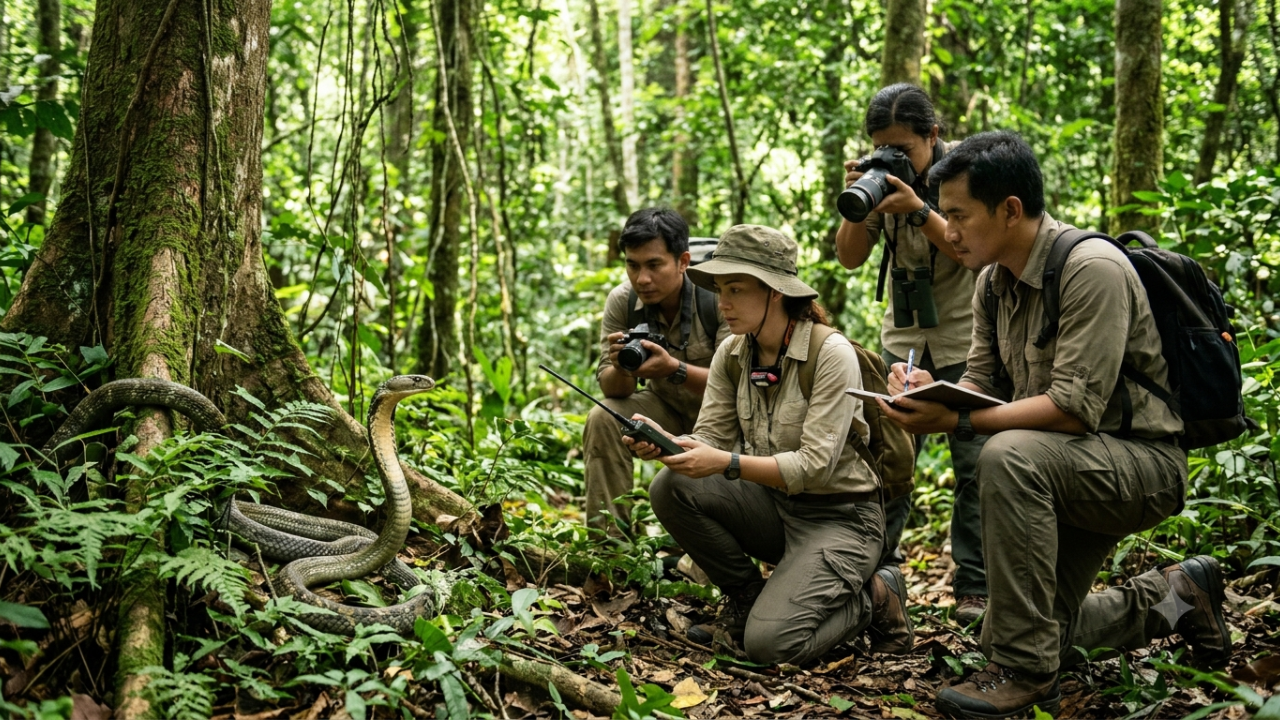
For decades, textbooks taught us to view the king cobra through a narrow lens of solitary menace. You picture a massive serpent rearing up, spreading its hood, and hissing warnings in dense Asian jungles. But that traditional picture misses a lot of nuance. Field researchers examining recent serpentine face-offs in Thailand have documented complex behavioural patterns that standard reptile books completely overlooked.
If you assume these apex predators operate purely on blind aggression, you're missing how sophisticated their social and tactical lives actually are. Let's break down what recent field biology in Thailand actually revealed about the world's longest venomous snake.
Moving Beyond the Stereotype of Blind Aggression
People love simple narratives. Snakes are either terrifying monsters or mindless automatons. Reality is much messier. When biologists closely analyzed three distinct king cobra encounters in Thai habitats, they didn't just log standard defensive postures. They tracked subtle tactical choices, spatial awareness, and specific movement triggers that challenge how we define reptile intelligence.
Most people think a king cobra will instantly strike when cornered or spotted. Instead, observations show these animals often display high calculation thresholds. They weigh the energy cost of a defensive display versus stealthy retreat. In many instances, rather than escalating a confrontation, they use structural cover to slip away silently.
The Reality of Male-Male Competition and Territorial Mechanics
Another area where old assumptions fall apart is how these snakes interact with each other. Recent studies focusing on northern populations in Thailand have zoomed in on ritualistic male-male combat. This isn't just about raw physical dominance. It involves prolonged, highly stylized wrestling matches where opponents test each other's stamina and strength without necessarily inflicting lethal damage.
It's basically a test of endurance. Understanding these combat rituals helps biologists explain why certain males travel massive distances across fragmented forests. They aren't wandering aimlessly. They are patrolling zones, maintaining status, and handling complex social borders that humans disrupt every time we build roads or clear land.
Why This Research Changes Local Conservation Strategy
Knowing how king cobras actually behave in the wild completely alters how local communities should handle snake encounters. For years, panic drove immediate lethal action. When villagers saw a giant snake, translation meant destruction.
By mapping their actual movement corridors and documenting how they react to human proximity, conservationists can design better coexistence strategies. Relocating a king cobra blindly often fails because these animals have deep spatial memory and specific habitat requirements. Dump a displaced cobra into a strange forest, and its survival rates drop sharply.
What You Should Do If You Encounter One
If you ever find yourself traveling through rural or forested regions of Southeast Asia, keep these field-tested realities in mind:
- Give them massive amounts of space. They can strike from surprising distances due to their sheer body length.
- Never block their retreat path. If a king cobra feels trapped between you and an obstacle, you force its hand.
- Stay calm and back away slowly. Sudden, jerky movements trigger defensive escalation.
We have to stop treating these reptiles as cartoon villains. They are complex ecological actors trying to navigate an increasingly crowded landscape. Recognizing their actual behavioral patterns is the first step toward keeping both humans and snakes alive.
What it's like to encounter a massive king cobra in a Thai reserve
This video provides a firsthand look at a researcher observing a massive king cobra in a Thai biosphere reserve, highlighting the snake's actual calm demeanor and behavior in its natural habitat.