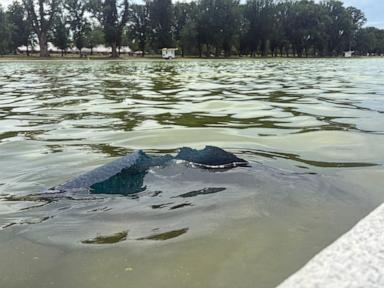
The Lincoln Memorial Reflecting Pool is supposed to look majestic. Instead, it looks like a poorly maintained backyard swimming pool that someone tried to fix on a tight weekend deadline. Just days after a highly publicized, multi-million dollar rush job to paint the basin "American flag blue," the whole thing is literally coming apart at the seams. Big flaps of blue material are peeling right off the concrete floor, unsticking from the bottom and floating lazily to the surface.
It's a mess. If you walk down the National Mall right now, you won't see a pristine mirror reflecting Abraham Lincoln. You'll see patches of bright blue coating floating like dead leaves in a soup of murky green algae.
This latest breakdown shouldn't surprise anyone who understands how large-scale water features actually work. The federal government spent millions trying to paint over a deep architectural flaw. They wanted a quick win before the big July 4th national celebrations. What they got is a lesson in why cosmetic fixes never work on structural problems.
The Lincoln Memorial Reflecting Pool is Flaking Under Pressure
When workers began filling the six-acre basin in early June 2026, the official word from the Department of the Interior was that the landmark had been restored to glory. The new "American flag blue" finish was promised to make the water pop. But by June 18, tourists and reporters noticed something was wrong. Flaps of the blue liner material had detached from the concrete.
Eddie Wood, the owner of Atlantic Industrial Coatings—the Virginia-based firm that got the contract—acknowledged that his team has things to address when they return for scheduled maintenance. But pool infrastructure experts are looking at this with a much more critical eye. Tim Auerhahn, chairman of the Aquatic Council, pointed out that coating systems fail for specific, predictable reasons. It usually comes down to bad substrate preparation, moisture under the surface, or wrong application conditions.
When you rush a coating job on a massive concrete basin that has been sitting in a swamp for a century, the coating fails. Concrete is porous. It breathes. If moisture trapped inside the concrete pushes outward, it breaks the bond between the paint and the stone. That is called delamination. It means the blue layer is basically choking on the water trapped underneath it.
The True Cost of a Fast-Tracked Fix
The math behind this project keeps shifting. When the initiative was announced in April, the public heard estimates around $1.5 million or $1.8 million. It was supposed to happen at breakneck speed. By the time the contracts settled, federal records revealed the cost had ballooned to $13.1 million, and recent contract summaries show the final award to Atlantic Industrial Coatings sitting at a staggering $14.7 million.
That is nearly eight times the original estimate for a project that is already flaking apart.
Paying more money for faster results didn't buy a better outcome. The budget increased because the government threw more people, more materials, and round-the-clock shifts at the pool to beat the clock. Speed is the enemy of proper chemical curing. If you don't let a commercial-grade underwater sealant dry under perfect environmental conditions, it won't stick.
The Green Slime Problem That Won't Go Away
The peeling liner isn't even the only headache. Before the material started floating to the top, the water turned bright green.
Algae loves warm water, sunlight, and stagnant conditions. The Reflecting Pool holds roughly 4 million gallons of water, creating a giant petri dish when the sun beats down on Washington. To fight the sudden outbreak of green slime, maintenance crews resorted to pouring massive jugs of hydrogen peroxide straight into the pool. They also deployed "advanced nanobubbler technology" to inject oxygen into the water and break up the organic matter.
It didn't work. Large sections of the pool remain thick with algae.
The green tint ruins the entire aesthetic purpose of the pool. A reflecting pool needs clear water and a dark bottom to act as a proper mirror. Painting the bottom a bright, vivid blue actually makes the green algae stand out more. It highlights the dirt instead of hiding it.
Why the Deep Plumbing Pipes are the Real Culprit
The underlying problem has nothing to do with the paint color. The entire plumbing infrastructure beneath the National Mall is broken.
The Reflecting Pool sits on historic marshland. Because the ground is soft and constantly shifting, the main 12-inch plastic pipes running beneath the structure are under immense pressure from the surrounding soil. These pipes connect the main basin to a water treatment plant designed to purify and circulate the water.
Right now, those pipes are cracked. They leak constantly. Kym Hall, a former National Capital Area director for the National Park Service, described filling the pool as equivalent to pouring water into a colander. It is an impossible battle against physics.
When the pipes leak, the water level drops. To fix the pipes, engineers have to shut down the entire filtration system for weeks at a time. The moment the filtration system stops moving, the water goes stagnant, the temperature rises, and the algae takes over.
The $14.7 million project focused entirely on sealing the surface joints and applying that blue coating. It completely ignored the broken plumbing network hiding in the dirt below. The National Park Service previously determined that fixing the leak problem requires digging up and replacing thousands of feet of underground pipeline. The current administration claims that pipe work will start in the fall, but skipping it during the main drain-and-fill phase was a major strategic error.
A History of Costly National Mall Repair Failures
Every presidential administration tries to fix this pool, and almost everyone gets it wrong.
Back in 2012, the Obama administration wrapped up a massive 18-month, $34 million overhaul of the Reflecting Pool. That project was supposed to solve the structural issues forever. Crews installed more than 2,100 timber pilings deep into the ground to support the massive concrete weight and stop it from sinking into the swamp. They put in a brand-new water supply system to pull water from the nearby Tidal Basin instead of using expensive city drinking water.
It took less than a year for that $34 million fix to show cracks. The water became a smelly, stagnant soup filled with duck waste, blanket weed, and trash.
The lesson is clear. You cannot manage a four-million-gallon stagnant pond with surface-level cosmetic upgrades. The 2012 project focused on the foundation but struggled with water quality management. The 2026 project focused on paint and ignored the plumbing entirely.
How Engineering Standards Clash With Political Deadlines
Public works projects require patience. Concrete requires specific temperature and humidity windows to cure. Industrial epoxy coatings need days of completely dry conditions before they can handle the immense hydrostatic pressure of four million gallons of water pressing down on them.
When political timelines dictate construction schedules, engineering standards go out the window. The push to have a bright blue pool ready for the national 250th anniversary meant that the application of the liner was rushed through erratic spring weather.
If the concrete substrate was damp when the technicians sprayed the blue coating, the failure was guaranteed from day one. Water vapor gets trapped under the impervious liner. As the sun heats the pool, that trapped moisture turns to gas, expands, and bubbles up. Eventually, the bubble pops, the water enters the gap, and the liner starts peeling away in massive sheets.
Actionable Next Steps for Fixing the Reflecting Pool For Good
Fixing this embarrassment requires abandoning the quick-fix mindset. The National Park Service and its contractors need to follow a strict engineering protocol rather than a public relations schedule.
- Drain the basin completely: You cannot fix a delaminating liner while the pool is full. The water needs to be evacuated so engineers can inspect the full extent of the bond failure.
- Acknowledge the pipe failure: Stop waiting until autumn. The ground is already open, and the pool is already failing. The 12-inch underground distribution lines must be excavated and replaced with high-density polyethylene (HDPE) piping that can flex with the shifting marsh soil without cracking.
- Blast off the failed coating: The remaining blue material needs to be completely stripped using high-pressure water blasting or mechanical grinding. Leaving patches of compromised liner will cause future coats to fail.
- Address the substrate moisture: Run comprehensive relative humidity tests on the concrete floor. Do not apply a single drop of new sealant or paint until the core concrete matrix hits acceptable dryness levels.
- Re-evaluate the color choice: Ditch the bright blue swimming pool look. Historical accuracy aside, dark gray or black bottoms provide a far superior reflection and mask the minor, inevitable organic growth that happens in open-air water features.