You can't just slap a fresh coat of paint on a century-old monument and expect it to hold up like a suburban swimming pool. Someone should have told the White House that before they hit the gas on a rushed $14 million renovation.
Less than two weeks after Donald Trump announced that the long-awaited cleanup of Washington's iconic Lincoln Memorial Reflecting Pool was finished, the grand vision has literally dissolved. The plan was simple enough on paper. Drain the 610-meter-long rectangular basin, fix the lining, and coat the bottom in a custom shade dubbed "American flag blue." The goal was to make the historic site pop just in time for the upcoming 250th anniversary of American independence.
Instead, tourists are looking at a swamp.
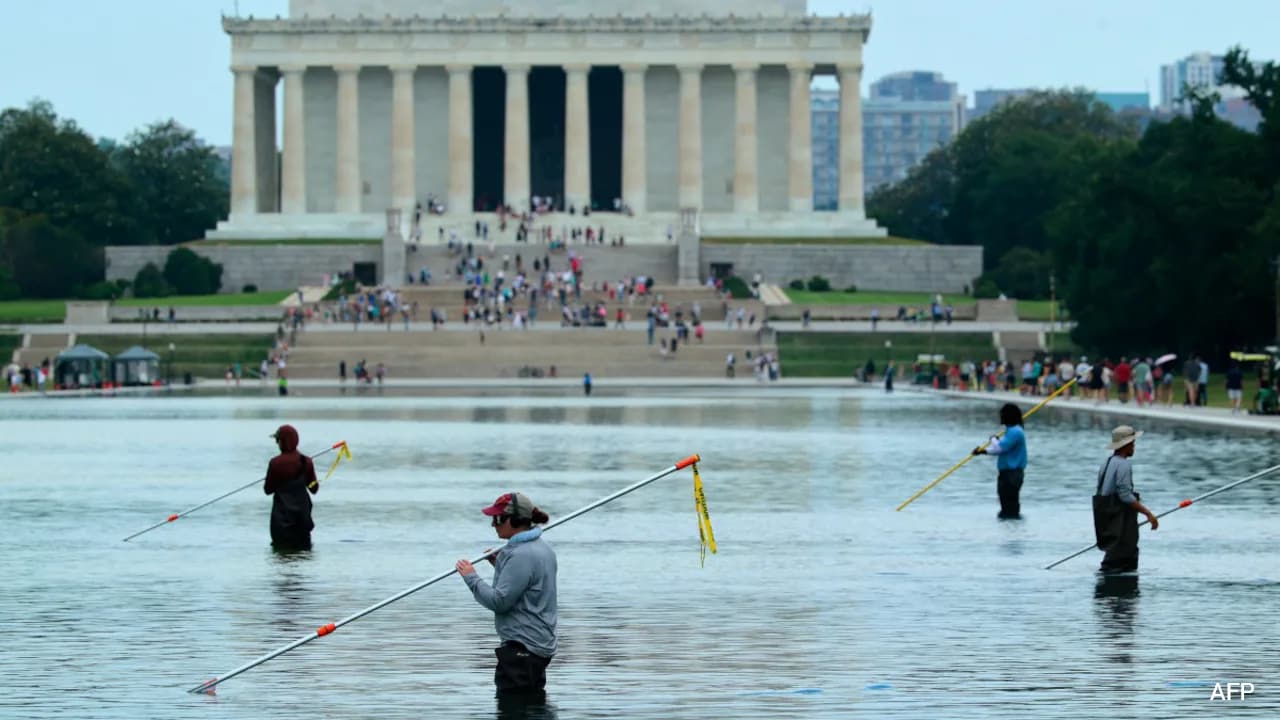
A massive wave of green algae choked out the bright blue hue within days of the water being turned back on. If that wasn't embarrassing enough, the industrial-grade blue sealant started lifting right off the stone floor. Huge, jagged ribbons of blue material are floating to the top, leaving patchy, gray concrete exposed underneath. Workers are spending their mornings dumping massive bottles of hydrogen peroxide into the water and dragging skimmers across the surface to suck out chunks of loose paint. It is messy, it is expensive, and it was entirely predictable.
When Speed Trumps Basic Engineering
What went wrong here comes down to a classic mistake. Fast execution over proper planning. Civil engineers have seen this exact story play out a thousand times, and they aren't surprised by the result.
Federal contracting records show the Trump administration bypassed the traditional procurement process entirely. They handed out a $14.2 million no-bid contract to a Virginia-based outfit called Atlantic Industrial Coatings. Interestingly, that is the same firm that previously did work on a private swimming pool at one of the president's golf clubs. The administration defended the no-bid approach by claiming they needed to cut through red tape to ensure the pool was pristine and filled well ahead of the July 4 holiday crowds.
That rush job skipped critical steps. Engineering experts point out that when you apply thick, industrial-grade sealants to a massive outdoor stone surface, environmental factors rule everything. The surface has to be perfectly prepped, completely dry, and given ample time to cure under specific temperature thresholds.
If you rush the process to meet a political deadline, moisture gets trapped underneath the coating. When the hot June sun hits that shallow water, the concrete heats up, vaporizes the trapped moisture, and creates immense pressure. The result is inevitable. The coating bubbles, cracks, and rips away from the substrate. That is exactly what is happening along the floor of the National Mall right now.
The Perfect Incubator For Algae
Then there is the biological failure. The administration promised that the new setup used highly sophisticated, industrial-strength materials built to last a century. On Truth Social, Trump pushed back against critics, claiming the project used the latest filament technology and wasn't just a simple paint job.
Biology didn't get the memo.
The Lincoln Memorial Reflecting Pool is a massive, shallow body of water completely exposed to direct sunlight all day long. It has no natural shade. When you fill a basin like that with fresh water in the middle of a hot summer, you create a giant petri dish.
The Department of the Interior initially tried to wave off the thick green scum as a temporary hiccup. They claimed it was just residual algae from the old supply lines that had sat dormant during the eight weeks of construction. They promised it would clear up instantly.
When it didn't, the response turned frantic. Officials started deploying what they called "nanobubbler technology"—an advanced water treatment system designed to blast the water with ozone nano-bubbles to destroy the biological bloom. A spokesperson even bragged that the tech had successfully killed off the bloom, claiming the water was crystal clear and that workers were just vacuuming up the dead remnants.
But a quick walk down the National Mall tells a different story. The green tint is stubborn. Even worse, the aggressive cleaning efforts and vacuum hoses seem to be aggravating the fragile, poorly bonded blue sealant, tearing up even more chunks of the floor.
A Polarizing Transformation On Hallowed Ground
This isn't just an engineering flub. It is a massive political headache because of where it is happening. The National Mall is hallowed ground in American history. This is the exact spot where Martin Luther King Jr. delivered his "I Have a Dream" speech in 1963 to hundreds of thousands of people lining the banks.
For generations, the pool was designed to quietly reflect the sky, the Washington Monument, and the Lincoln Memorial. Its natural, darker tone was intentional. Critics argue that trying to turn it into a vivid, bright blue pool is an act of aesthetic vandalism that strips the site of its somber, historic character.
The administration has pushed back hard against that narrative. They have pointed out that the pool has been plagued by plumbing failures, leaks, and nasty algae issues under almost every single previous president, including Barack Obama. They argue that older, multi-million dollar attempts to fix the infrastructure failed to solve the underlying issues, and that this project was a bold attempt to fix a broken, dirty eyesore for good.
As the finger-pointing intensifies, Trump has offered his own explanation for the peeling material. In a recent social media post, he alleged that the damage was actually the work of vandals who intentionally sabotaged both the grass surrounding the site and the newly installed inside surface of the pool. He claimed that law enforcement is actively investigating the matter, while reassuring his followers that the issue is confined to a small area and will be completely repaired within days.
Local civil engineers don't buy the sabotage theory. The pattern of the tearing matches classic coating adhesion failure perfectly. It is happening across the entire length of the 610-meter structure, not just in one isolated spot where a bad actor could have reached.
What Happens Next
Fixing a failed commercial coating of this scale is a nightmare. You cannot simply paint over a surface that is actively peeling. The water will have to be drained yet again. The remaining loose sealant will need to be mechanically stripped off. The concrete will have to be dried and re-evaluated.
If you want to see how real project management avoids these disasters, look at standard commercial water infrastructure protocols.
First, independent environmental testing must happen before a drop of sealant is applied. Engineers test the core moisture levels of the concrete substrate using specialized meters. If the moisture vapor emission rate is too high, you do not coat. Period.
Second, competitive bidding processes exist for a reason. They force multiple engineering firms to look at the design specs, flag potential points of failure, and offer realistic timelines. When you hand a massive public works project to a single contractor on a no-bid basis because they did a good job on a golf club swimming pool, you lose all of those vital technical sanity checks.
Third, water treatment systems need to be integrated into the infrastructure, not rolled out as an emergency afterthought when the water turns into pea soup. A true long-term solution for the Reflecting Pool requires continuous filtration and biological mitigation built directly into the plumbing layout, balanced against the unique chemical constraints of whatever coating sits on the floor.
The crew on the Mall is working around the clock to patch the spots and clear the scum before the upcoming holiday crowds arrive. But unless they address the fundamental bonding failure between that blue coating and the historic concrete beneath it, those blue ribbons of paint will keep floating to the top all summer long.