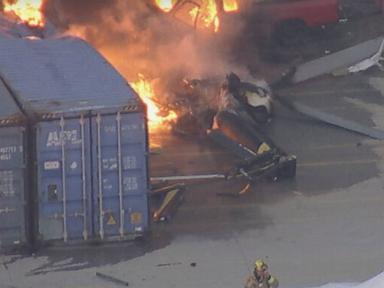
Two separate tragedies collided in the San Fernando Valley, leaving five dead and forcing a harsh look at how local news organizations rush to cover breaking events.
In the span of a few hours on a Tuesday evening in Chatsworth, a reckless vehicle collision involving an SUV and a city bus claimed multiple lives. Shortly after, a news helicopter covering that very wreckage plummeted into a parking lot nearby, killing three more people. It was a compounding disaster that shook Los Angeles and exposed the quiet, high-stakes risks taken daily by airborne journalism crews.
If you watched the local broadcasts or followed the updates, the timeline felt surreal. But underneath the shocking visuals lies a sobering reality about airspace congestion, split-second operational pressures, and the human cost of 24-hour news.
The Anatomy of a Double Disaster
The sequence started around 5:00 p.m. on a busy Los Angeles avenue. According to police and transit reports, an SUV careened into a Metro bus, leaving the vehicle lodged in the side of public transport and trapping passengers inside. That crash alone was catastrophic, resulting in fatalities and injuries that immediately drew emergency responders and a swarm of media aircraft to the area.
About two kilometers away and two hours later, the situation turned exponentially worse.
An NBC4 and Telemundo 52 news helicopter—operated by Angel City Air—went down near a storage facility on North Mason Avenue. The Eurocopter AS350 slammed into a parking lot, landing on shipping containers and several parked vehicles before erupting into a violent blaze.
The onboard crew included veteran pilot George Marciniw and aerial reporter Eliana Moreno, both of whom lost their lives. A third victim, identified by the Los Angeles County Medical Examiner as 29-year-old Edy Gutierrez Mejia, was killed on the ground in the parking lot.
What the Investigation is Uncovering
When aircraft crash during live reporting, investigators immediately look at a grim set of variables: mechanical failure, pilot disorientation, airspace congestion, and environmental stress.
In this case, National Transportation Safety Board (NTSB) investigators zeroed in on a crucial piece of evidence immediately: the final seconds of audio and video broadcast from the helicopter itself. Cockpit recordings captured standard advisory tones and changes in engine sound before a female voice exclaimed "uh oh," followed by a desperate question about pulling up just before the feed cut out.
NTSB investigator Fabian Salazar noted that these audio cues and engine changes form the bedrock of the initial technical assessment. Yet, answering why the chopper lost altitude requires untangling a dense web of factors.
When multiple news choppers converge on a single breaking news scene, the local airspace becomes crowded and chaotic. Pilots must manage maintaining visual lines on the story, keeping a safe distance from other aircraft, monitoring fuel, and listening to dispatch—all while reacting to a rapidly shifting ground narrative. It is a high-pressure environment where there is zero margin for error.
The Real Cost of Aerial Journalism
Most viewers take live helicopter shots for granted. You turn on the morning or evening news, and there is a smooth, sweeping aerial view of a freeway chase, a wildfire, or a major accident.
You rarely think about the person holding the camera or the pilot flying low over dense urban sprawl.
The data tells a grim story about this line of work. Aviation safety records show that news helicopter operations carry disproportionate risks compared to standard commercial transit. Over the past couple of decades, multiple fatal accidents involving news choppers across the United States have killed journalists and pilots, prompting recurring debates about whether networks should rely more heavily on drones or stationary cameras.
Yet, the demand for live aerial feeds remains high. Ratings spikes and audience appetite for immediate, visceral visuals drive newsrooms to push their air teams into the skies the second an emergency breaks.
Moving Past the Headlines
The grief rippling through Southern California newsrooms and the Chatsworth community is palpable. Colleagues at NBC4 and Telemundo 52 delivered tearful tributes on air, remembering Moreno and Marciniw as fixtures of the local skies who loved their craft. At the same time, city officials like Mayor Karen Bass grappled with a staggering loss of life from two incidents tied to the same neighborhood on a single day.
If you are looking at this tragedy and wondering what changes next, the answer is likely slow to arrive. Federal regulators will spend months analyzing wreckage, reviewing radar data, and dissecting maintenance logs before issuing a final probable cause report.
Until then, the incident serves as a grim reminder. Breaking news is driven by an engine of urgency, but the human toll behind the lens is often far higher than anyone at home realizes.


