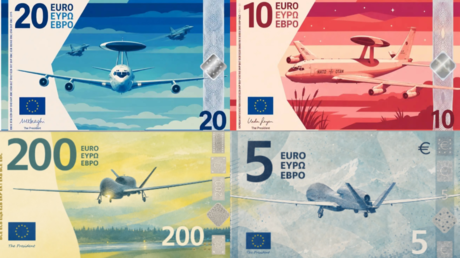
You would think government officials know the basic difference between military alliances and economic blocks. Apparently, that is asking too much. Luxembourg's Directorate of Defence recently learned this lesson the hard way after launching an AI-generated social media campaign proposing brand-new designs for upcoming euro banknotes.
Instead of bridges, windows, or cultural landmarks, they pitched military hardware. Think transport planes on five-euro notes, satellites on twenties, tanks on hundreds, and machine guns on two-hundreds. The caption dared to ask why anyone would want alternative proposals when they could focus on European security.
People hated it. The backlash arrived fast, forcing the post down and triggering official apologies and political panic.
The ECB Banknote Redesign Process
To understand why this misstep drew so much fire, you have to look at what the European Central Bank is actually doing. The ECB is currently running a massive public consultation to redesign future euro banknotes, aiming to make them more modern, sustainable, and relatable to everyday citizens.
Citizens get a say. Public surveys let ordinary Europeans vote on themes that represent shared values, art, nature, and European identity.
Enter the Luxembourg Directorate of Defence. Seizing on the public redesign trend, they decided to inject militarism into a civilian currency. Displaying weapons of war on the single currency of the eurozone completely misses the historical point of the euro, which was built to foster economic integration and peace among member states.
Political Fallout and Public Backlash
The internet did not hold back. Social media users and local politicians jumped on the stunt immediately, pointing out that weaponizing currency aesthetics sends the wrong message.
Yves Cruchten, a prominent Luxembourgish lawmaker, publicly questioned whether this aggressive imagery represents the true image the country wants to project globally. Christian Schleck, head of the army union SPAL, criticized the campaign as being in terrible taste, noting that the defense sector has far more pressing operational priorities than mocking up imaginary firearm-laden cash.
Defense Minister Yuriko Backes had to step in to clean up the mess. She reiterated that the government holds a serious responsibility in communication, emphasizing that weapons and military equipment should never be trivialized. She made it clear that official defense messaging must avoid promoting a toxic military culture.
What the Blunder Teaches Us About PR Stunts
Government social media accounts love chasing viral trends. They want to look relatable, edgy, and plugged into internet culture.
This disaster proves why institutional PR teams need to slow down. Using artificial intelligence to churn out tone-deaf concepts without weighing public sentiment is a recipe for disaster.
The euro belongs to millions of civilians across the eurozone, not to defense planners looking to flex military hardware on a medium meant for buying groceries. If you want to build public trust in national security, mocking up machine guns on cash is definitely the wrong way to do it.