Emmanuel Macron loves a high-stakes diplomatic theater, but his latest trip to the Middle East just became a lot more literal. On Tuesday morning, the French president entered the presidential palace in Damascus to shake hands with Syrian President Ahmad al-Sharaa. Almost exactly at that moment, two improvised explosive devices ripped through a busy street just outside the Four Seasons Hotel. That is the exact luxury hotel where Macron and his massive economic delegation were staying. It was loud. Smoke covered the capital. Blood stained the pavement. At least 18 people were injured, including four Syrian police officers who had been standing right next to a rigged trash can when it exploded.
Macron didn't hear the blasts from his armored motorcade. His office quickly put out a statement confirming he was safe and that the meetings would go on as planned. He even took to X to defiantly state that nothing would smother the aspirations of the Syrian people. But let's look past the carefully polished diplomatic damage control. These explosions are a massive, public black eye for both the French leader and Syria's fragile new government.
You have to understand the context here to see why this matters so much. Macron is the first major Western head of state to set foot in Syria since December 2024, when an alliance of rebel forces broke the decades-long dictatorship of Bashar al-Assad. For the past year and a half, President Ahmad al-Sharaa has been playing a delicate game. He wants to convince the Western world that he is a reformed statesman, not the former leader of Hayat Tahrir al-Sham, an organization with historical roots tied to al-Qaeda. Macron bought into that transformation. He didn't just back Sharaa in words; he pushed Washington and European capitals to drop punishing economic sanctions.
The bombs that went off on Tuesday shattered that carefully managed illusion of a peaceful, open-for-business Syria. They served a direct message to the world: Damascus is not safe, the war is not truly over, and the new government's grip on security is slipping.
The chaos outside the Four Seasons Hotel
The attack itself was coordinated to cause maximum panic right under the noses of French intelligence. The Four Seasons Hotel in Damascus isn't just any hotel. It's an absolute fortress. It serves as the primary hub for United Nations staff, visiting foreign diplomats, and international aid workers. If you want to show the world that you control the capital, you secure the perimeter of the Four Seasons. Sharaa’s security apparatus failed that test completely.
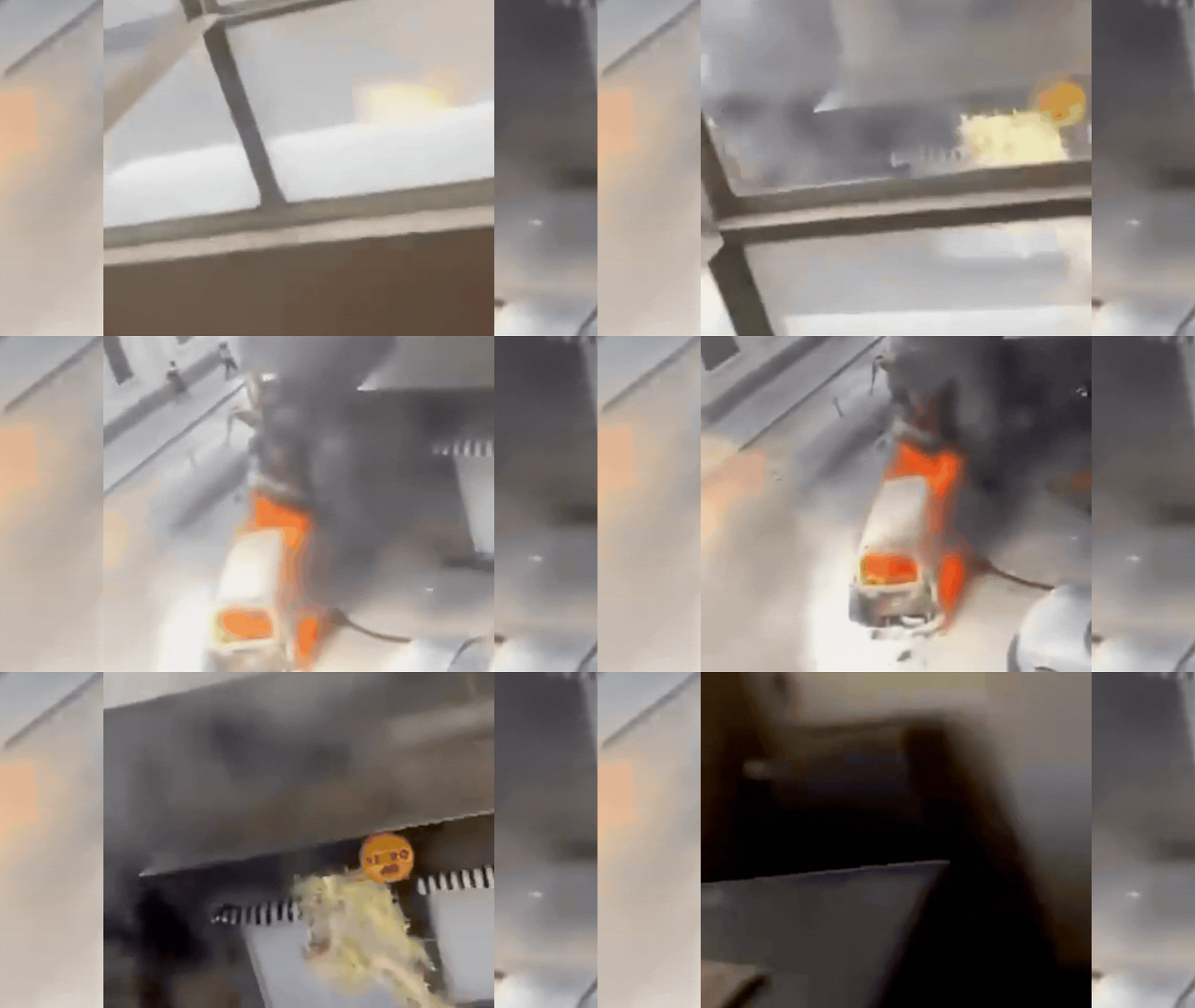
According to Syrian interior ministry officials, the attackers utilized two separate explosive devices. The first was hidden inside a public dumpster on a bustling street positioned between the Ministry of Tourism and the Damascus National Museum. Syrian police officers had gathered around the trash receptacle, seemingly alerted to something suspicious, when the device was detonated. Video footage captured by local onlookers and journalists showed a massive fireball erupting, instantly engulfing a nearby van and a motorcycle.
The terror didn't stop there. A few minutes later, as a crowd of roughly two dozen people and emergency workers rushed to help the wounded, a second bomb exploded inside a parked car next to an ambulance. This classic, cruel secondary-detonation tactic was designed to maximize human casualties and terrorize first responders. Thick black smoke choked the air, and frantic crowds scattered down the avenue while emergency personnel fought the flames.
While the French press pool accompanying Macron reported they didn't see or hear the actual blasts due to their tight security bubble, the geopolitical shockwaves were felt instantly. No group has claimed responsibility for the twin bombings yet. However, anyone following the region knows the list of suspects is long. Just last week, another bomb exploded inside a busy cafe near the Damascus Justice Palace, killing ten people and wounding 20 others. The capital, which had enjoyed a period of relative calm after Assad's fall, is suddenly turning into a combat zone again.
Why France is betting on the new Syrian regime
Why was Macron even there in the first place? It comes down to a mix of classic French posturing and hard economic opportunism. Paris has always viewed itself as a central player in the Levant, owing to its historical colonial mandate over Syria and Lebanon. When Assad's regime collapsed in late 2024, Macron saw a wide-open door to reassert French influence in the Middle East.
Macron decided to take a gamble that other Western leaders refused to touch. While Washington and London watched Sharaa with deep suspicion, wondering if an Islamist fighter could truly govern a pluralistic country, France chose to actively help him build legitimacy. Macron became Sharaa's most vocal defense attorney on the international stage. The French government argued that the alternative to Sharaa was total chaos or an Islamic State resurgence, so Europe had no choice but to back the new administration in Damascus.
This week’s landmark visit was supposed to be the ultimate validation of that policy. Macron didn't arrive alone. He brought a heavy delegation of corporate executives and investors looking to secure lucrative reconstruction contracts. Syria's infrastructure is completely broken after 14 years of brutal civil war. The country needs hundreds of billions of dollars to rebuild its power grids, water systems, ports, and housing sectors.
Among the high-profile business figures traveling with Macron was Jacques Saadé, an executive with deep Syrian roots within the massive shipping and logistics conglomerate CMA CGM. The goal was to sign major memorandums of understanding, signal to global markets that Syria was a safe bet, and position French firms at the front of the line for reconstruction money. Instead, those executives spent their morning watching smoke rise over the city from their hotel windows.
The hidden message behind the Damascus bombs
You have to look at who benefits from making Macron look vulnerable and Sharaa look helpless. The timing of these IEDs was too precise to be a coincidence. They were planted and detonated precisely when the global media spotlight was focused intensely on Damascus.
One obvious suspect is the remnants of the Islamic State. Back in February, the jihadist group officially announced a fresh phase of operations targeting Sharaa's government, labeling his administration as traitors to their extreme ideology. For ISIS, a bombing that scares away European billionaires and makes the government look weak is a massive victory. They want to prove that Sharaa cannot protect his allies, let alone ordinary Syrian citizens.
There are other players with a motive to sabotage this meeting. Remnants of the old Assad regime, underground pro-Iran militias, or rival rebel factions who feel betrayed by Sharaa's rapid pivot to the West all have an interest in destabilizing Damascus. By hitting the tourist and diplomatic heart of the city right next to Macron's base, the attackers proved that they can penetrate the most heavily guarded zones in the country.
This creates a brutal paradox for the French president. Macron wants to show that his foreign policy is brave and forward-thinking. He wants to show he can broker peace where others fail. But when you fly into a war-torn state with a corporate entourage and bombs start going off outside your bedroom, you don't look like a visionary diplomat. You look reckless. You look like you miscalculated the stability of a regime that is still held together by duct tape and promises.
Security gaps in a post Assad Syria
The hard truth is that managing a successful insurgency is completely different from running a functional nation-state. Sharaa was brilliant at coordinating rebel factions to overthrow a heavily entrenched dictator. He knows how to fight a war. What he is realizing now is that policing a capital city and preventing asymmetric terrorist attacks is an entirely different beast.
When the old state apparatus collapsed in 2024, the police forces, intelligence agencies, and internal security networks were completely dismantled. Sharaa had to build a new security force out of various rebel groups, civilian volunteers, and remnants of the old bureaucracy who agreed to switch sides. That kind of patchwork security structure is incredibly easy for terrorists to infiltrate.
The fact that someone could drive an explosive-laden vehicle right up to the Four Seasons area, park it, and walk away without raising alarms shows a massive breakdown in basic counter-terrorism operations. There are too many checkpoints that can be bribed, too many security officers with poor training, and too many blind spots in the city’s surveillance grid.
For international businesses, this is the ultimate red flag. Investors are terrified of instability. They don't mind investing in poor countries or politically complicated markets, but they absolutely will not pour millions of dollars into a city where their executives might get blown up while walking out of a hotel. Macron can sign all the memorandums of understanding he wants, but the private sector will look at the footage of that burning van in Damascus and decide to keep their money in the bank.
What happens next for Macron and Sharaa
So, where do they go from here? Macron cannot simply pack his bags and run away. That would look like total cowardice and signal a complete failure of his Middle Eastern strategy. He is forced to double down. He will likely stay, finish his meetings, sign the economic agreements, and head to his upcoming NATO summit in Ankara trying to spin this as a reason why the West needs to support Syria even more aggressively.
For Sharaa, the stakes are existential. He needs to find out who ordered these attacks and eliminate them quickly if he wants to keep his Western backers on his side. He has spent the last year trying to shed his image as a militant commander. He wears sharp suits, speaks to Western journalists, and talks about pluralism and economic reform. But if he cannot keep the streets of Damascus safe for a visiting European president, his political project is dead in the water.
Expect a massive, heavy-handed security crackdown across Damascus over the next few weeks. Sharaa’s forces will likely conduct sweeping raids, set up tighter cordons, and try to restore a semblance of order. But iron-fisted crackdowns can also backfire, alienating local populations who are already exhausted by years of authoritarian rule and economic misery.
If you are tracking the future of the Middle East, stop focusing on the optimistic press releases coming out of the Elysee Palace. Focus on the streets of Damascus. The real story isn't the smiles and handshakes between two leaders inside a palace. The real story is the fact that a couple of homemade bombs hidden in a trash can and a parked car just hijacked the foreign policy agenda of a European superpower.
The next step for international observers is clear. Watch how the corporate delegation reacts over the coming days. If French companies actually begin ground operations in Syria, Macron’s gamble might survive. If they quietly withdraw their teams and delay their projects, then we will know that the Damascus bombers achieved exactly what they set out to do.