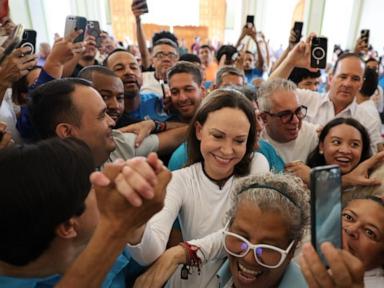
Venezuela's opposition leader Machado returns after months in exile, as doubts over democracy deepen across the region. When Nobel laureate María Corina Machado stepped into a church in Lara on Sunday, October 25, 2026, she wasn't just ending ten months of exile. She was throwing down a direct challenge to both Caracas and Washington.
"I am here. With you," she announced online.
Her return comes at a tense moment. Venezuela sits in democratic limbo. Nicolás Maduro is gone, ousted by U.S. military action earlier this year and taken to New York to face drug charges. But the promised democratic transition hasn't arrived. Instead, acting President Delcy Rodríguez, a former Maduro loyalist who stepped in with Washington's initial backing, remains in power well past her 90-day mandate. No election date has been set.
If you've been following South American politics, you know this situation is volatile. Here is what's really happening on the ground, why Machado took such a massive personal risk to return, and what this power dynamic means for the future of Venezuelan governance.
Why Machado Returned Now
Machado didn't come back on a whim. She tried seven separate times to enter the country over recent months. One charter boat trip fell through when the operator pulled out citing vessel safety. A flight attempt through Curaçao hit a brick wall when aviation permits were denied.
She risked arrest or worse because staying abroad meant losing leverage.
When she accepted the Nobel Peace Prize in Oslo last December, she had international attention. But international awards don't force autocratic regimes to hold elections. Domestic presence does. By walking back into Venezuela—appearing unannounced in Lara west of Caracas to crowds chanting her name—she forced every player in this crisis to react.
Her coalition partner Edmundo González quickly confirmed her presence, signaling that he plans to join her in-country shortly.
The Power Struggle Inside Caracas
To understand why democracy is stalled, look at who is actually running the state.
When Maduro was removed, Venezuela's Supreme Tribunal of Justice permitted Delcy Rodríguez to serve as interim president for up to 90 days. Any extension required a formal vote from the National Assembly. That vote never happened. Yet Rodríguez remains in the presidential palace.
She told the U.N. General Assembly in September that citizens will decide the "right moment" for a ballot. That's political code for delaying indefinitely.
Meanwhile, the institutional apparatus built during two decades of United Socialist Party rule remains intact.
- The National Electoral Council stays packed with regime loyalists.
- Security servicesMaría Corina Machado Returns to Venezuela and What It Means for the Country Future
news
María Corina Machado is back in Venezuela, and the political stakes couldn't be higher. After months spent living in hiding and moving secretly across borders to evade Nicolás Maduro’s security apparatus, the prominent opposition figure has returned to a country where democratic norms have eroded to near non-existence.
Her return isn't just a dramatic political standard-bearer moment. It's a calculated, high-risk gambit that directly challenges Maduro’s consolidation of power following the fraud-marred presidential election. For millions of Venezuelans who voted overwhelmingly for regime change, Machado’s presence inside the country restores a focal point for resistance that exile politics simply couldn't sustain.
The Reality Behind Machado Return from Clandestine Exile
Operating from exile or underground safehouses creates an inevitable disconnect. You can post videos on X or brief foreign diplomats over Zoom, but political movements die without physical presence. Machado understood this reality. Staying outside Venezuela risked turning her into another distant voice while the ruling United Socialist Party of Venezuela (PSUV) systematically dismantled what was left of the political opposition.
Her movement across borders and ultimate re-emergence inside Venezuelan territory sent a deliberate message to both Maduro’s inner circle and the military high command. The regime wanted her sidelined, silenced, or permanently exiled. By coming back, she strips away Maduro’s narrative that the opposition has given up or retreated to comfortable overseas offices in Miami, Madrid, or Bogotá.
It's a brutal move for her personal safety. The Maduro administration routinely uses the intelligence services, SEBIN and DGCIM, to detain political dissidents, journalists, and military officers suspected of disloyalty. Hundreds of political prisoners remain behind bars in facilities like El Helicoide. Machado faces constant threat of immediate arrest, barred from holding public office by regime-controlled institutions, and subjected to continuous surveillance.
Yet, remaining abroad carried a far greater political penalty: total irrelevance.
Why the Post-Election Democratic Crisis Hits Differently Now
To grasp why Machado’s return matters right now, look at how the political situation evolved after the disputed vote. Official results released by the loyalist National Electoral Council (CNE) declared Maduro the winner without publishing itemized tally sheets (actas). Meanwhile, the opposition gathered and published over 80% of voting receipts collected directly from precinct polling stations, showing candidate Edmundo González Urrutia winning by a decisive, multi-million vote landslide.
International reaction was swift but largely predictable. Groundbreaking documentation from observers, independent statistical analysts, and international bodies verified the authenticity of the opposition's voting records. The United States, the European Union, and key Latin American governments refused to recognize Maduro’s victory claim.
Here is the problem: diplomatic statements don't remove an entrenched authoritarian regime.
Maduro responded to international condemnation by doubling down on state-sponsored repression. Security forces launched "Operation Tun Tun"—a systematic campaign knocking on the doors of election workers, poll monitors, and local activists. Thousands were swept into detention centers within weeks. González Urrutia was forced to flee to Spain after facing an arrest warrant, leaving a leadership vacuum on the ground inside the country.
Machado’s return fills that vacuum at a time when collective fatigue and fear threaten to crush public morale.
The Misconception About Western Sanctions and Regime Survival
Many observers mistakenly believe that diplomatic isolation and economic sanctions will eventually force the Maduro regime into a political transition. History shows the exact opposite.
Maduro’s survival doesn't rely on Western diplomatic approval. It relies on a tightly managed coalition built on four specific pillars:
- Military Loyalty: High-ranking generals control key sectors of the economy, including food distribution, mining, and state oil company PDVSA operations.
- Alternative Financial Networks: Capital flows through illicit economies, gold extraction in the Orinoco Mining Arc, and transactions facilitated by Russia, China, and Iran.
- Institutional Control: Every branch of power, from the Supreme Tribunal of Justice (TSJ) to the electoral authority, operates as an arm of the executive branch.
- Fear: Targeted repression keeps public street protests contained by raising the cost of dissent to life-threatening levels.
Sanctions hit state revenues, but the regime adapted by leaning harder into informal economies and authoritarian allies. Expecting Washington or Brussels to solve Venezuela's crisis through press releases or incremental sanctions tweaks is a fundamental misunderstanding of how Maduro retains control.
Real leverage only shifts when internal friction within the ruling elite or military command structure makes maintaining Maduro more costly than negotiating a transition. That internal friction requires a visible, organized domestic opposition capable of applying continuous political pressure from within the country.
What Needs to Happen Next
Machado’s return isn't a victory in itself; it's the start of a far more dangerous phase for Venezuela’s democratic movement. For her return to translate into actual political leverage, several concrete developments must occur:
First, the opposition must maintain internal unity behind a single strategy. Internal divisions have repeatedly destroyed Venezuelan opposition movements in the past, allowing the regime to divide and conquer key figures.
Second, international pressure needs to pivot from symbolic statements to targeted actions against the financial networks sustaining elite regime loyalty. Broad trade embargoes often hurt ordinary citizens while elites profit off black markets. Targeted operations aimed at illicit assets held abroad alter the risk calculus for key military commanders.
Third, regional diplomatic hubs in Brazil, Colombia, and Mexico must stop offering Maduro rhetorical cover under the guise of non-intervention. Without clear pressure from neighboring left-leaning governments, the regime feels no urgency to discuss power-sharing or verified democratic reforms.
Machado stepped back into the firing line because political fights are won or lost on the ground. Whether her physical presence inside Venezuela forces structural cracks in Maduro's hold on power or results in another crackdown depends entirely on what happens in the coming months.