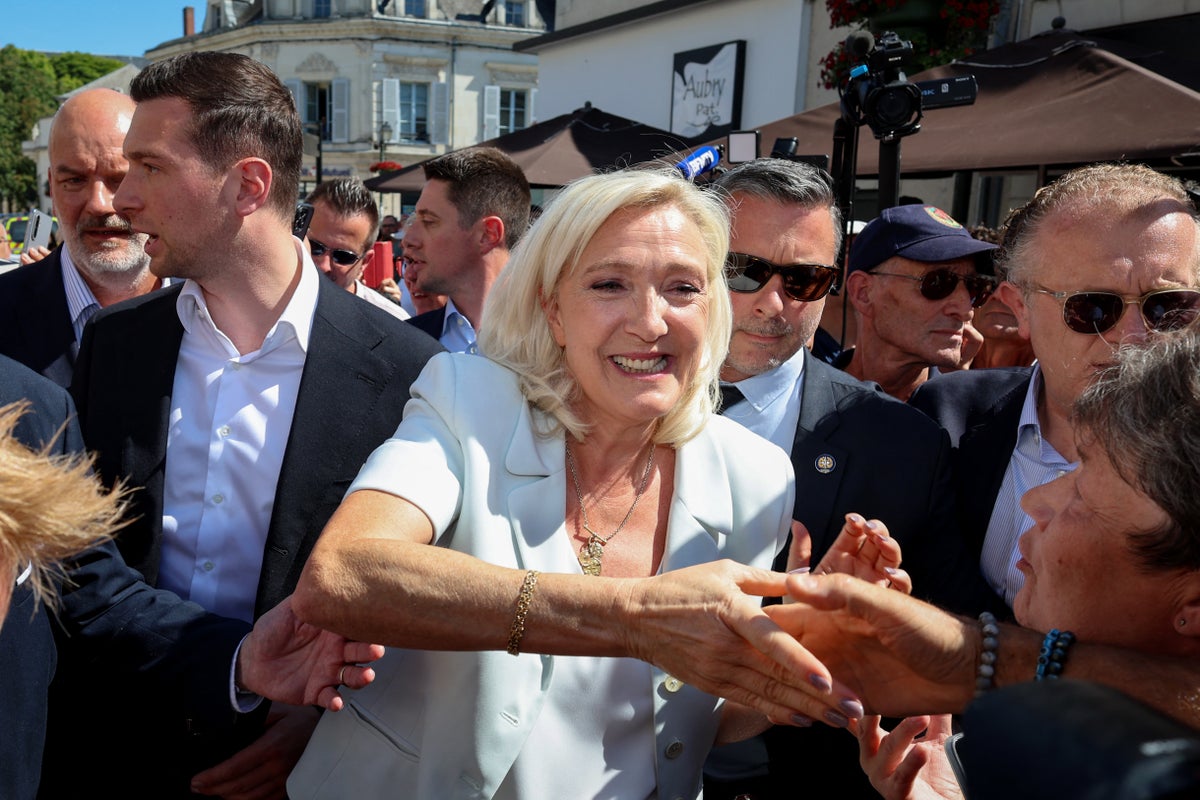
Marine Le Pen wants you to think she just won. On July 7, 2026, a Paris appeals court upheld her conviction for embezzling millions of euros in European Parliament funds. Yet within twenty-four hours, she was walking through a crowded street market in La Flèche, flashing smiles, taking selfies, and launching her fourth official bid for the French presidency.
Some onlookers cheered her name. Others yelled "Thief!" and "Go to jail!" Meanwhile, you can explore related stories here: Why The Cbse Assessment Formula Is Ruining The Futures Of Gulf Students.
This split screen is exactly what the French far-right leader is counting on. She is turning her legal misery into a political asset. By pulling off a massive legal maneuver, she managed to clear her path to the ballot box next year. She is copying the Donald Trump playbook, betting that French voters care far more about inflation and crime than a financial scandal cooked up by what she calls the establishment elite.
But can you really run a credible campaign for the Élysée Palace while your candidacy hangs by a single thread? Let's look at what is actually happening behind the scenes. To understand the full picture, check out the detailed report by USA.gov.
The Legal Loophole That Saved Her Campaign
To understand how a convicted embezzler is legally allowed to run for president, you have to look at the exact math of the appeals court decision.
In March 2025, a lower criminal court hit Le Pen with a devastating five-year ban from public office, effective immediately. That sentence looked like a political death blow. It would have automatically locked her out of the 2027 presidential race.
The appeals court changed everything. Chief Judge Michèle Agi confirmed that Le Pen was guilty of running a massive, decades-long system to divert €2.8 million from the EU Parliament to pay national staff for her party, the National Rally. The judge called the facts serious. But the court also introduced a massive twist. They cut her total ban from public office down to 45 months, with 30 months of that sentence suspended.
That left an active ban of just 15 months. Because Le Pen had already served those 15 months since her initial conviction in early 2025, the barrier vanished. The judges explicitly wrote that blocking her candidacy entirely would undermine the freedom of choice for voters. They decided that her time served had already repaired the harm done to public integrity.
The Electronic Tag Catch
The ruling wasn't a total free pass. The court handed Le Pen a three-year prison sentence, suspending two years of it. The remaining twelve months must be served under house arrest with an electronic ankle bracelet.
Imagine trying to hold massive rallies, travel across rural France, and debate opponents while a court-ordered tracker curfews you to your apartment. Le Pen previously stated she would never run under those conditions. It would look terrible on camera. It would ruin the optics of a strong leader.
So, how did she fix this? She launched an immediate appeal to the Court of Cassation, which is the highest legal authority in France.
Under French law, lodging an appeal to this high court automatically suspends the enforcement of her criminal sentence. The electronic bracelet order is on ice. She can walk around, give speeches, and travel freely without an ankle monitor. That is why she confidently looked into a television camera on Tuesday night and declared her candidacy.
Inside the Fake Jobs Scheme
Opponents don't want voters to forget why Le Pen was in court in the first place. This wasn't a simple accounting mistake.
The case started over a decade ago in 2015. The European Parliament noticed that the National Rally, then called the National Front, was listing assistants on the payroll who never actually set foot in Brussels or Strasbourg. Instead, these people were working full-time on French national party business in Paris.
The money meant for European legislative work was keeping a cash-strapped domestic political party alive. Prosecutors proved that the system covered salaries for everything from party accountants to Le Pen’s own personal bodyguard and her father's private secretary.
Le Pen ran the operation with total authority. When her father, Jean-Marie Le Pen, ran the party, things were messy. When Marine took over in 2011, she organized the funding system to save the party millions. She maintained her total innocence throughout the trial, claiming her party was the victim of a political witch hunt. But the appeals court didn't buy her story. They confirmed that she deliberately used EU taxpayers' money as a private piggy bank for her party machinery.
The Trump Strategy Comes to France
Le Pen’s immediate pivot to the campaign trail shows a calculated gamble. She knows her core base doesn't care about the embezzlement verdict.
When she arrived in La Flèche on July 8, her team had already published a fresh campaign website. The main page features a massive picture of Le Pen with her arms spread wide under the slogan, "For France, Revival." Her critics quickly pointed out the imagery makes her look like a religious figure returning from the dead. It is a deliberate image choice meant to project resilience.
Her strategy relies on three main pillars:
- Discrediting the Judicial System: She frames the courts as highly political bodies trying to steal an election from the people.
- Highlighting Populist Targets: She focuses her speeches entirely on high energy bills, immigration, border controls, and low wages.
- Projecting Inevitability: By continuing her campaign normally, she forces other politicians to react to her rather than letting them control the narrative.
Data from French pollsters shows this approach works well with her existing supporters. A large portion of the French electorate has grown cynical about political finance scandals. They assume all politicians are corrupt, so a conviction doesn't change their voting habits.
The Hidden Risk in Her Legal Timing
While her strategy looks clever right now, her lawyer Rodolphe Bosselut admitted on French radio that this path carries massive danger.
The Court of Cassation does not re-examine the facts or the evidence of the embezzlement case. It only checks whether the appeals court followed correct legal procedures. If the high court finds a procedural error, the case gets sent to a new trial. There would not be enough time to hold a new trial before the presidential vote, meaning Le Pen would be totally safe until after the election.
But what happens if the high court rejects her appeal?
The Court of Cassation announced that it could issue its final verdict before April 2027. That timeline is incredibly tight. The two rounds of the French presidential election take place on April 18 and May 2.
If the high court throws out her appeal in February or March, her conviction becomes permanent and final. The suspension ends instantly. Le Pen could find herself forced to put on an electronic ankle tracker right as the election enters its final weeks.
Running a presidential campaign while restricted to home confinement during specific hours would destroy her momentum. Her rivals would have a massive weapon to use against her in the final televised debates. They could argue she is a convicted criminal heading to house arrest instead of a leader heading to the Élysée Palace.
The Protégé Dilemma
Le Pen's choice to run also creates internal friction inside her own party. For months, the National Rally was quietly preparing a backup plan centered around Jordan Bardella.
At just 30 years old, Bardella is the president of the party. He is highly popular, incredibly savvy on social media platforms like TikTok, and completely clean of the older financial scandals that plague Le Pen. Recent polling from firms like Ifop showed Bardella hitting 34 percent in a first-round presidential poll, which was actually four points higher than Le Pen.
Bardella stood right next to Le Pen during her market walkabout in La Flèche, looking serious and offering his full support. Le Pen promised that if she wins the presidency, she will appoint Bardella as her prime minister.
But behind closed doors, party strategists are quietly worried. They know Bardella carries far less political baggage. He appeals to younger voters who want a fresh face, not someone who has spent decades fighting court battles. By jumping back into the race, Le Pen has pushed her most popular asset into the background to save her own career.
How Her Rivals Plan to Fight Back
Centrist and left-wing politicians are already shifting their strategies to counter her new campaign. They are refusing to let her brush off the guilty verdict.
Former Prime Minister Gabriel Attal, who wants to lead the centrist coalition, publicly accused Le Pen of taking the entire French presidential campaign hostage. He called her candidacy a joke that hangs by a single legal thread. Another former Prime Minister, Édouard Philippe, pointed out the deep hypocrisy of a nationalist leader who constantly rails against elite corruption while being convicted of running a multi-million-euro fraud scheme.
On the radical left, Manuel Bompard called it extraordinary that a politician would launch a presidential bid the morning after an appeals court confirmed her guilt.
The strategy for her opponents is simple. They want to turn every single debate into a trial on her character. They will constantly ask how she can promise law and order for France when she refuses to accept the decisions of French judges.
What to Watch Next
The French presidential race has just become completely unpredictable. If you want to understand how this story unfolds over the coming months, keep your eyes on three specific developments.
First, watch the speed of the Court of Cassation. If the high court fast-tracks its review, a decision could land during the winter, forcing the issue to a crisis point early. If they slow-walk the process, Le Pen can cruise into the spring without any legal interruptions.
Second, monitor the polling gap between Le Pen and Bardella. If her poll numbers drop because of the conviction while Bardella’s personal popularity keeps growing, internal panic might force the party to reconsider its candidate.
Third, look at how centrist voters react. Le Pen needs to win over moderate, middle-class voters to secure a majority in the second-round runoff. A confirmed criminal conviction for stealing public money makes it much harder to convince those cautious voters that she represents a safe, responsible alternative to the current government.
The campaign has officially started, but the real battle is still happening inside the halls of justice.