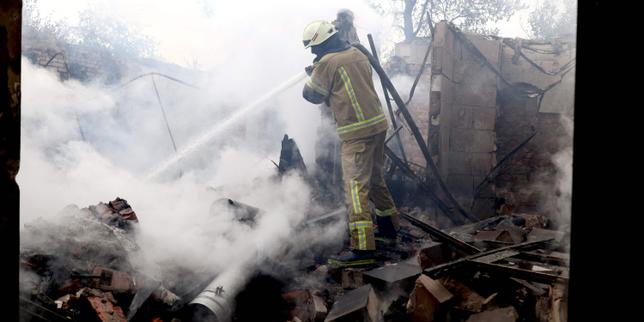
Kyiv woke up to hell again this morning. Russia fired 68 missiles and launched 351 drones overnight, targeting residential blocks, homes, and vital energy infrastructure. The numbers don't even begin to capture the raw horror. At least 21 people are dead. Dozens more are buried under burning concrete or fighting for their lives in crowded hospital wards. This isn't just another statistics update in the ongoing war. This is a flashing red light for the West.
The timing of this brutal escalation isn't an accident. It comes exactly on the eve of the highly anticipated NATO summit in Ankara, Turkey. Leaders from across the alliance are gathering to talk strategy, but the burning streets of Kyiv have already set the agenda.
NATO Secretary General Mark Rutte didn't mince words during his pre-summit press conference in the Turkish capital. He openly denounced what he called indiscriminate Russian attacks against civilians and infrastructure. But strong words don't stop ballistic missiles. The cold truth of this latest strike reveals a terrifying vulnerability that Ukraine and its allies can no longer afford to ignore.
The Grim Reality of Empty Air Defense Stockpiles
We need to talk about what actually happened during the early hours of Monday morning. Ukraine's air force fought bravely, downing dozens of drones and cruise missiles. But when the heavy ballistic missiles came raining down, something went terribly wrong. Every single one of the 29 ballistic missiles fired by Russia struck its target.
Think about that for a moment. A 100% hit rate for Russian terror.
This didn't happen because Ukrainian operators forgot how to use their equipment. It happened because they ran out of ammo. Air force spokesman Yurii Ihnat put it bluntly on national television, explaining that to intercept ballistics, you actually need the physical means for interception. Ukraine is simply out of Patriot interceptor missiles.
President Volodymyr Zelenskyy had been warning about this exact scenario for weeks, especially in the lead-up to his conversations with US President Donald Trump. The Patriot system is arguably the only shield capable of knocking down Russia's most sophisticated ballistic weapons. When those stockpiles sit empty in European or American warehouses while Ukrainian cities burn, it sends a clear signal to Moscow.
For the average person on the ground, this logistical failure means absolute terror. Take 20-year-old Khrystyna Piatetska, a resident of Kyiv's Darnytskyi district. She woke up screaming as the first blast shattered her apartment windows. The lights cut out instantly. The air filled with thick, toxic smoke. As she stumbled out of the crumbling stairwell, she had to navigate past dead bodies littering the ground. Just as she made it to the street, parked cars began exploding around her. She basically walked out from under the rubble straight into an active wall of fire.
Another survivor, 61-year-old Halina Ivanivna, described waking up at 2:00 AM to the sound of her apartment building literally collapsing around her. Water from severed pipes poured through the ceilings as smoke blinded the residents. Five minutes later, while emergency crews were still trying to pull people from the debris, a second missile struck the exact same spot. This is the definition of deliberate terror.
Mark Rutte and the Deficit of Western Action
Mark Rutte finds himself in a demanding position as he steps into the Ankara summit. He claims that Ukrainian forces are changing the battlefield dynamics through sheer bravery and ingenuity. He is right about their courage. Kyiv has successfully taken the fight to Russian territory, using deep drone strikes to hit oil refineries, like the recent strike on a facility in Yaroslavl, and disrupt Russian logistics.
But ingenuity can only carry a military so far when they lack basic ammunition. Rutte promised that NATO allies will announce billions of dollars in new contracts to boost defense capabilities. He talks about dozens of billions of dollars for essential equipment. That sounds great in a press release. It looks fantastic on a news ticker. But a promise for a contract signed today doesn't protect a child sleeping in Kyiv tonight.
The defense industry across the alliance has been painfully slow to react to the realities of high-intensity conflict. Rutte is calling on arms manufacturers to open new production lines, expand supply chains, and deliver quickly. Honestly, we are years into this conflict, and the fact that we are still talking about opening production lines rather than delivering massive stockpiles is a massive failure of Western political will.
Western leaders have treated air defense supplies as a slow, metered luxury. They worry about depleting their own stockpiles, failing to realize that those stockpiles exist precisely to counter the exact threat currently destroying Ukraine. Every Patriot missile left sitting in a storage facility in Germany or the United States is a missile that failed its primary purpose.
Rebalancing the Alliance on the Eve of Ankara
The political backdrop of this summit makes the situation even more volatile. Donald Trump has been active on the phone, holding lengthy discussions with Vladimir Putin and Zelenskyy. The Kremlin openly states that Trump offered to help find a solution to the conflict, placing heavy pressure on European capitals to step up.
Europe and Canada are finally realizing that the era of relying entirely on American taxpayers for conventional defense is over. Rutte noted that non-US allies are on track to significantly lift their defense investments, adding over 90 billion dollars to their budgets. Canada and European nations are aiming to commit roughly 70 billion euros in direct military aid to Ukraine for the 2026-2027 period.
Germany has emerged as a primary player in this shift. Chancellor Friedrich Merz has pushed for substantial defense investments, including permanently stationing an armored brigade in Lithuania. But again, these are long-term strategic moves designed to protect NATO territory years down the line. They don't solve the immediate tactical emergency happening right now on the ground in Ukraine.
Russia knows that the alliance is in a state of transition. Moscow sees the political debates in Washington, the shifting leadership in Europe, and the temporary gaps in Ukrainian air defense. This massive strike on Kyiv was an explicit message to the leaders meeting in Ankara. It was Vladimir Putin showing that he can strike the Ukrainian capital at will, completely bypassing their defenses whenever he chooses.
Immediate Tactical Next Steps
The talking needs to stop. If the Ankara summit is going to be anything other than a high-priced photo op, alliance members must take immediate action.
First, emergency transfers of Patriot interceptors must happen within the next 48 hours. Countries like Germany, Poland, and the United States hold active stockpiles that can be flown into eastern Europe immediately. Bureaucratic hurdles regarding export compliance must be waived.
Second, the alliance must authorize and facilitate the expansion of deep-strike capabilities. Ukraine has proven that hitting Russian supply lines and energy infrastructure slows down the front-line momentum of the Russian army. If Ukraine cannot defend its skies, it must be allowed to systematically destroy the launch sites and logistics hubs inside Russian territory that make these attacks possible.
Third, Western governments must issue direct mandates to defense contractors, utilizing emergency wartime powers if necessary to bypass standard procurement timelines. Production of air defense missiles needs to be treated as a matter of urgent national survival for the West, not a standard corporate contract to be fulfilled over the next decade.
The smoke over Kyiv provides a dark, unvarnished look at what happens when Western hesitation meets Russian ruthlessness. Mark Rutte can talk all he wants about how the alliance represents two-thirds of the global economy. But until that economic power translates into physical missiles intercepting Russian weapons, those numbers mean absolutely nothing to the people digging through the rubble in Ukraine.