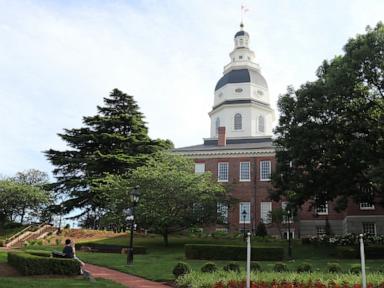
Maryland democrats just made a major power move. They are hauling state lawmakers back to Annapolis in the dead of summer for a high-stakes special session. Starting August 3, the General Assembly will gather for three days with a single, laser-focused goal. They want to change the state constitution to wipe out Maryland’s last remaining Republican congressional seat.
This isn't about the upcoming midterms. Those maps are locked in. This is a long game targeting the 2028 elections. By fast-tracking a constitutional amendment for the November ballot, Democratic leaders are attempting to reshape the political map. They want to turn a 7-1 congressional advantage into a permanent 8-0 sweep.
If you think this is just local political theater, you're missing the bigger picture. This special session is part of a coordinated, national retaliation. Democrats across the country are responding to aggressive Republican gerrymandering in the South. The national sandbox has changed. Maryland is simply the latest state to weaponize its legislative majority to fight back.
The Mid Decade Redistricting Wars Are Officially Here
For decades, redistricting followed a predictable rhythm. States redrew their congressional maps once every ten years following the federal census. That unwritten rule is dead.
National political figures threw out the old playbook. After pressure escalated last year to redraw lines mid-decade to protect congressional majorities, state parties took notice. Then came a massive blow from the judiciary. A recent U.S. Supreme Court decision weakened core protections of the Voting Rights Act. That ruling gave Southern Republicans the green light to dismantle several minority-heavy districts that traditionally elected Democrats.
Republicans openly brag about netting up to ten extra seats nationally because of those new Southern maps. National Democrats realized they couldn't just sit back and take it. House Minority Leader Hakeem Jeffries is reportedly looking at nearly a dozen Democratic-controlled states to retaliate. New York already started the process to alter its lines for 2028. Now Maryland is jumping into the fray.
Governor Wes Moore laid it out bluntly. He stated that inaction is not an option while voting rights and fair representation face national attacks. He made it clear that until national redistricting reform happens, Maryland won't get caught flat-footed. It is a classic eye-for-an-eye political strategy.
The Stunning About Face of the Maryland Senate
The most fascinating part of this story is how quickly Maryland's top leadership changed its tune. Earlier this year, the state House of Delegates enthusiastically approved a highly partisan map. That plan would have aggressively carved up the state to eliminate the lone Republican district.
But that bill died a quiet death in the state Senate. Senate President Bill Ferguson killed it. He argued at the time that an aggressive mid-decade redraw would face brutal judicial review. He feared state courts would strike it down just like they did to a heavily gerrymandered Democratic map back in 2022.
What changed? Two big things.
First, the Supreme Court's recent judicial shifts altered the math. Second, Ferguson faced a bruising primary challenge that signaled shifting winds within his own party base. The pressure to act became unbearable.
So Ferguson flipped. Instead of trying to pass a standard map that a judge could easily throw out, leadership found a loophole. They decided to rewrite the rules entirely.
Ferguson and House Speaker Joseline Peña-Melnyk issued a joint statement explaining the shift. They claimed that recent court decisions created deep uncertainty around congressional redistricting. They argued that the state needs a clear legal path forward.
By passing a constitutional amendment instead of a simple law, they bypass the state courts. You can't rule a map unconstitutional if you change the constitution itself to allow it.
Erasing the Lone Red District
The explicit target of this legislative maneuver is Congressman Andy Harris. He represents Maryland’s 1st Congressional District and currently chairs the far-right House Freedom Caucus. Harris is a thorn in the side of state Democrats. His district covers the rural, deeply conservative Eastern Shore and parts of northern Maryland.
The proposed changes would alter the state's political geography. The strategy involves severing the upper portion of the Eastern Shore from the rest of the district. Lawmakers then plan to loop in heavily Democratic pockets of Howard County and Anne Arundel County.
The math behind this shift is devastating for Republicans. Donald Trump carried the current 1st District by roughly 17 percentage points back in 2024. The new proposed boundaries would completely invert those numbers. Under the rewritten lines, the district transforms into a seat that Kamala Harris would have won by about 14 percentage points.
It is a massive demographic shift accomplished with the stroke of a pen. It turns a safe Republican stronghold into an incredibly steep uphill battle for any GOP candidate.
Republicans are predictably furious. Senate Minority Leader Steve Hershey blasted the announcement. He accused Governor Moore of dragging lawmakers back to Annapolis in August to silence the last dissenting voice in the delegation. Hershey argued the move has everything to do with Moore's national political ambitions and nothing to do with Maryland's actual needs.
Republicans plan to counter by introducing bills focused on inflation, utility costs, and vehicle fees during the special session. They want to force Democrats to vote against kitchen-table economic relief while focusing on partisan maps. But with supermajorities in both chambers, Democrats can easily ignore the distraction and push their agenda through.
What Happens Next on the Road to November
Passing this amendment is not a done deal, but the track is greased. The special session will run from August 3 to August 5.
To place a constitutional amendment on the ballot, both the House and the Senate must pass the measure by a three-fifths majority. Democrats hold a commanding advantage in both chambers. They have the raw numbers to clear this hurdle without a single Republican vote.
Once it passes the legislature, the real battle moves to the voters on November 3. Marylanders will decide whether to grant lawmakers the explicit power to redraw these maps mid-decade.
If the ballot measure passes, expect the General Assembly to move quickly. They will likely draw and pass the new 8-0 congressional map during their regular winter session. That guarantees the new lines will be fully active for the 2028 election cycle.
If you live in Maryland, your immediate next step is to watch for the exact wording of the amendment when it drops in early August. Don't rely on party talking points. Read the text yourself to understand exactly how it alters legislative power before you head to the ballot box this fall.
For a deeper look into how these partisan boundary battles are playing out across the country, check out this detailed breakdown of the National Redistricting Battle which highlights how states are reacting to recent federal shifts.