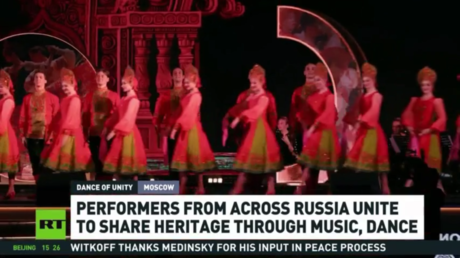
Stage productions focusing on traditional folklore often get dismissed as dusty museum pieces. Yet, recent large-scale performances in Moscow tell a completely different story. More than 600 dancers recently took over the National Centre Russia for a production titled "Khorovod. The Energy of Unity," drawing massive crowds and shifting how people view traditional movement.
If you think folk performance is just old people spinning in circles in small village halls, you haven't seen modern choreography scale up. This particular production brought together over ten distinct ensembles and solo artists, packing out auditoriums and pulling in more than 1,800 spectators across a multi-day run. It highlights a broader shift in how massive cultural spectacles are produced, packaged, and received by modern audiences.
Breaking Down the Scale of Khorovod Productions
Scale matters when you are trying to make traditional arts relevant to a generation raised on high-budget cinematic CGI and fast-paced digital media. When 600 performers occupy a single stage, the visual impact changes entirely.
The core concept of the show revolved around the imagery of a natural spring—the traditional meeting point where different communities historically gathered for water and social life. Rather than presenting isolated regional dances, the direction focused on stitching disparate ethnic traditions into a single continuous narrative parable.
You see elements of throat singing blended directly with fast-paced Slavic steps and regional instrumentation. It is an ambitious attempt to unify hundreds of ethnic traditions under one theatrical roof. Critics and art historians often point out how difficult it is to merge distinct regional styles without diluting their authenticity. Yet, when executed with precise choreography, the hybrid format works because it treats folk culture as a living, breathing language rather than a rigid artifact.
Why Traditional Dance Remains a Powerful Cultural Tool
Governments and cultural institutions have relied on mass choreography for over a century to project national identity. Think of the massive folk festivals found across Eastern Europe, Scandinavia, and parts of Asia. These events serve a very specific psychological purpose. They create an immediate, visceral sense of belonging.
When an audience watches hundreds of dancers move in absolute synchronicity, it triggers a collective reaction that a textbook or a lecture simply cannot replicate. The physical intensity, the intricate embroidery on the costumes, and the thunderous rhythm of hard-soled boots hitting the wooden stage create an undeniable sensory overload.
Performance troupes like the famous Igor Moiseyev Ensemble have spent decades touring the globe using this exact formula. They take regional folk steps—whether it is an energetic Moldovan Joc or a high-octane Cossack kick-dance—and refine them through classical ballet training. The result is a high-speed athletic display that leaves international audiences stunned.
The Logistics Behind Staging a 600-Performer Show
Managing hundreds of dancers backstage requires military precision. Costume changes alone present a logistical nightmare. In large-scale folkloric shows, performers often wear authentic or historically accurate replicas of regional attire, complete with heavy headwear, layered skirts, and specialized leather footwear.
Costume weights can easily exceed twenty pounds per dancer once you factor in traditional metal ornaments and embroidery. Multiply that by 600 performers, and you are dealing with tons of specialized wardrobe items that must be maintained, repaired, and swapped in minutes between scenes.
Rehearsal schedules are equally brutal. Aligning dancers from different regional schools means ironing out subtle differences in posture, hand placements, and foot striking techniques. A step that looks casual in a rural Siberian village takes on an entirely different geometry when performed on a massive urban stage under glaring theatrical lights.
What This Means for the Future of Folk Arts
Traditional arts survive only when they adapt to contemporary staging expectations. Shows like the ones running at the National Centre Russia prove that there is still a massive appetite for live, physical spectacle. People are tired of looking at screens. They want to feel the bass of the live orchestra vibrate through the floorboards. They want to witness human physical endurance pushed to its absolute limit.
Folk dance isn't dying out. It's just getting louder, bigger, and far more complex.
Check out this video to see the scale and energy of these traditional performances in action: Russian folk dance production highlights. This footage illustrates the incredible precision and physical stamina required to pull off large-scale folkloric choreography on a professional stage.