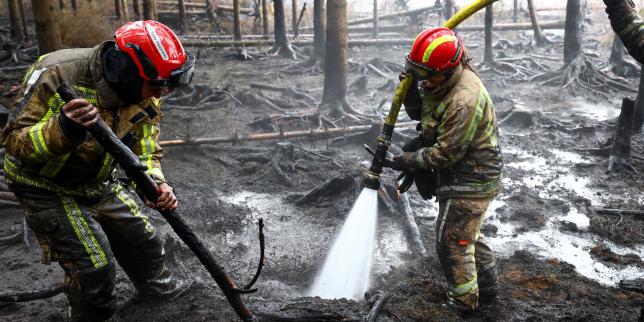
When three thousand hectares of protected land vanish in just a few days, people finally start paying attention. The wildfire currently tearing through the Hautes Fagnes in eastern Belgium isn't just another news story. It’s a harsh reality check for a country that long believed it was immune to the kind of infernos usually seen in the Mediterranean.
Since August 14, 2026, the Hautes Fagnes–Eifel nature park has been ground zero for the most intense fire in recent Belgian history. With flames still active as of this week, the sheer scale of the destruction has eclipsed the previous record set back in 2011. You’re looking at a disaster that has forced hundreds of evacuations and pulled in international help from as far away as Sweden.
The ground zero reality
If you’ve ever walked through the Hautes Fagnes, you know it’s not your average forest. This area is a delicate web of peat bogs and high moors. It sits near the Signal de Botrange, the highest point in Belgium. These landscapes are typically wet, spongy, and difficult to traverse. That’s exactly why this fire is so dangerous.
The fire started in the Fagne des Deux-Séries on the afternoon of August 14. Because the terrain is so rugged and isolated, fire trucks simply can't reach the heart of the blaze. It’s a nightmare for emergency teams. They’ve been forced to rely on helicopters, including specialized units from the Netherlands, Sweden, and Germany.
The strategy right now is all about containment. As of Tuesday, August 18, fire crews were working on a critical "junction" between the northern and eastern defense lines. By performing what experts call "étrépage"—basically stripping away the top layer of soil to create a firebreak of mineral earth—they are trying to starve the fire of fuel. It’s grueling, manual labor in an area where the terrain itself is fighting back against the responders.
Why this fire is different
Most people assume Belgium is too temperate for a wildfire of this magnitude. That mindset is dangerous. The summer of 2026 has been defined by persistent heatwaves and severe drought, pushing temperatures into the high thirties. The peat bogs, which usually act as a sponge, have dried out. When peat ignites, it doesn't just burn on the surface; it smolders underground, making it incredibly difficult to declare a fire "extinguished."
The economic and ecological impact is already massive. You’re talking about 3,000 hectares of biodiversity lost in a heartbeat. For local communities in municipalities like Waimes and Bütgenbach, the threat has been very real. Evacuation orders weren't just a precaution—they were a necessity as smoke and shifting winds turned the sky dark, with reports of the haze even reaching as far as the north-east of France.
The limitations of our current response
The reliance on international aid—the Chinook helicopters from the Netherlands and other European assets—shows that local resources were quickly overwhelmed. This isn't a knock on Belgian fire services; it’s a reflection of how unprepared many European nations are for the "new normal" of climate-driven disasters.
We saw this during the 2011 fire in the same region, which burned around 1,400 hectares. Back then, it was considered a freak event. Now, fifteen years later, we’ve more than doubled that impact. If we don't start viewing our natural reserves as high-risk zones, we’re going to be having this same conversation again in a few years.
Practical takeaways for those living nearby
If you live in or near high-risk wooded areas, relying on luck isn't a strategy. Here is what you need to consider:
- Stay informed on local alert systems. Don't wait for your neighbor to tell you to leave. Sign up for official municipal alerts and follow the guidance of the local governor’s office immediately.
- Understand your surroundings. If you live near a forest, keep your immediate property clear of "ladder fuels"—dead branches, dry brush, and overgrown shrubs that act as a bridge for flames to reach your home.
- Have a go-bag ready. In a wildfire situation, things move incredibly fast. You should have your essential documents, medication, and basic supplies packed and ready to go at a moment's notice.
- Respect access bans. When authorities close trails or roads in the Hautes Fagnes, it’s not to ruin your weekend. It’s to prevent further fire starts and ensure that emergency vehicles have clear passage.
This fire is a grim milestone. It has shown us that our natural heritage is fragile and that the climate conditions of 2026 have changed the rules of the game. The "encirclement" of the fire is a temporary fix, but the real work—of fire prevention and landscape management—must start long before the smoke appears on the horizon. The forest needs us to be more proactive, not just reactive when the sky turns black.