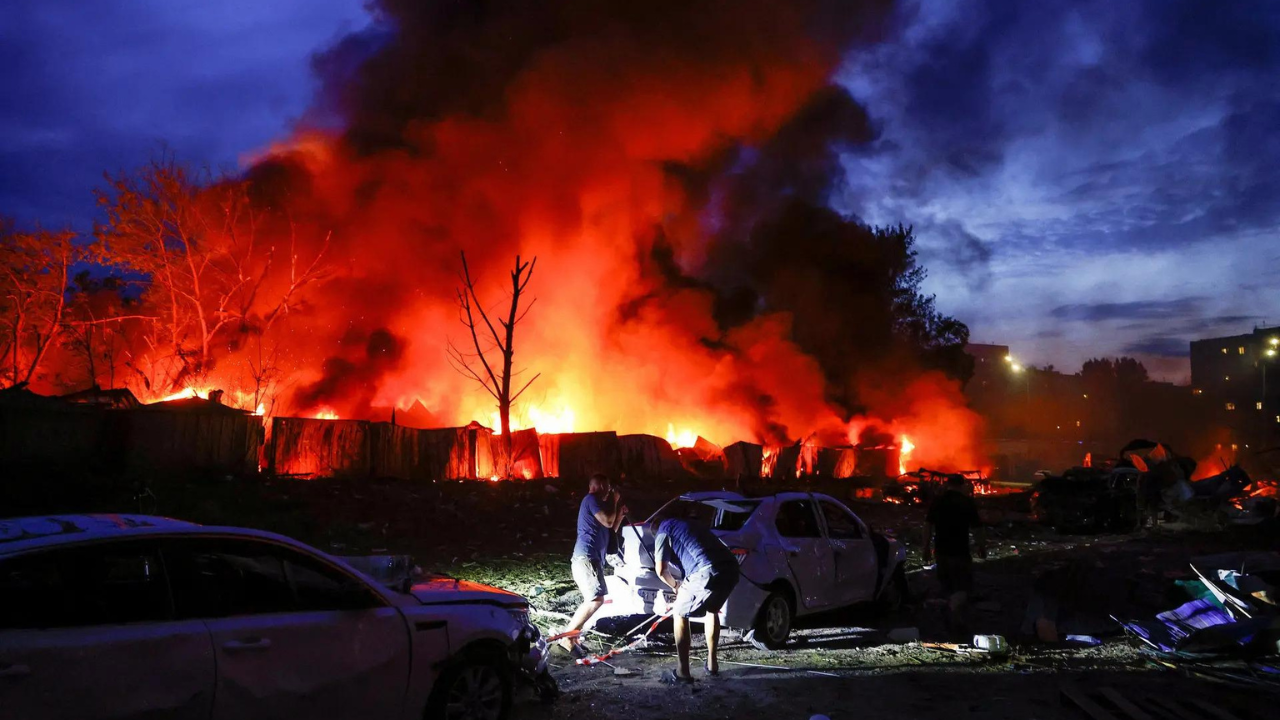
Russia didn't just launch an air raid on Kyiv on July 6, 2026. It sent an unmistakable, terrifying message written in 68 missiles and 351 drones.
If you are trying to understand why Vladimir Putin chose this specific Monday morning to trigger the second catastrophic bombardment of the Ukrainian capital in under a week, look at the calendar. On Tuesday, NATO leaders—including US President Donald Trump and Ukrainian President Volodymyr Zelenskyy—gather in Ankara, Turkey. This blitz wasn't random battlefield maneuvering. It was an aggressive show of force designed to test Western political resolve, expose critical gaps in Ukraine's defenses, and completely hijack the geopolitical narrative right before international leaders take the stage.
The cost of this political messaging is devastatingly human. At least 11 people are dead in Kyiv and the surrounding region. Over 60 are wounded. Families are watching emergency crews pull survivors out of crumbling concrete blocks. Kyiv is burning, and the political stakes have never been higher.
The Brutal Math Behind the Airstrikes
The scale of the July 6 assault is staggering, even for a city that has spent over four years under the shadow of war. Ukraine's Air Force confirmed that Russian forces unleashed a complex, combined mix of 419 aerial threats. The payload included:
- 23 Iskander-M and S-400 ballistic missiles
- 6 3M22 Zircon hypersonic anti-ship missiles
- 39 Kh-101 and Kalibr cruise missiles
- 351 Shahed, Gerbera, and Italmaz attack UAVs, alongside Parodiya decoy drones
Ukrainian air defense units worked miracles against the drones and cruise missiles. They managed to neutralize 326 drones and 37 cruise missiles. But look closely at what they missed.
Not a single Russian ballistic or hypersonic missile was intercepted.
Every single one of the 23 ballistic missiles and 6 hypersonic weapons penetrated the defense grid. They slammed into over 30 locations across Ukraine, with the brunt of the devastation reserved for the capital.
Why Kyiv Interceptors Ran Dry
There is a common misconception that Ukraine's air shield is an impenetrable dome. It isn't. The horrific reality of the July 6 attack exposed a glaring operational vulnerability that Zelenskyy has warned about for months: Ukraine has run out of interceptor missiles for its most advanced defense systems.
While standard mobile defense teams and short-range systems can easily swat down slow-moving Iranian-designed Shahed drones, they are completely useless against ballistic missiles like the Iskander-M or the hypersonic Zircon. Those weapons travel on steep, incredibly fast, arcing trajectories. The only tool capable of stopping them is the US-made Patriot missile system.
Zelenskyy didn't mince words following the strikes. He praised his soldiers for downing the drones but pointed directly at Western capitals for the civilian deaths.
"Our warriors performed well today in intercepting drones and cruise missiles, but unfortunately not Russian ballistic missiles," Zelenskyy stated on social media. "And the reason lies in the insufficient supply of interceptor missiles."
He pointed out that as long as Patriot stockpiles remain safely tucked away in allied warehouses instead of active deployment zones in Ukraine, Russia is effectively given a green light to keep destroying residential neighborhoods. It's a logistical bottleneck with fatal consequences.
The Devastation on the Ground
Walk through Kyiv's historic Podilskyi district right now, and you won't see military targets. You'll see a nine-story residential apartment block heavily torn apart from the fifth floor up. Firefighters are battling blazes while more than 400 first responders and police officers dig through the concrete dust.
So far, rescue teams have pulled 64 people from the rubble, including two children. In the city of Vyshneve, just outside the capital, a strike on a weapons depot triggered massive secondary detonations. The resulting secondary explosions forced the emergency evacuation of 500 local residents as munitions cooked off into the surrounding neighborhoods.
Meanwhile, the economic and civilian transit networks have ground to a halt. The state railway company, Ukrzaliznytsia, suspended train traffic across Kyiv Oblast, leaving thousands stranded and stalling supply chains.
Moscow's defense ministry issued its usual boilerplate response, claiming the strikes targeted "military industry enterprises and fuel and energy facilities." But the flattened apartment buildings in Podilskyi and the civilian casualty counts tell a completely different story.
The Shadow of the Ankara Summit and the Deep-Strike Strategy
This attack comes directly on the heels of another massive barrage on July 2 that killed 31 people in Kyiv. Why the sudden, violent acceleration?
First, Putin wants to enter any upcoming diplomatic talks from a position of absolute terror. President Donald Trump is scheduled to meet Zelenskyy at the Ankara summit, with plans to speak to Putin afterward to revive stalled peace negotiations. By raining down hypersonic missiles on civilian centers, Moscow is signaling that it won't be easily pressured into concessions.
Second, Russia is dealing with a severe internal crisis of its own. Zelenskyy recently ordered a summer deep-strike campaign using long-range Ukrainian drones to force Putin to the negotiating table.
It's actually working. Ukrainian drones recently struck the Baltic Sea ports of Vysotsk and Ust-Luga, hitting a vital Russian oil export terminal. These persistent strikes on oil refineries have triggered Russia's worst domestic fuel crisis in decades, forcing fuel rationing and long queues at gas stations even in Moscow. Putin is bleeding economically, and this massive assault on Kyiv is a desperate attempt to project strength home and abroad.
What Happens Next
The immediate focus shifts directly to the NATO meetings in Turkey. The diplomatic theater is officially over. The strategic options for Western allies are clear, concrete, and urgent:
- Release the Interceptors: Western nations must immediately unlock and transfer Patriot interceptor missiles from active stockpiles to refill Ukraine's depleted defense grid.
- Expand the Air Shield: Dictating where and how Ukraine can defend itself is getting people killed. Allies face immense pressure to lift restrictions on targeting Russian launch sites inside Russian territory.
- Coordinate Regional Defense: The geopolitical spillover is real. During the July 6 strike, Poland was forced to scramble fighter jets to secure its own airspace, proving that these massive barrages are rapidly becoming a direct threat to NATO's eastern flank.
The Ankara summit can no longer just be about political pleasantries or vague promises of future support. If Western leaders leave Turkey without delivering concrete anti-aircraft decisions, Russia's ballistic missiles will keep getting through.