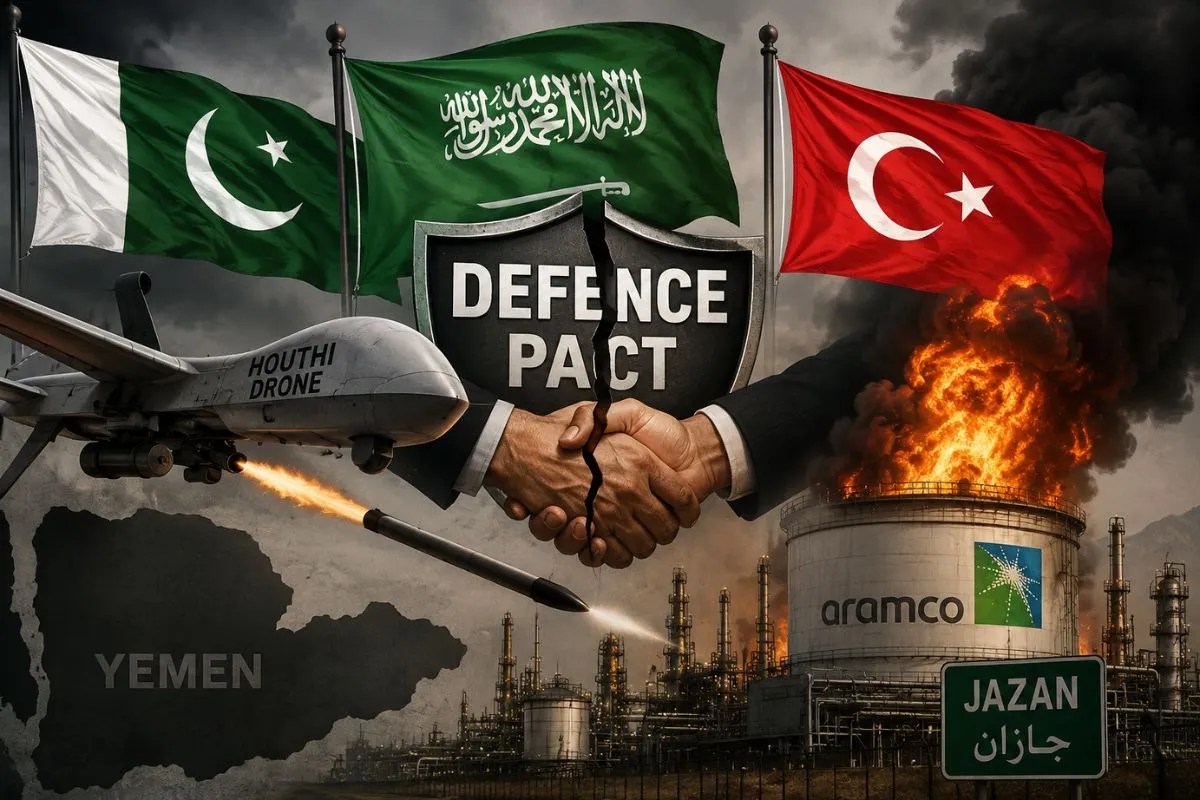
The ink on the Mecca Joint Defence Agreement was barely dry when a Houthi drone struck the Saudi Aramco refinery in Jazan. Signed just 48 hours earlier by Saudi Arabia, Turkey, and Pakistan, this pact was supposed to be a signal of strength. Instead, it became a punchline.
If you were looking for a sign of how this "Islamic NATO" would function, you just got your answer. Spoiler: it didn't do anything.
What the agreement actually says
On August 7, 2026, Saudi Crown Prince Mohammed bin Salman, Turkish President Recep Tayyip Erdogan, and Pakistani Prime Minister Shehbaz Sharif met in Mecca to sign what is officially called the Mecca Joint Defence Agreement. The core premise sounds impressive: an armed attack against one signatory is an attack against all three.
People keep calling it an "Islamic NATO," but that's a massive overstatement. Real military alliances have integrated command structures, shared intelligence protocols, and clear rules of engagement. This agreement? It has none of that. It’s essentially a piece of paper that expresses a desire for "collective deterrence" without the mechanisms to actually enforce it.
Why the Jazan attack matters
When the Houthi rebels hit the Jazan refinery with a drone on Sunday, they weren't just attacking a piece of energy infrastructure. They were stress-testing a brand-new alliance.
Riyadh confirmed a fire broke out, which they managed to extinguish. The Houthis, clearly emboldened by the ongoing regional instability involving the U.S., Israel, and Iran, didn't hesitate to target a site that processes 400,000 barrels of crude oil per day.
If the agreement were a serious military union, you would expect a joint statement, a coordinated movement of forces, or at least a stern, unified warning to the Houthis. Instead, there was silence. Neither Ankara nor Islamabad made a move.
The limits of the pact
Let’s be honest about why this happened. Each country has its own distinct agenda:
- Saudi Arabia is still heavily dependent on U.S. weapons, logistics, and intelligence for its own home defense. They are building "strategic redundancy," meaning they are trying to stack up different partners to hedge their bets, not replace their primary security provider.
- Turkey brings the weight of a massive army and a growing defense industry, but they have their own interests to protect, often centered on Mediterranean security and their status within NATO.
- Pakistan is the nuclear-armed wildcard. They have deep ties with both Riyadh and Ankara, but their military focus remains firmly locked on India.
Expecting Pakistan or Turkey to jump into a skirmish in Yemen just because a refinery in Jazan caught fire is naive. They simply aren't built for that kind of automatic, high-stakes military response.
What to expect next
This isn't the beginning of a new regional superpower axis. It’s a political arrangement meant to project influence. Saudi Arabia is clearly feeling the pressure of a volatile Middle East where the U.S. seems less reliable by the day. They want a "web" of alliances, not a single, solid block.
For the average observer, here is the reality: Don't expect this pact to change the military facts on the ground. When the next drone strike happens—and it will—look at the silence from the signatories. That silence is the real policy.
The Mecca Agreement provides a framework for cooperation, perhaps in training, technology transfers, or joint exercises. But don't mistake it for a shield. If you are tracking regional stability, watch the bilateral moves between these three countries and Washington, Beijing, or Tehran. Those relationships will dictate the future of the Middle East far more than this vague defense promise ever will.
The test has been taken, and the alliance has effectively chosen to look the other way. That is the only result that matters.