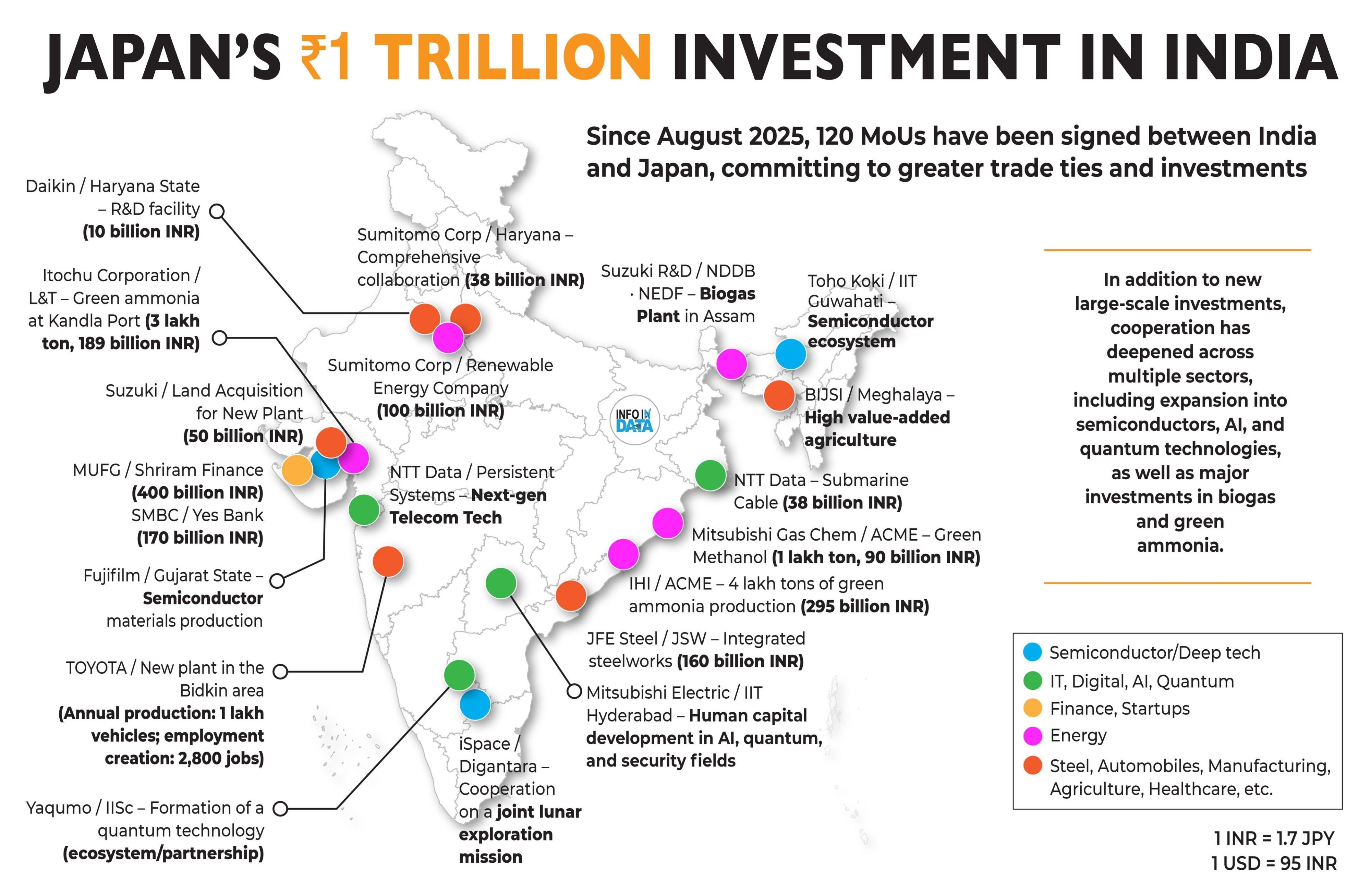
Big numbers make great headlines. You've probably seen the news flashing across your feed that Japan signs 129 MoUs worth Rs 1 lakh crore with India during the latest high-profile bilateral summit in New Delhi. It sounds massive. JPY 2 trillion is nothing to sneeze at. Most news reports just copy and paste the press releases, list a few sectors, and call it a day. They talk about bilateral cooperation as if it's just another routine diplomatic handshake.
It isn't.
If you look past the standard government optics, this summit reveals a massive shift in how global trade and regional security will operate for the next decade. Japanese Prime Minister Sanae Takaichi chose India for her first official bilateral visit since taking office. That choice was completely intentional. This isn't just about throwing money at factories or signing generic pieces of paper. It's a calculated, defensive, and deeply strategic realignment. Both nations are quietly preparing for a much more volatile global market.
To understand why this matters, you have to look at the specific friction points the deal addresses. We're talking about real money, real security risks, and a profound anxiety over supply chains that a lot of corporate leaders are still trying to ignore.
Decoding the Deal Where Japan Signs 129 MoUs Worth Rs 1 Lakh Crore with India
Let's break down the actual substance of these agreements. The India-Japan Joint Economic Forum didn't just happen in a vacuum. It comes at a moment when Japanese corporations are feeling immense pressure at home. Japan has the capital and the hyper-precise engineering. India has the sheer scale, the booming tech talent, and the geographic real estate.
When you combine those factors, things move fast. The Japan External Trade Organization, known as JETRO, recently ran a survey showing that over 80 percent of Japanese companies already operating in India want to expand their local footprint. That is an incredibly high number for a corporate culture traditionally known for being cautious and risk-averse.
The Rs 1.1 lakh crore commitment isn't a vague future promise. It's backed by 129 private-sector agreements targeting very specific pain points. The investments span across regions like Gujarat, Maharashtra, Odisha, Haryana, and the Northeast. This isn't just about setting up a few software hubs in Bangalore. It is a nationwide manufacturing push.
Take Maruti Suzuki as a prime example. The summit highlighted a massive Rs 25,000 crore expansion for a new vehicle manufacturing plant. That tells us that the automotive sector remains a major foundation of this economic bridge. But the real story lies in the newer, higher-stakes fields that received the most attention during the closed-door meetings.
Moving Away From Single Country Supply Chains
Let's speak plainly about the elephant in the room. Neither Prime Minister Modi nor Prime Minister Takaichi explicitly screamed the word "China" in every single press briefing. They didn't have to. The joint statements made the target completely obvious.
The official documents openly state the urgent need to reduce dependence on single-country supply chains. They explicitly warn against the weaponization of economic dependencies. For years, global manufacturing relied on a fragile, highly centralized network. If one country decides to choke off exports or manipulate trade rules, the entire global economy grinds to a halt.
Japan learned this lesson the hard way during recent geopolitical standoffs. India knows it too. This new deal is a direct blueprint for economic decoupling.
By diversifying production bases into India, Japanese industries are building a giant shock absorber. They are investing heavily in critical minerals and semiconductor infrastructure. If you control the minerals and the fabrication plants, you control the future of electronics, computing, and defense.
This strategy goes beyond bilateral trade. Japanese business leaders, including Tatsuo Yasunaga from the Japan-India Business Cooperation Committee, are looking at India as a launching pad. They want to use Indian manufacturing bases to export products to Africa and the Middle East. It's a brilliant play. They are merging Japanese quality control with India's cost-effective production scaling to capture the fastest-growing markets in the Global South.
Tech and AI as the Core Engines of Growth
Forget the old narrative that India is just an outsourced back office. Prime Minister Modi made it clear during his address that technology is now the strongest pillar of the India-Japan relationship. The summit produced a dedicated Joint Declaration on AI and a formal Economic Security Partnership.
We're seeing a literal convergence of two distinct strengths. Japan excels at physical hardware, hardware engineering, and high-precision machinery. India dominates the software side, data management, and AI development. Putting them together is a logical necessity.
Major Indian tech institutions and Japanese firms signed direct pacts to co-develop practical AI systems. This isn't about building chatbots to write corporate emails. They are looking at industrial AI, automated logistics, and smart grid systems for energy management.
The semiconductor push is equally aggressive. Setting up chip assembly, testing, and fabrication facilities requires an obscene amount of capital and specialized knowledge. Japan is bringing both to the table. They are establishing a reliable corridor for electronic components that bypasses traditional chokepoints. This keeps both nations competitive even if maritime trade routes in East Asia face severe disruptions.
The Strategic Defense and Maritime Shift
You can't separate economic security from military security. The absolute biggest surprise of this summit was the signing of the first-ever defense co-development project between India and Japan.
They are going to jointly develop and manufacture the Naval Radio Antenna system, code-named "Unicorn."
This is a massive shift in policy. For decades, Japan maintained a highly restrictive stance on exporting or co-developing military tech. Breaking that tradition for India proves how serious the security situation has become. The Unicorn antenna project is designed to improve maritime security, regional peace, and a rules-based international order.
The security concerns are highly practical. Toshihiro Kitamura, the spokesperson accompanying the Japanese Prime Minister, explicitly pointed out the severe risks in the West Asian region. Specifically, any major disruption in the Strait of Hormuz or the Persian Gulf could instantly trigger a catastrophic energy crisis for both countries.
To counter this, the two nations are discussing something highly tactical: the strategic stockpiling of crude oil. They want to ensure that even if conflict breaks out in West Asia, their domestic industries won't run dry. They are also expanding joint naval exercises in the Indian Ocean to protect vital shipping lanes. This ties directly into India's MAHASAGAR initiative and Japan's updated Free and Open Indo-Pacific vision. They want to ensure the oceans remain a shared, open space rather than a zone dominated by a single aggressive power.
Beyond Tech: Energy and Global Health Security
If you look closely at the list of the 129 MoUs, you see a massive emphasis on clean energy and healthcare. These aren't just feel-good environmental initiatives. They are hard business decisions.
The clean energy pacts focus heavily on green ammonia and biogas. India wants to become a global hub for green hydrogen production, and Japan needs to import clean fuels to meet its climate targets. By funding green ammonia projects in India, Japan secures a long-term supply of clean energy while helping India build its industrial infrastructure.
In healthcare, the strategy is all about affordability and reliability. The agreements cover pharmaceuticals, medical devices, and advanced biotechnology. The formula here is simple: combine Japan's strict quality standards with India's massive pharmaceutical manufacturing capacity. The goal is to build an alternative medical supply chain that doesn't rely heavily on raw materials from volatile regions. It's a direct response to the supply chain vulnerabilities exposed during recent global health emergencies.
Actionable Next Steps for Indian and Japanese Businesses
If you're an executive, investor, or entrepreneur, you can't just treat this as a political news story. You need to position your business to catch this massive wave of capital. The two governments set an explicit target to hit 10 trillion Yen in investments over the next decade. They also plan to facilitate the exchange of 500,000 human resources.
The opportunities are immense, but you have to know where to look.
First, look at the vendor ecosystems forming around the major manufacturing hubs. If Maruti Suzuki is spending Rs 25,000 crore on a new plant, or if new semiconductor units are popping up in Gujarat and Maharashtra, they will need thousands of local suppliers. Component manufacturing, specialized logistics, and industrial maintenance companies will see a massive surge in demand.
Second, bridge the language and cultural gaps immediately. The biggest bottleneck in India-Japan collaborations has never been money or technology. It's communication. With a target of half a million people moving between the two tech ecosystems, there is a massive market for cross-cultural training, specialized recruitment, and bilingual project management.
Third, pay close attention to the green energy supply chain. If you are involved in solar, wind, biogas, or hydrogen tech, look for Japanese investment partners. They have the capital and are actively looking for Indian execution partners who understand local land acquisition, regulations, and project deployment.
The alliance is set in stone. The money is moving. Don't wait for the factories to finish building before you start making your move. Get your business aligned with these five priority sectors—semiconductors, critical minerals, clean energy, ICT, and pharmaceuticals—and start building those cross-border connections right now.
:quality(70)/cloudfront-us-east-1.images.arcpublishing.com/metroworldnews/FKBGM6Y3ERCNNIOTGXBNA3GHBQ.jpg)