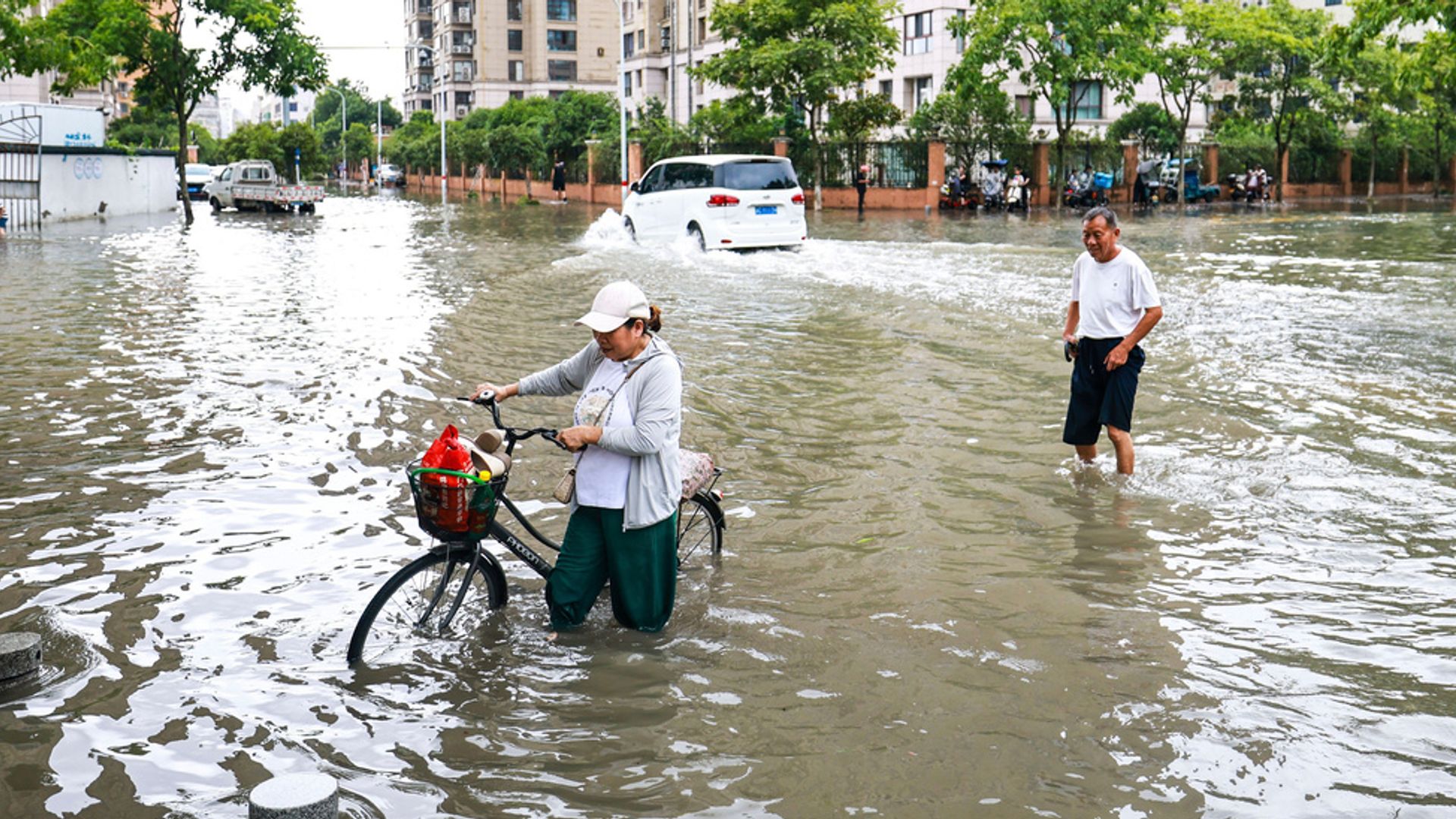
When a monster storm the size of France slams into a heavily populated coastline, the numbers paralyze us. You see the headlines screaming about millions evacuated in China as severe flooding traps villagers and sweeps cars away, and it's easy to just view it as another distant disaster. But the raw scale of Typhoon Bavi hitting Zhejiang province reveals a much deeper crisis in infrastructure and climate reality that traditional news bytes completely gloss over. It's not just a story about bad weather. It's a stark look at what happens when nature completely overwhelms human engineering.
The Real Mechanics Behind the Millions Evacuated in China as Severe Flooding Traps Villagers and Sweeps Cars Away
Typhoon Bavi made a double landfall in eastern China, striking Yuhuan city first with 144 km/h winds, then roaring into Yueqing minutes later. Over 2.68 million people had to abandon their homes in Zhejiang province alone. Think about that number. That's more than the entire population of many major Western cities packed into temporary shelters or fleeing inland over a matter of hours. The logistics behind an evacuation of that scale are staggering.
The sheer mass of this system spanned 620 miles at its widest point. It spent nearly two weeks churning across the Pacific Ocean before chewing through northern Taiwan and Japan's southwestern islands. By the time it struck mainland China, it wasn't just a storm. It was an atmospheric ocean dumping relentless sheets of water onto land that couldn't absorb any more.
Stranded in Kuancheng and Floating Vehicles
The viral clips of vehicles colliding in rushing water aren't just sensational footage. They show a structural breaking point. In Kuancheng, a northern area within Hebei province, around 1,800 villagers found themselves entirely cut off. Roads transformed into rivers with water levels peaking over two meters high.
Some locals adapted with extreme, desperate measures. People swam or used paddleboards to navigate streets that were dry pavement just a day prior. In coastal Yueqing, the storm's fury tore down over 1,300 trees, uprooting 700 of them instantly. The Ministry of Water Resources reported that 46 rivers across the country surged past their official warning levels. When that many major waterways overflow at the same time, the entire regional water management network reaches its limit.
The Broader Human Toll Outside China
We can't ignore what happened before Bavi even touched the mainland. The storm battered the Philippines first, causing devastating landslides and floods that claimed at least 18 lives, particularly on the southern island of Mindanao. Tens of thousands lost power in Japan, and Taiwan faced terrifying ten-meter waves. The economic disruption is staggering, with hundreds of flights grounded, rail lines halted, and schools padlocked across multiple provinces.
Why Urban Infrastructure Fails Under These Conditions
Many people assume that modern cities can handle heavy rain. That's wrong. When soils are already completely saturated from weeks of seasonal downpours, a massive typhoon acts like dumping a bucket of water onto concrete. There's nowhere for it to go.
China's rapid urbanization means more pavement and fewer natural drainage basins. Runoff speeds up. Water accumulates in low-lying areas faster than pumps can clear it. When 46 major rivers overflow simultaneously, the automated emergency protocols dictate mass evacuations because the alternative is catastrophic loss of life.
Practical Steps to Prepare for Extreme Weather Events
If you live in an area prone to severe tropical storms or flash flooding, don't wait for official orders to start planning. Real survival relies on proactive measures before the grid goes down.
Pack a go-bag with essential documents, a three-day supply of water, and backup power sources. Water ruins paper assets instantly, so keep your medical records and identification in watertight dry-bags.
Track the storm using local meteorological updates rather than relying solely on social media feeds. When local officials call for an evacuation, leave immediately. Roads clog fast. Waiting even one hour can mean the difference between driving to safety and getting trapped on a flooded highway.
Never try to drive through moving water. It takes surprisingly little current to lift a vehicle and sweep it away, as thousands of drivers discovered too late. If water rises around your car, abandon it immediately and seek higher ground on foot.