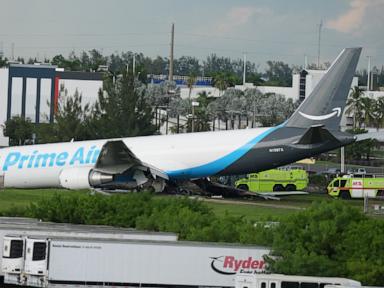
The black box data from the Amazon Air Boeing 767 crash at Miami International Airport tells a terrifying story of hesitation, unstable descent, and a late scramble to abort. When Flight 7598 barreled 1,300 feet past the end of the runway, smashing into a van and killing five people, it wasn't just a sudden tragedy. It exposed a chain of compounding failures that aviation experts have warned about for years.
If you look past the initial breaking news headlines, the federal investigation led by the National Transportation Safety Board (NTSB) points directly to fundamental questions about cockpit resource management, unpredictable weather patterns, and airport infrastructure safety zones.
The Decisive Seconds Before Impact
Flight data recorders recovered from the wreckage revealed that the pilots attempted a "go-around" just seconds before impact. But that decision came far too late. Thirty seconds before the end of the recording, the nose and right main landing gear touched down. Nineteen seconds before the end, the left main gear hit the tarmac.
At that point, the aircraft was already floating abnormally far down the runway. Instead of deploying immediate brakes and thrust reversers to stop the heavy cargo jet, the crew briefly released the brakes and shoved the throttles forward to increase thrust. They aborted that takeoff attempt four seconds later, leaving no remaining runway to scrub off speed.
Former aviation officials and safety investigators have noted that the plane was exhibiting classic signs of an unstable approach. Automated cockpit warning systems were sounding off about excessive descent rates and proximity to terrain. Yet, the crew continued pressing downward instead of executing a missed approach while they were still safely airborne.
The Deadly Human Cost on the Ground
While the two pilots survived the crash and were later released from the hospital, the catastrophe claimed five lives entirely on the ground. All of the victims were inside a Ford Econoline van owned by Professional Ocean Service Corp., a contractor providing cleaning services for planes.
The victims were identified as Rolando Aleman Leon, 55; Yoel Rodriguez Naranjo, 53; Julio C. Pineda, 75; Carlos Acosta Fajardo, 53; and Javierkys Reyes Quevedo, 47.
This tragic detail highlights a blind spot in airport perimeter safety. Airport ground workers transit service roads and staging zones near active runways every single day, assuming the buffer zones are secure. When an aircraft overruns the pavement, the margin for error evaporates instantly. NTSB Chair Jennifer Homendy pointedly noted that workers riding in a van to clean an airplane should never face such catastrophic risks.
Weather, Tailwind Pressures, and Cockpit Dynamics
Investigators are heavily scrutinizing the environmental conditions at the time of the landing. Storms were moving through the Miami area, generating shifting wind patterns. Industry experts suggest the aircraft may have been caught in a strong tailwind, which acts like an invisible shove pushing a landing plane significantly further down the tarmac than intended.
Air traffic controllers are also under the microscope. Analysts are asking why the approach wasn't flipped to allow the plane to land safely into a headwind.
Compounding the environmental factors are serious questions regarding crew coordination. Aviation veterans have pointed out that in high-stress situations involving adverse weather, the pilot flying and the pilot monitoring must act in absolute synchronization. When a junior first officer calls out excessive speed or instability, leadership in the cockpit must dictate an immediate, unquestioned go-around. Hesitation in these critical windows turns a correctable mistake into a hull loss.
The Infrastructure Debate Over Runway Arresting Systems
The crash has reignited a contentious debate over airport safety infrastructure. Miami International Airport complied with federal regulations by providing a standard cleared buffer space past the end of the runway. However, the airport is not equipped with an Engineered Materials Arresting System (EMAS).
EMAS uses beds of lightweight, crushable concrete blocks designed to safely deform under the weight of an overrunning aircraft, bringing it to a controlled halt without catastrophic structural failure or loss of life. While the Federal Aviation Administration has installed these systems at more than 120 airports nationwide—saving hundreds of lives over the decades—many major hubs still lack them. Critics argue that retrofitting more runways with these crushable beds should be an urgent priority rather than an optional safety upgrade.
As federal investigators comb through maintenance records of the 32-year-old converted Boeing jet, examine carrier operations under 21 Air, and review airline safety protocols, the aviation industry faces a sobering reminder. Safety isn't maintained by good luck; it's enforced by ruthless adherence to standard operating procedures the moment a landing starts to go sideways.
Amazon Prime Air cargo flight crash and investigation overview
This video provides additional context and visual breakdowns of the Miami International Airport cargo plane incident and the ongoing NTSB investigation.