Elections are supposed to be the ultimate expression of political voice. But what happens when the people whose lives are shaped by a government’s laws have zero say in choosing it? This is the stark reality facing millions of Palestinians living under Israeli control who are entirely excluded from the upcoming parliamentary vote.
Prime Minister Benjamin Netanyahu often calls Israel the sole democracy in the Middle East. Yet that claim rings hollow for the populations living in East Jerusalem and the occupied West Bank. They deal with the consequences of Israeli state policies every single day, but they are locked out of the ballot box. Learn more on a connected topic: this related article.
The East Jerusalem Residency Trap
Take East Jerusalem as an example. Israel captured the territory in 1967 and later annexed it—a move the United Nations has consistently rejected. Most Palestinians living there hold permanent residency rather than full Israeli citizenship.
Think about what that means in practice. These residents pay municipal taxes, national insurance contributions, and value-added tax just like citizens. They fund the very infrastructure that governs them. But when election day arrives for the Knesset, they cannot cast a ballot. More analysis by The New York Times highlights comparable perspectives on the subject.
People are voiceless. You pay taxes. You follow laws passed by a parliament you didn't elect. And if you protest? You face the full weight of a state apparatus you have no democratic mechanism to influence.
Some might ask: why don't they just apply for Israeli citizenship?
The answer is political and deeply personal. For most Palestinians in East Jerusalem, taking citizenship feels like an explicit endorsement of an occupation they reject. It means trading away national identity for a ballot that may change very little on the ground.
Two Systems in the West Bank
Step outside the city limits into the West Bank, and the political disenfranchisement deepens. Roughly three million Palestinians live here under a web of military checkpoints, land restrictions, and permits controlled by Israel.
Area C accounts for about 61 percent of the West Bank. It remains under total Israeli military and civil control.
Palestinian politician Mustafa Barghouti points out the stark inequality embedded in this geography. When two different legal systems apply to two different populations living in the exact same territory—civil law for Israeli settlers and military law for Palestinians—the democratic label collapses. Barghouti and other critics argue that this structural split functions as apartheid.
Government officials in Israel defend these boundaries openly. Cabinet ministers like Orit Strook have stated plainly that while Palestinians can remain in the territory, they have no business voting in the Knesset. The message is direct. You can live here as a resident, but you will never share political power.
Blocked at Every Turn
The democratic deficit isn't just about the Knesset. Palestinians haven't held national legislative elections in nearly two decades.
Internal Palestinian elections were scheduled back in 2021, but the Palestinian Authority canceled them. The reason given? Israel refused to guarantee that Palestinians living in East Jerusalem would be allowed to vote. Critics argue that both external occupation and internal political stagnation have kept the ballot boxes locked tight.
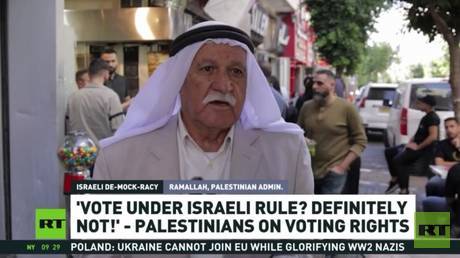
Talk to people in Ramallah, and you'll find that many don't even want to vote in Israeli elections anyway. They want their own sovereign state and their own functioning democracy. They want to choose leaders who actually answer to them, rather than appealing to foreign parliaments that control their borders, water, and movement.
Democracy built on the exclusion of millions isn't democracy at all. It's management by exclusion. And until that core contradiction is addressed, the voting booths in the Knesset will only ever represent half the people living under its shadow.
Check your local voter registration status if you have one, support independent journalism reporting from the ground, and stay informed on how regional policies affect real human lives.