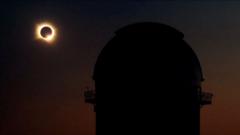
Millions of people across the United Kingdom and Europe paused their evening routines to stare upward, witnessing the most significant solar eclipse seen in the region since 1999.
Streets emptied, parks filled, and a frantic scramble for certified safety gear swept across towns from London to Madrid. If you missed out on the frenzy, you missed a rare celestial alignment that turned day into eerie twilight and drove internet searches for "sore eyes" up by 650% the very same day. Let's break down what actually happened during this monumental event, why people lost their minds over it, and what you need to know if you want to catch the next big one.
The Madness of Eclipse Day
Across the UK, more than 90 percent of the Sun was obscured by the Moon. That is a massive leap from the weak 30 percent partial coverage we usually get stuck with.
Crowds poured into iconic spots like Stonehenge, Calton Hill in Edinburgh, and Greenwich Park in London. People brought lawn chairs, homemade cereal-box projection filters, and high-end camera rigs. Some folks even planned their entire weddings around it. Jerry and Jamie Bone, aged 30 and 25, timed their ceremony in Alpheton, Suffolk, specifically for the eclipse, handing out special glasses to all their wedding guests.
At Greenwich Park, champagne corks popped as neighbors toasted "Happy Eclipse Day". Up in Merseyside, thousands gathered on Crosby beach while a DJ spun The Beatles classic Here Comes The Sun from the top of a bus.
Why This Eclipse Felt Different
We talk about partial eclipses all the time, but hitting the 90 percent mark changes the atmosphere completely.
The temperature drops. The light turns a weird, metallic gray. Shadows sharpen into strange crescents. Abdul Othman, a 28-year-old who managed to grab one of the last tickets at the National Space Centre in Leicester just hours before peak view, called the experience surreal. He noted how watching the Moon physically march across the sky to choke out the Sun feels entirely different from reading about it in a textbook.
Even celebrities got in on the action. Queen guitarist and astrophysicist Sir Brian May posted updates from a hillside vantage point in Spain, tracking the path of totality where the Moon completely erased the solar disc.
The Scramble and the Safety Panic
Demand for certified ISO 12312-2 solar eclipse glasses completely overwhelmed retailers. The Royal Observatory Greenwich sold out its entire stock of roughly 15,000 pairs over the preceding month. Convenience stores, museums, and science centers nationwide reported empty shelves.
Desperate viewers turned to makeshift alternatives like kitchen colanders and pinhole projectors. Others learned the hard way that regular sunglasses do nothing to protect your retina. Medical professionals issued strict warnings ahead of the peak, recalling the fallout from the 1999 eclipse when dozens of people suffered permanent vision impairment from staring at the sun too long. True to form, Google searches for eye pain spiked dramatically hours after the event concluded.
What Comes Next for Stargazers
If you thought the sky was finished showing off, think again. The celestial calendar gave stargazers a double feature. Hours after the eclipse wrapped up, the annual Perseid meteor shower reached its peak overhead, streaking through the night sky as Earth ploughed through the debris trail left by Comet Swift-Tuttle.
If you missed this eclipse, you will be waiting a long time for a comparable spectacle in UK skies. Make sure you source certified viewing glasses months in advance rather than hours before the next major alignment, and keep your eyes peeled for local astronomy club meetups where proper solar telescopes are shared with the public.

/media/artists/avatar/2023/04/anita-hart_a34089.jpg)